Aged, Not Bitter
Hops
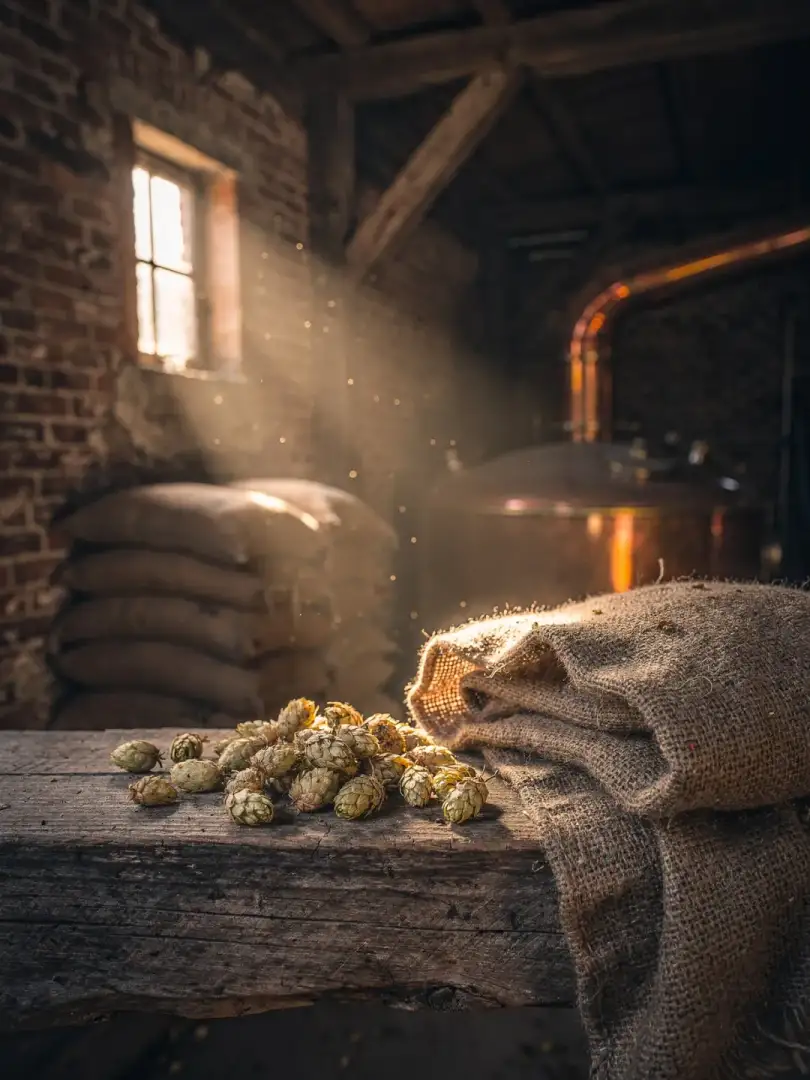
Why does Lambic have so little hop character? Because brewers deliberately use old, dried-out hops that have largely lost their aroma and bitterness. The hops sit in the attic for several years before going into the kettle. In the beer, they mainly act as a preservative against unwanted microbes.
No significant hop growing happens in the Pajottenland itself. For Lambic, origin plays a minor role anyway, since the aroma is meant to disappear. The trellis systems familiar from Bavaria are absent in the Senne Valley, and no one misses them on the farms around Beersel.
Large quantities go into the kettle during the boil, and the wort boils for a long time. Bitterness still stays low: BJCP lists Lambic at 0 to 10 IBU. IBU is the unit of measurement for bitterness; a German Pilsner, by comparison, ranges from 22 to 40.
So the hops aren't meant to provide aroma and sharpness the way they do in an IPA. Instead, the acidity from the lactic acid bacteria is allowed to take center stage, unopposed by bitterness. That explains why Gueuze and Kriek are more reminiscent of sparkling wine, cider, or lemon than of a draft beer.
Anyone tasting a Lambic for the first time notices acidity first, then fruit and wood, but rarely the familiar hop bitterness of a lager. Even the Gueuze from Boon in Lembeek follows this principle, which is why it's compared more to a dry sparkling wine than to a Pilsner or Helles.