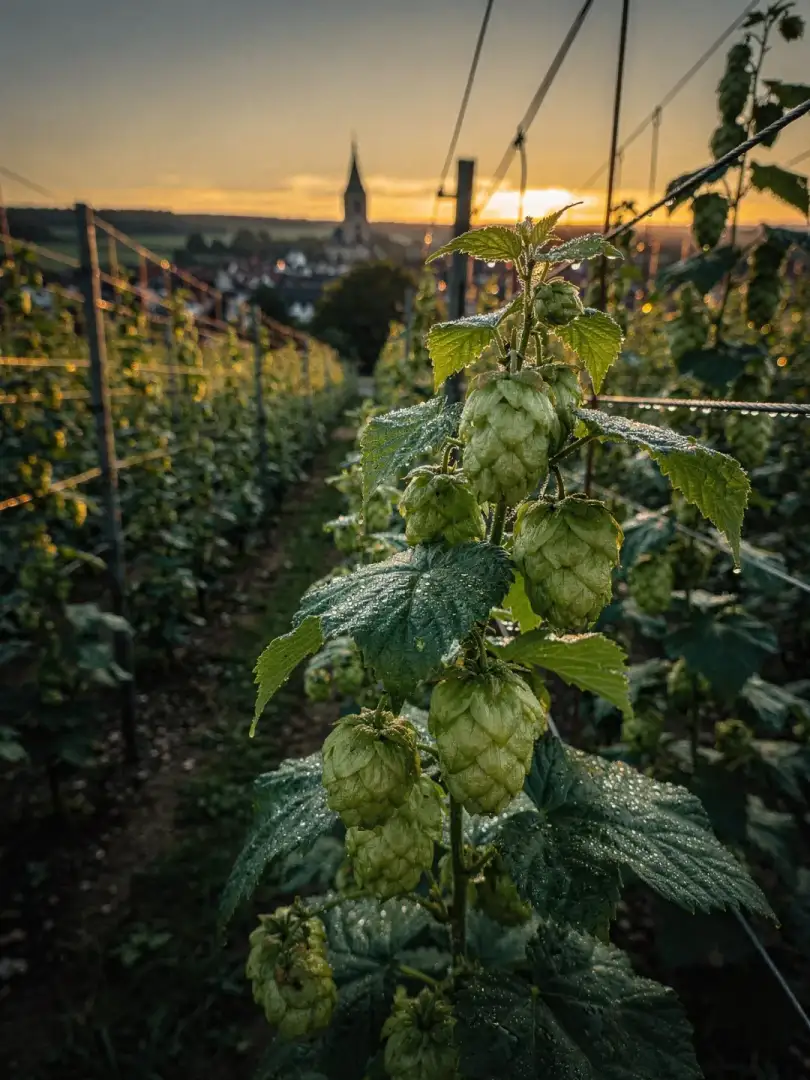
Elbe-Saale Bitterness
Hops
Where do the hops for Saxon Pilsner grow? Some come from the Elbe-Saale growing region, Germany's second-largest after the Hallertau. It spans Saxony-Anhalt, Saxony and Thuringia, and hops have been grown here since the Middle Ages — according to regional sources, as far back as the 11th century.
Today around thirty operations grow hops there, with the 2025 harvest at roughly 2,500 tonnes. The area under cultivation is a little over a thousand hectares; figures vary between sources, so we won't cite an exact number. For comparison, hops grow on more than 17,000 hectares in the Hallertau.
Since 2014, the name Elbe-Saale Hops has been protected as a PGI, a Protected Geographical Indication. It may only be used for hops grown within this region. Varieties such as Magnum and Herkules, grown mainly for bitterness, dominate here.
Bitterness is the hallmark attributed to Pilsner, and it comes from the alpha acids in the hop cones. During the wort boil, these convert and give the beer its crisp bite. Aroma hops go into the kettle later and contribute fragrance rather than sharpness — notes of blossom or herbs, for instance.
The first Radeberger brews got their hops from Bohemia, according to the brewery, together with the malt. Which varieties today's regional breweries buy is up to them. What matters for Pilsner is the balance: plenty of bitterness, little sweetness, a long, dry finish.
Anyone wanting to measure bitterness looks at International Bitterness Units, or IBU. For German Pilsner, competition guidelines put the range at roughly 22 to 40 — a level clearly noticeable on the palate, yet not overwhelming.