Gentle Rather Than Sharp
Hops
Does hops grow in Franconian Switzerland? There's no significant evidence of it, so the hops for Kellerbier usually come from Germany's classic growing regions. The largest lie in Bavaria, and Germany as a whole had roughly 18,962 hectares under cultivation in 2025, according to the BarthHaas report.
The nearest source is the Hersbrucker hills east of Nuremberg. The Hersbrucker Spät variety is considered finely spiced with a light floral note. It carries no EU protected designation. Spalter hops from southern Franconia are different, registered as a protected designation of origin since 2012.
Which variety each brewery uses rarely appears on the label. But the pattern is consistent: Kellerbier should taste of malt, not of hops. The bitterness stays subtle, with an average Helles landing around 16 to 22 bittering units, or IBU for short.
Bitterness and aroma need to be kept clearly apart. Bitterness comes from alpha acids, which only pass from the hops into the liquid during a long boil of the wort. Aroma sits in volatile oils that evaporate quickly, even during a short boil, which is why hops meant for aroma go in late.
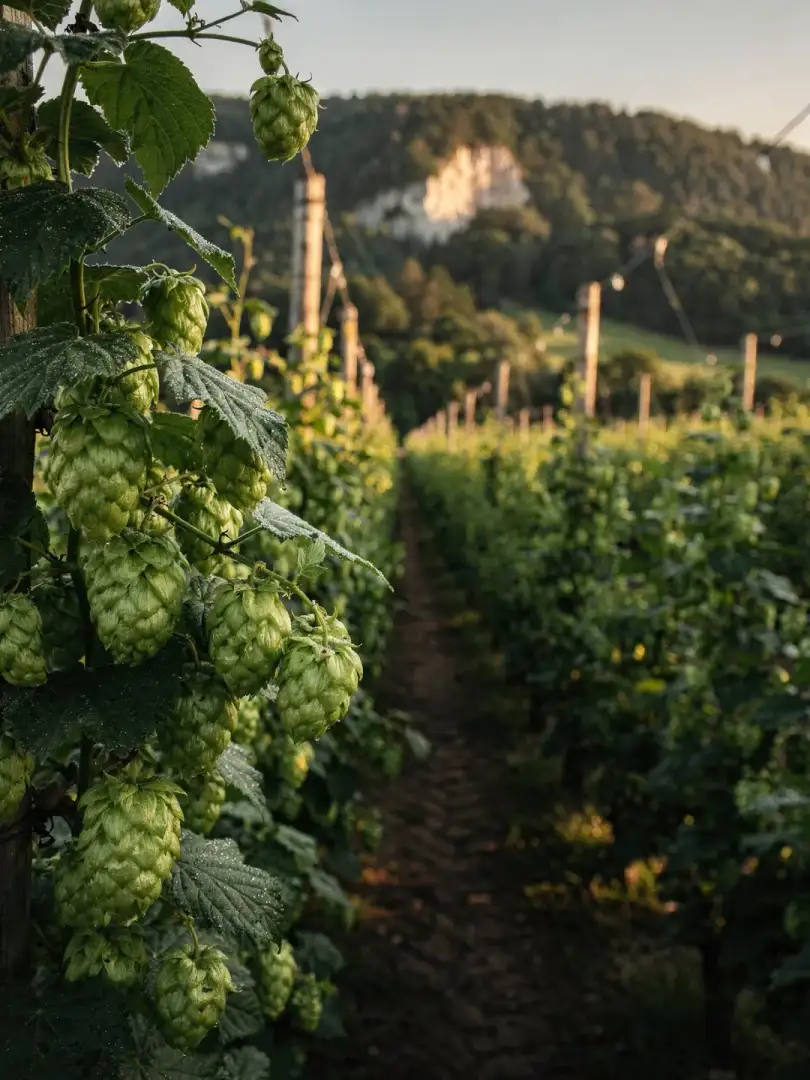
The cones themselves are sticky, green flowers harvested in late summer and dried quickly. In Franconia, hops have been credited for centuries with keeping beer stable and giving its flavor structure. A pinch is enough for an easy-drinking Landbier, since too much drowns out the malt that matters here. The brewers of the region prefer to keep things simple and leave the experimenting to others.