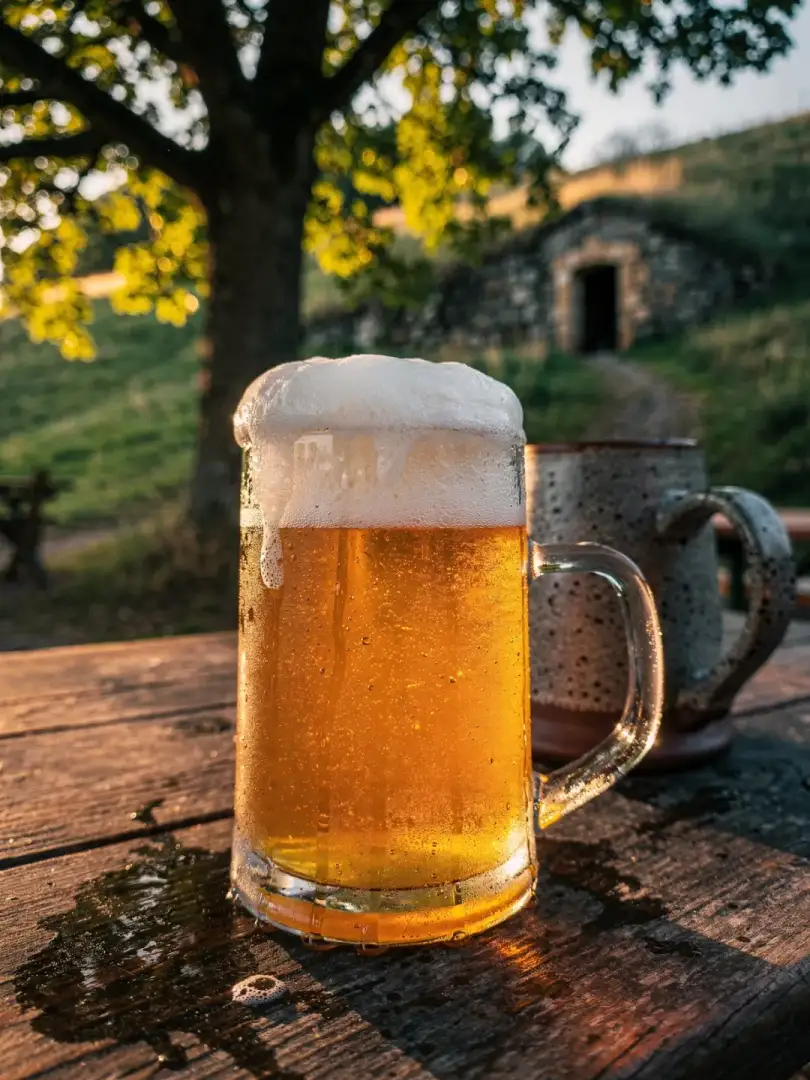
Kellerbier and Landbier
Beer Styles
What is Kellerbier? It's an unfiltered, bottom-fermented beer that takes its name from the beer cellar where it's matured and often served too. It has no recipe of its own: it follows the base style, usually Helles, sometimes Märzen or Dunkel, just left naturally cloudy.
How much alcohol does Kellerbier have? As a Helles, it sits at roughly 4.7 to 5.4 percent ABV according to BJCP competition guidelines, and as a Märzen, at 5.6 to 6.3 percent. Exact figures are stated on the brewery's label, and nowhere else.
Landbier isn't a protected term but a name breweries use freely. In Franconian Switzerland, it usually means an amber to light-brown, bottom-fermented beer with a soft malt body and little bitterness. The word sounds like a village, and that's exactly how it tastes.
The difference from Zwickelbier is small. Zwickelbier is likewise naturally cloudy, and the name comes from the Zwickelhahn, the tap the brewer once used to draw a sample straight from the lagering tank. Many Franconian breweries call the very same beer Zwickel, Kellerbier, or Landbier, depending on the day.
Kellerbier differs from Pils in body and restraint. Pils is paler, drier, and noticeably more bitter. The Seidla from the cellar isn't trying to impress — it shouldn't tire you out after the second sip. That's why locals consider it an everyday beer in the best sense: a drink for the table, not for the display case, something you sip along the way and only miss once the next glass arrives.
Kellerbier (Helles base style)bottom-fermented
- Original gravity
- 11–11.9 °P
- Alcohol
- 4.7–5.4 % vol
- Bitterness
- 16–22 IBU
- Colour
- 6–10 EBC
Naturally cloudy, golden, yeast visible in the glass, soft malt note, little bitterness.