Bitterness, Shelf Life
Hops
'Hopffen' appears second in the 1516 wording, right after barley. The dukes understood exactly what it did: hops make beer bitter, aromatic, and more stable. Even Munich's Duke Albrecht IV had written in 1487: 'hops, barley, and water.'
Brewers measure a beer's bitterness in IBU, International Bitterness Units. A Helles typically sits between 16 and 22 IBU, a German Pilsner between 22 and 40, while Weissbier often stays lower, at 8 to 15. These are competition ranges, not recipes, and no brewery in the city is bound by them.
The law only says hops may go into beer—not which kind. Today, Section 9 of the Provisional Beer Law also permits hop powder and hop extracts. So a brewery brewing 'according to the Reinheitsgebot' doesn't necessarily use whole hop cones, and that's perfectly legal.
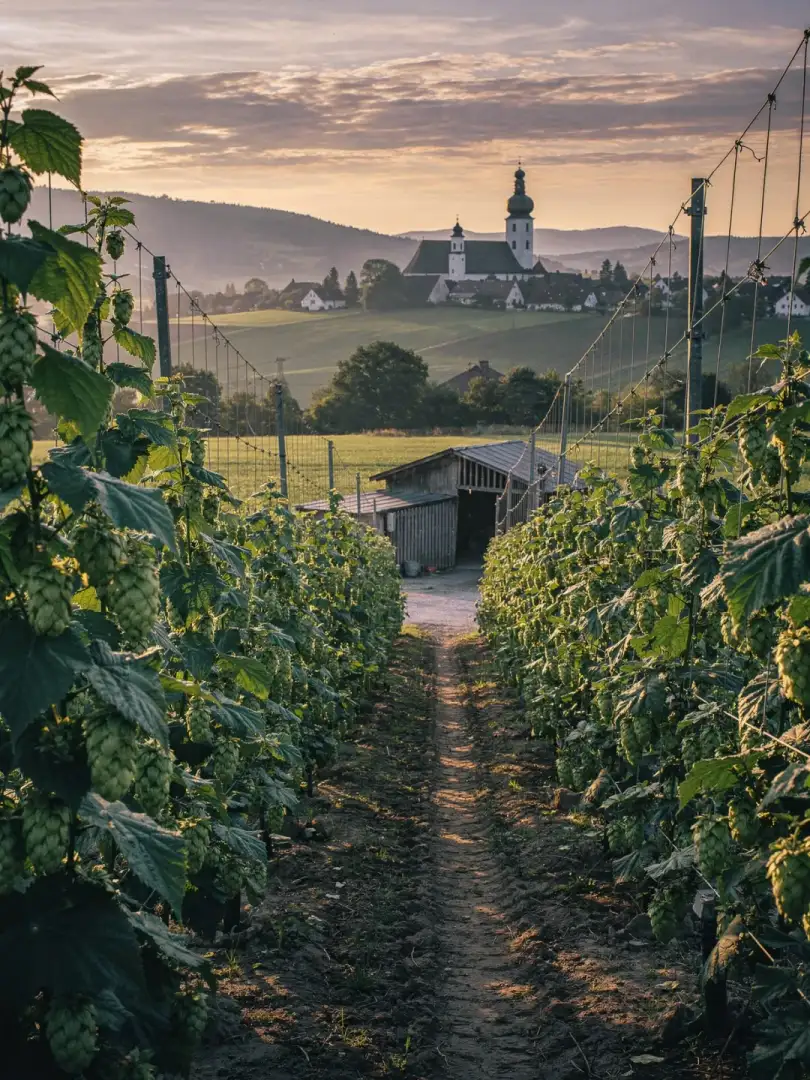
The hops' homeland lies close by. The Hallertau, between the Danube and the Isar, is the largest contiguous hop-growing region in the world, and its hops have carried the EU's PGI seal since 2010. Whether Herrnbräu or Nordbräu actually brew with it isn't something the law tells you. Our Hallertau region guide tells that landscape's story in detail.
What hops do in the glass becomes clear through comparison: a Helles keeps bitterness in the background, a Pilsner pushes it forward, and in Weissbier the hops take a back seat to the banana and clove notes from the yeast. Which brings us to yeast next.