From the Neighborhood
Hops
Does hops grow in Straubing? Not as a main crop. The Gäuboden stands for grain, and the hops used by the city's breweries come from elsewhere in Bavaria. Karmeliten Brauerei says so explicitly: apart from the barley from within the city area, the remaining ingredients come from the state of Bavaria.
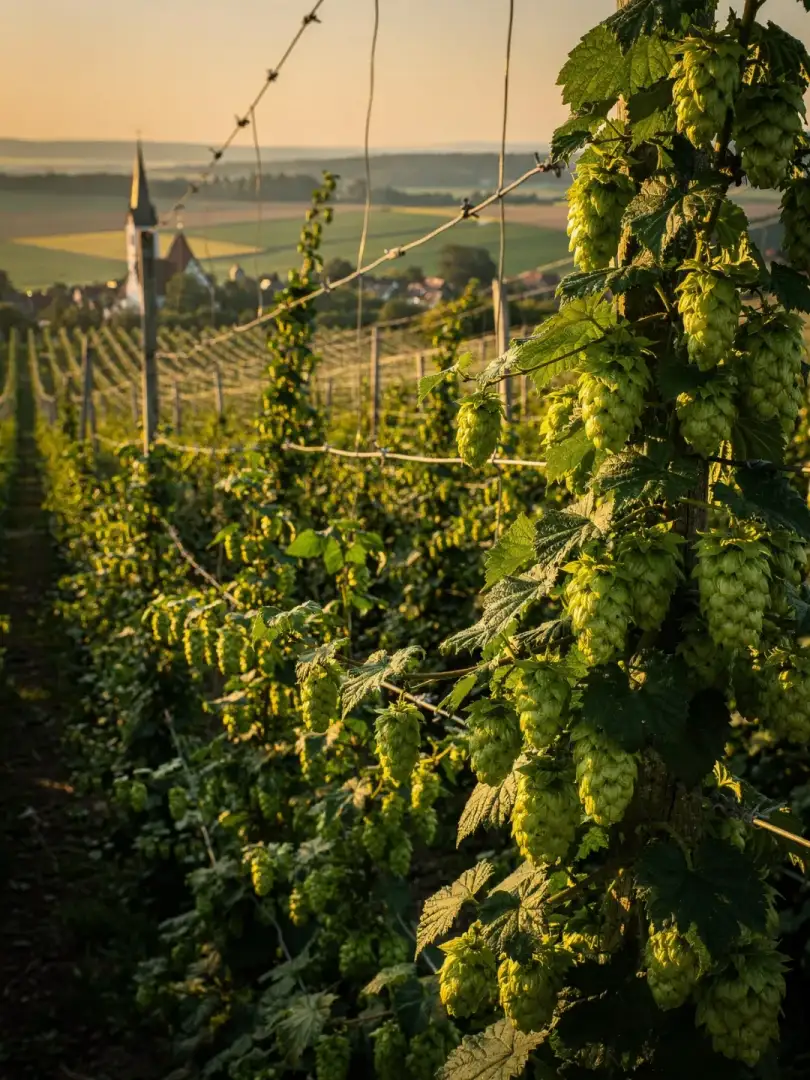
The world's largest hop-growing region lies not far away, in the Hallertau. According to the 2025 BarthHaas report, around 17,000 hectares were under cultivation there, roughly 83 percent of Germany's total hop acreage. The name "Hopfen aus der Hallertau" has been protected as a PGI since 2010, and by late summer, just before harvest, the trellis structures tower meters high.
Few breweries reveal exactly which variety they use. For styles like Festbier and Helles, Bavarian brewers commonly reach for aroma hops such as Hallertauer Mittelfrüh or Perle. How this is handled here in each individual case remains up to the brewers themselves.
What hops actually do can be explained without knowing the variety. They give beer its bitterness, which balances the malt sugar, and later additions bring aromas of herbs, flowers, or grass. Bitterness is measured in IBU. A Festbier typically falls between 18 and 25 according to style guidelines, while a Weißbier, at 8 to 15, is hopped far more gently.
In Straubing's festival tents you can taste this restraint. The bitterness stays in the background behind malt and yeast. That suits a beer meant to be drunk alongside rich food and enjoyed over many hours. A Festbier that leaves a sharp, bitter echo after the first sip would quickly grow tiresome in the tent. That's why brewers rely on fine aroma hops with mild bitterness, dosed sparingly and added with care during the boil.