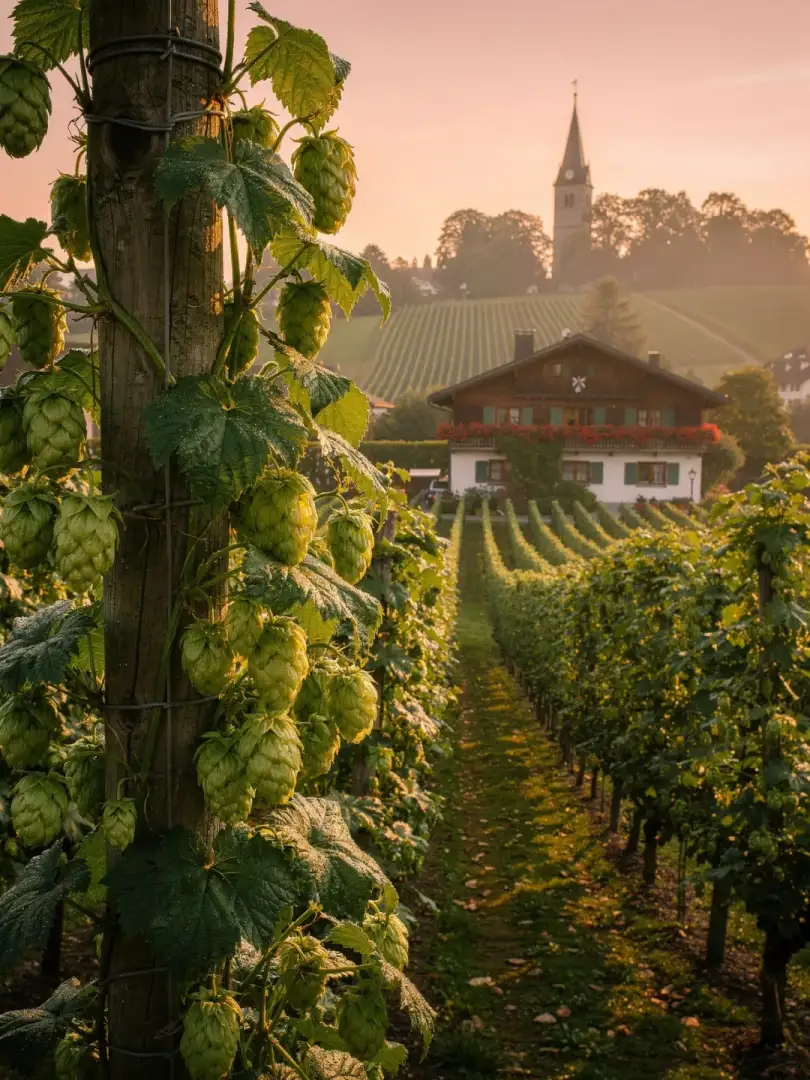
Stammheim and Hallertau
Hops
Where do the hops for Eastern Swiss beer come from? There are no large-scale growing areas in this region. The Locher brewery names aromatic hops from Stammheim and from the Hallertau as its sources. Stammheim lies in the Zürcher Weinland, about an hour's drive away, while the Hallertau in Bavaria is the largest contiguous hop-growing region in the world.
Hops make beer shelf-stable and bitter. The bittering compounds, the alpha acids, are released when the wort — the sugary liquid from the mash — is boiled. The longer the boil, the more bitter the beer becomes. The aroma oils, on the other hand, evaporate quickly, which is why part of the hops is added only toward the end of the boil.
A Helles from Eastern Switzerland shouldn't be sharply bitter. Drinking it, you notice the bitterness more in the finish than on the tongue, accompanied by a hint of herbal and hay-like aroma. This sets it apart from many German pilsners, which are noticeably more bitter, and even more so from an American IPA with citrus and resin notes.
In the Naturperle, the hops are certified organic. Such cones come from farms that forgo chemical-synthetic treatments. They don't automatically taste different, but they contribute to the overall impression of a clean, unassuming beer. In Appenzell country, hops therefore rarely take center stage, deliberately staying in the background behind malt and spring water. Smell closely and you'll find a subtle, herbal note reminiscent of freshly mown meadow rather than fruit. This understated character is intentional and is part of the Helles style, which prizes drinkability over flashiness.