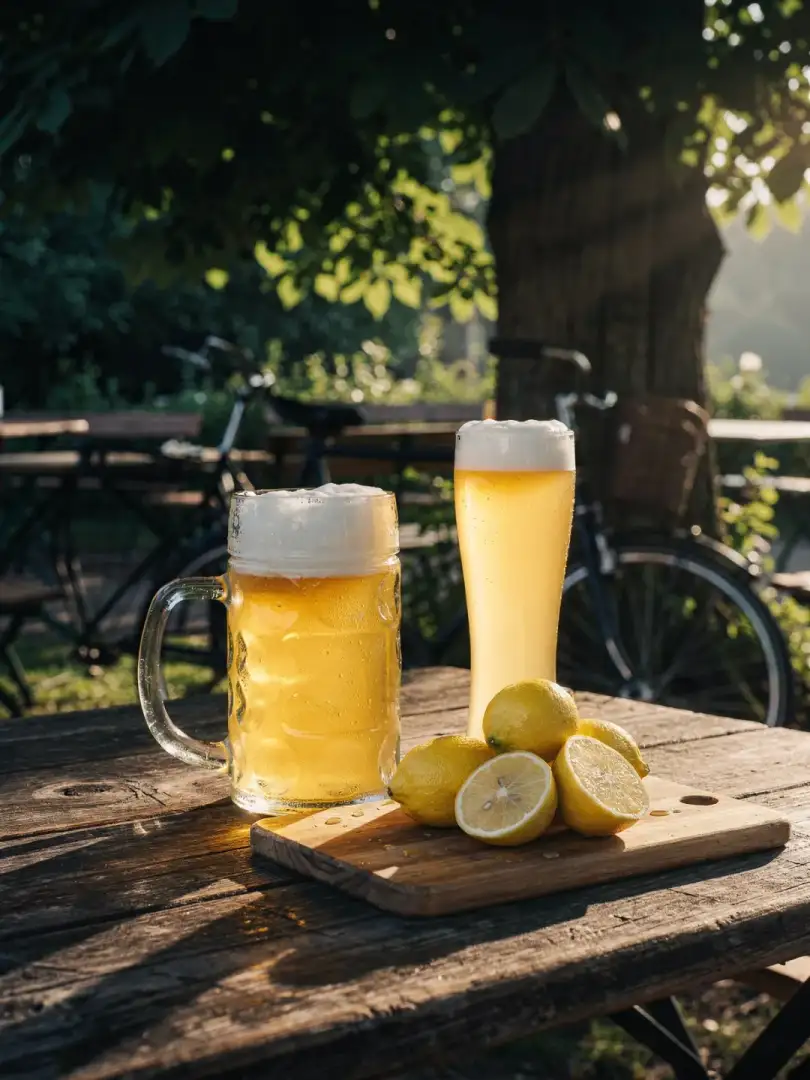
Beer with Lemonade
Radler, Alster and Beer Mixed Drinks: The Difference
Radler is beer mixed with lemon soda, usually roughly half and half. In northern Germany, the same drink is called Alster. Where the names come from, how much alcohol a Radler contains, and what Russ, Diesel, Shandy and non-alcoholic Radler are.
What Is a Radler and How Much Alcohol Does It Contain?
A classic Radler is made right in the glass: pale beer, usually a Helles or Pils, and clear lemon soda. A ratio of about one to one is typical, though it's not set by law. Every pub and every brewery mixes it slightly differently. The alcohol content roughly halves with a fifty-fifty mix. A Helles at 5% ABV thus becomes a drink of around 2.5% ABV.
That makes Radler lighter, but by no means alcohol-free. A large Radler contains about as much alcohol as a small beer. Anyone wanting to avoid alcohol needs a non-alcoholic Radler, mixed from non-alcoholic beer and lemonade. Calories follow their own logic too: the lemonade brings sugar with it. Ready-made Radlers in bottles and cans vary widely here, so it's worth checking the nutrition label.
Bavaria also has a version without sweetness. If you order a "sauer Radler" (sour Radler) in a beer garden, you get beer mixed with sparkling mineral water instead of lemonade. It tastes more bitter, drier, and closer to plain beer. Even with the sweet version, the lemonade makes a big difference. Clear lemon soda produces a pale, zesty Radler, while cloudy, juice-based lemonade makes a fruitier, fuller one. The beer underneath matters too: a Helles makes the Radler soft and malty, while a Pils adds more bitterness to the glass.
Where Does the Name Radler Come From?
The best-known story takes us to the south of Munich. In 1922, the innkeeper Franz Xaver Kugler is said to have had so many cyclists (Radler) visiting his Kugleralm in Oberhaching on a hot day that he ran out of beer. He stretched what was left with lemon soda and called the mixture Radlermaß. That's how the legend goes, and the inn still keeps the story alive today.
It isn't fully documented in every detail. There are indications that mixtures of beer and lemonade were known under similar names a good decade earlier. What is certain is that the name dates from the era when the bicycle became a popular leisure item in Bavaria, and it caught on throughout the south.
Alster, Russ, Diesel and Shandy: Regional Mixes
In northern Germany, the same drink is ordered as Alster or Alsterwasser, the name recalling Hamburg's river. Bavaria also has the Russ, also called Russenmaß: wheat beer instead of Helles, mixed with lemon soda. Thanks to the wheat beer yeast, it tastes fruitier and rounder than a Radler. Mixing beer with cola gets you, depending on the region, a Diesel, a Colabier, or a Krefelder, the latter made with Altbier.
Other countries mix their beers too. In the UK, beer with lemonade or ginger ale is called a Shandy; in France, a Panaché. The basic idea is the same everywhere: less alcohol, more refreshment, a sweet-sour counterpoint to the beer's bitterness.
Bottled Beer Mixed Drinks: What's Inside?
Ready-bottled Radlers and other beer mixed drinks aren't beers in the sense of German ingredient rules. They're allowed to contain sugar, acidifiers, fruit juice and flavorings that would have no place in a beer brewed under the Reinheitsgebot (Purity Law). That's why the can usually reads "beer mixed drink." The range spans from the classic lemon Radler to grapefruit versions and blends with herbs or ginger.
Economically, they've long been core to the business. According to the German Brewers' Association, non-alcoholic beers and beer mixed drinks together accounted for more than 10 percent of beer sales in retail for the first time in 2025. Non-alcoholic Radlers contribute a good share of that.