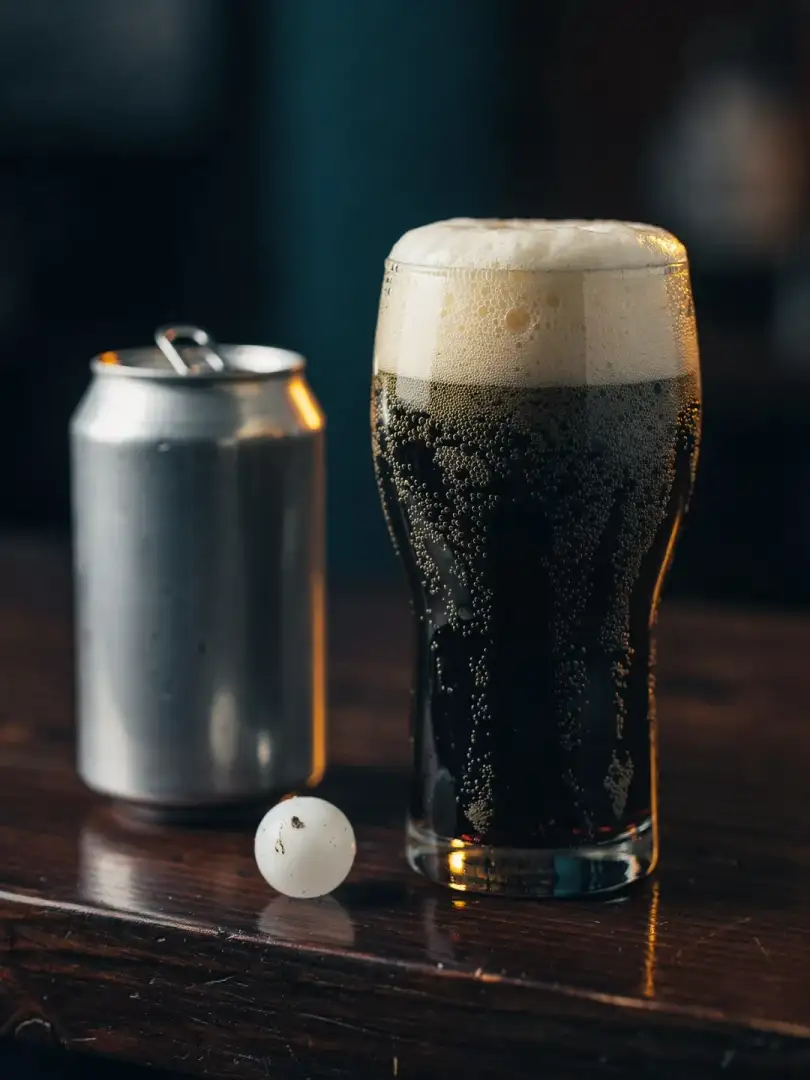
Creamy with Nitrogen
Nitro Stout: Nitrogen, the Widget, and the Perfect Guinness
Nitrogen makes a stout creamy: the gas barely dissolves in the beer and forms tiny bubbles that create a dense, velvety head. That's why Guinness is dispensed with a nitrogen-rich mixed gas, poured in two stages, and replicated in cans with a widget.
Why does nitrogen make beer creamy?
Regular draft beer is dispensed with carbon dioxide. This gas dissolves readily in beer, tingles on the tongue, and tends to form larger bubbles when poured. Nitrogen behaves differently. It barely dissolves in liquid, and the bubbles it does form stay tiny. In large numbers, they create a firm, creamy foam that lasts a long time. At the same time, a nitro beer contains less carbonation, making it feel soft and barely fizzy in the mouth.
For dispensing, a mixed gas of nitrogen and carbon dioxide is used, with far more nitrogen than CO2. The tap itself is specially built, too: inside the spout sits a restrictor plate with fine holes that forces the beer through under high pressure. This tears the dissolved gas out of solution, creating the characteristic tiny bubbles. Without this plate, a nitro beer would pour into the glass with almost no head and taste flat.
The Cascade: Why Do the Bubbles Sink in a Guinness?
Anyone watching a freshly poured stout sees a little spectacle. A pale, cloudy swirl appears to sink down inside the glass while the head forms on top. In reality, the bubbles are rising—mostly in the middle. Along the glass wall, friction slows the beer down, causing it to sink there and drag the tiny bubbles along with it. Because stout is so dark, this current is especially easy to see.
Once the beer has settled, there's deep, almost black stout at the bottom and an ivory-colored head on top. The color comes from roasted malt and roasted barley. Despite its heavy appearance, Irish Stout is actually a fairly light beer: the BJCP competition guidelines list 3.8 to 5 percent alcohol and an original gravity of 9 to 11 degrees Plato—meaning less dissolved malt extract before fermentation than in a German Pilsner.
How do you pour the perfect Guinness?
Guinness, which by its own account has called St. James's Gate in Dublin home since 1759, has turned pouring into a ritual. The glass is held at an angle under the tap and filled to about three-quarters. It's then left to rest until the cascade has settled. In the second step, it's topped up until the head sits just above the rim. The brewery itself cites 119.5 seconds for this two-part pour—a manufacturer's figure that's more brand upkeep than a measurement standard.
The name stout is misleading if you assume Ireland is its origin. Stout simply meant strong, and in 18th-century London, Stout Porter referred to a particularly robust Porter. Guinness made the style famous, but it didn't invent it. Porter and stout today are barely distinguishable from each other in any strict sense. As a rough rule of thumb, stout tastes drier and more distinctly roasted, while porter is softer and more chocolatey.
How does the widget in the can work?
You can't take the tap home with you, so Guinness moved it into the can instead. The widget is a small plastic capsule with a tiny hole. During canning, a drop of liquid nitrogen is added to the can, which evaporates and builds up pressure. This fills the widget with gas and a bit of beer. When the can is opened, the pressure drops suddenly, and the widget shoots its contents through the hole into the beer. The fine jet works just like the restrictor plate in the tap.
Guinness introduced the widget into cans in 1988, followed by a floating ball version in 1997. The can is best poured quickly and completely into a glass so the cascade can form. Drunk straight from the can, the effect is largely lost. Nitro is now also used with other styles, such as milk stout, coffee stout, or even IPA. So nitro is a dispensing technique, not a beer style in its own right.