British Cask Culture
Cask Ale and the Handpump: What Is Real Ale?
Cask Ale is beer that undergoes secondary fermentation in the pub's cask and is served without added gas, usually via a handpump. It arrives in the glass with little carbonation at cellar temperature, tastes soft and round, and must be drunk within a few days of being tapped.
What's the difference between Cask Ale and keg beer?
In British pubs, there are two worlds behind the bar. Keg beer is fully fermented at the brewery, usually filtered, carbonated, and delivered in a pressurized keg—much like lager in Germany. Cask Ale, on the other hand, leaves the brewery unfinished. In the cask, there's still living yeast and some fermentable sugar. It's only in the pub's cellar that it undergoes secondary fermentation, developing its own gentle carbonation.
The consumer organization CAMRA, the Campaign for Real Ale, was founded on March 16, 1971, when keg beer threatened to push traditional cask beers out of the market. It coined the term Real Ale for beer that matures in the very vessel from which it's served, reaching the glass without any added carbon dioxide. Typical cask beers include Bitter, Mild, Porter, and Golden Ale. Kentish ale is even listed as a Protected Geographical Indication in the EU register.
What does the cellarman do in the pub?
Since the beer isn't finished until it's in the pub, the publican is essentially a co-brewer. The cask rests on a stillage in the cellar and is first left to settle. The publican then taps a small wooden peg, the spile, into the shive on top so excess gas can escape. A soft, porous spile lets a lot of gas out, while a hard one seals more tightly. Only once secondary fermentation has subsided and the yeast has settled is the cask tapped.
To help the beer clear, many breweries add finings to the cask, traditionally isinglass, a protein derived from fish swim bladders. It binds yeast and other particles and draws them to the bottom. Cask Marque, a British quality certification scheme for pubs, requires a cellar temperature of 11 to 13 degrees Celsius. Warmer temperatures spoil the beer faster, while colder ones slow down its development. Once tapped, air enters the cask with every pint drawn, which is why it must be emptied within a few days.
How does the handpump work?
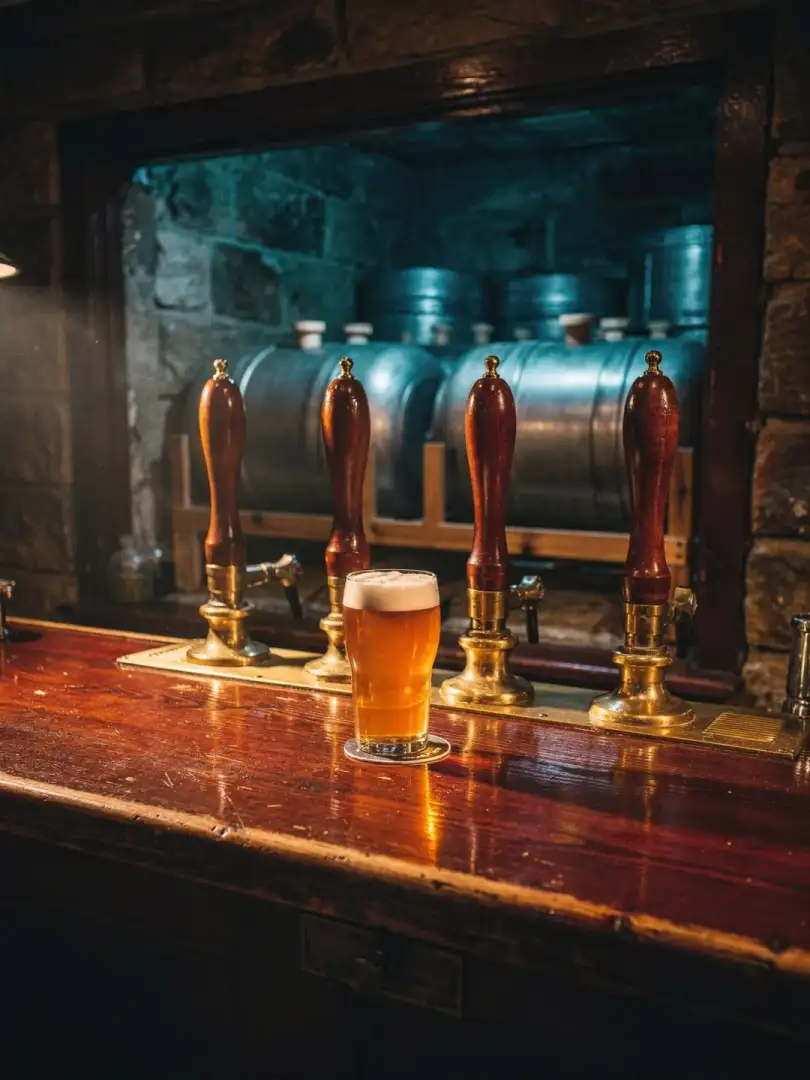
Since there's hardly any pressure in the cask, the beer needs help getting from the cellar up to the bar. That job is done by the handpump, known in English as a beer engine. It's a simple piston pump: the long handle at the bar draws a fixed amount—often half a pint—up from the cellar with each pull. One design of this pump was patented by the inventor Joseph Bramah in 1797.
At the spout, a small fitting determines what ends up in the glass. In northern England, a sparkler is often screwed on—a nozzle with fine holes that agitates the beer and produces a dense, creamy head. In the south, it's often left off. There, the foam stays flatter, and the beer keeps a bit more carbonation and hop aroma. Pub-goers have argued over the right approach for decades, and both sides have good reasons.
Why is Cask Ale rarely found outside Britain?
Cask Ale can't tolerate long journeys or any carelessness. It needs a cool cellar, a publican who oversees secondary fermentation and clarification, and enough customers to empty a cask within a few days. Outside the British Isles, it's therefore only kept alive by individual pubs and breweries. In German-speaking countries, wooden cask beer comes closest to this principle: low carbonation, natural pressure instead of a gas cylinder, and a short window after tapping.
Anyone trying a Cask Bitter for the first time might mistake it for flat or too warm. Both are intentional. The low carbonation lets the malt and hops come through more softly, and the cellar temperature brings out aromas that would stay hidden ice-cold. A good Cask Ale is clear, fresh, and aromatic. A cloudy, sour, or stale glass, on the other hand, points to a care problem in the cellar rather than a stylistic trait.