Gaining the Wort
Lautering: Separating Wort and Spent Grain
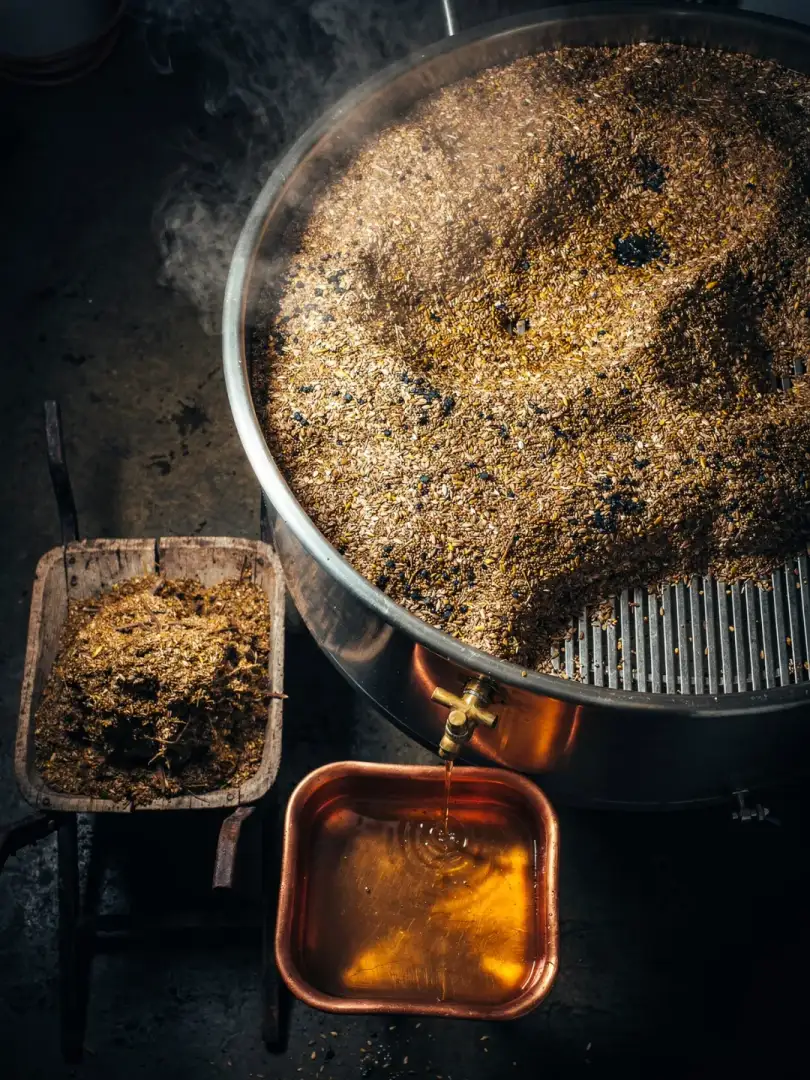
Lautering means separating the sweet wort from the solid malt residues. The husks settle in the lauter tun as a filter bed, the first wort runs off, and hot sparge water washes out the remaining sugar. What's left behind is the spent grain, usually used as cattle feed.
Lautering in the Lauter Tun: How it Works
After mashing, the sugar is dissolved but still floats among husks and grain remnants. The brewer pumps the mash into the lauter tun, a broad vessel with a slotted false bottom just above the actual floor. There, the solid particles settle. After a rest period, they form a layer, the grain bed, which acts like a natural filter.
The first wort to run off is still cloudy. It's pumped back over the bed until it runs clear. Only then does the actual lautering into the kettle begin. A rake fitted with knives loosens the spent grain periodically so it doesn't compact. Draw off too quickly, and you compress the bed too tightly, causing the lautering to stall.
First Wort and Sparge Water: What's the Difference?
The wort that runs off first is called the first wort, or first runnings. It's the strongest, since it contains the most dissolved sugar. But plenty of extract still remains in the spent grain afterward. That's why the brewer rinses the grain bed with hot water at around 78 °C (172 °F), the sparge, washing out the rest. This process is known as sparging.
With each addition of sparge water, the runoff becomes thinner. At some point, it's no longer worth continuing to rinse. Oversparging also extracts tannins from the husks, which make the beer harsh and astringent. Experienced brewers therefore stop in good time, even if a little sugar remains in the spent grain.
First wort and sparge water together make up the full kettle wort. Its extract content is measured with a hydrometer or a refractometer and expressed in degrees Plato. During boiling, water evaporates and the value rises. The extract content of the fully boiled wort is the original gravity, which in Germany determines the beer category: under 11 percent, it's at most classified as a table beer under German beer regulations, while from 16 percent it may be called a strong beer or Bock.
Lauter Tun or Mash Filter?
Large breweries often rely on a mash filter. Here, the mash is pressed between plates fitted with filter cloths. This is faster, doesn't require an intact husk bed, and allows for much finer milling, which increases yield. The lauter tun, by contrast, is slower but robust, and remains the standard in many mid-sized breweries.
A special case is found in British and historical brewing tradition: several beers were produced from a single mash. The strong first wort yielded a robust ale, while later, thinner runnings produced lighter beers, known in English as small beer. This method is called parti-gyle, and some breweries are reviving it today.
What Happens to the Spent Grain?
Depending on the batch size, anywhere from a few hundred kilos to many tonnes of wet spent grain remain after each brew. It consists of husks, protein, and fibre, with the sugar largely washed out. Traditionally, farmers collect it and feed it to cattle. These days, some bakeries bake bread with it, and start-ups are turning it into flour, bars, or packaging material.
For the flavour of the beer, lautering is a fairly invisible step. Mistakes, however, can still be tasted: too many leached tannins make a beer astringent, meaning it puckers the mouth, like over-steeped tea. Clean lautering is therefore the quiet foundation on which hops and yeast later take centre stage.
Lautering and Filtering: Two Different Steps
Lautering is often confused with filtering. In lautering, wort and spent grain are separated right at the start, before boiling even begins. Filtering comes much later: that's when the finished, matured beer is cleared of yeast and haze. An unfiltered Kellerbier has of course been lautered; it has simply skipped the final filtration step.
Lambic also has a special feature here. Traditionally, it's brewed with a portion of unmalted wheat and a cloudy mash, so that more unfermentable starch remains in the beer for the long spontaneous fermentation. Lautering therefore takes correspondingly longer. The step is the same, but the goal is different.