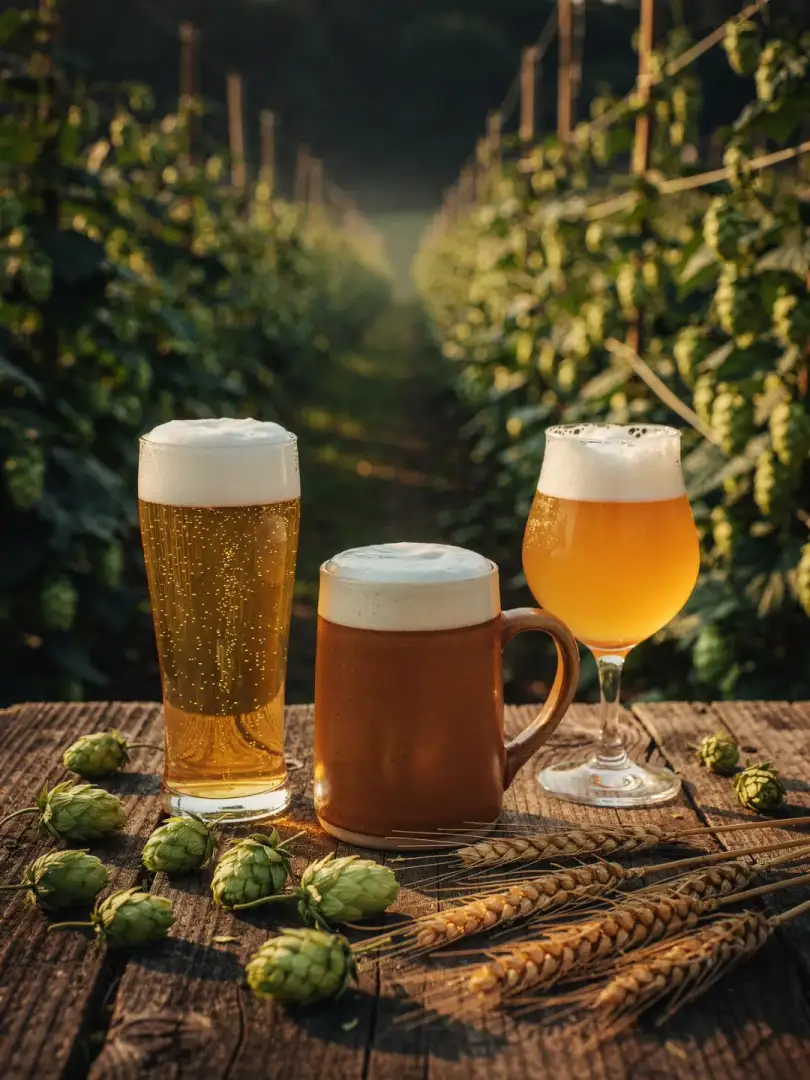
Hops Meet the Purity Law
Craft Beer in Germany: Beginnings, Law, Breweries
Craft beer arrived in Germany around 2010: Braufactum, from the Radeberger Group, and Crew Republic from Munich popularized IPA and stout, and Stone Brewing opened in Berlin in 2016. Most German craft brewers work with just malt, hops, yeast, and water, drawing their variety from new hop varieties.
When did craft beer arrive in Germany?
Up until 2010, the American wave was barely visible on German shelves. Then, of all things, a major player got there first: the Radeberger Group, part of the Oetker business sphere, launched the Braufactum project. The first beers hit stores in September 2010, including Progusta, an IPA brewed with American and German hop varieties. The bottles cost more than any pilsner and were presented like wine.
Almost simultaneously, Crew Republic got its start in Munich. Founders Mario Hanel and Timm Schnigula quit their office jobs in 2011 to brew beer in the American style. In Berlin, Hamburg, and many smaller cities, brewpubs, gypsy brewers, and beer shops with dozens of taps followed. From the very start, craft in Germany was therefore two things at once: a grassroots movement and a corporate project.
Can craft beer in Germany deviate from the Purity Law?
What may be called beer in Germany is governed by Section 9 of the Provisional Beer Law, whose core provisions remain in force even after the law's repeal in 2005, together with the Beer Ordinance. The word Reinheitsgebot, or Purity Law, isn't actually the name of a statute but an early 20th-century term for a rule first issued in Ingolstadt in 1516 for Bavaria. Today, bottom-fermented beer may only consist of barley malt, hops, yeast, and water. Top-fermented beer may also contain other malts and certain pure sugars, though not in Bavaria.
Anyone wanting to use coriander, salt, or fruit needs an individual exemption from the state authority for a special beer. According to the German Brewers' Association, such exemptions are available everywhere except Bavaria. One example is Gose, brewed with salt and coriander. Hop powder and hop extracts are explicitly permitted. That's why many German craft brewers stay within the rule: a single new hop variety alone can make a pilsner smell of mandarin or gooseberry, without anything other than hops ever entering the kettle.
What became of Stone Berlin and Braufactum?
California's Stone Brewing opened a brewery with a 100-hectoliter brewhouse, restaurant, and beer garden in a former gasworks in Berlin-Mariendorf in spring 2016. It was the country's most ambitious craft project. Yet by May 1, 2019, the Scottish brewery BrewDog had already taken over the site. For many, this was a sign that the German market for pricey hop-forward beer was smaller than hoped.
Braufactum followed a similar path. On January 1, 2024, the Radeberger Gruppe handed over purchasing, production, and distribution of the brand to its founders, who have run it as a side venture ever since; the brand itself remained with the Group. The company cited the fact that the craft market hadn't grown as strongly as hoped. On top of that, Germans are drinking less beer overall: in 2025, sales fell to around 78 million hectoliters, dropping below 80 million for the first time since record-keeping began in 1993.
Is Franconian Kellerbier craft beer too?
In spirit, yes; in name, no. Germany had plenty of small, independent breweries long before the craft wave—today around 1,500, according to the German Brewers' Association. In Franconia especially, family-run breweries make Kellerbier, an unfiltered, mostly bottom-fermented beer that comes cloudy and lightly carbonated straight from the cask. In the Upper Palatinate, townspeople brew their own Zoigl in a shared communal brewhouse and take turns serving it in their parlors. This is craftsmanship in the literal sense—nobody ever called it craft, though.
The new scene brought something different: the courage for bold hop aromas, styles borrowed from England, Belgium, and the US, and open communication about ingredients. Traditional breweries benefit from this too. Many now offer a cold-hopped Pils or a Pale Ale alongside their Helles. The hops for these often grow right next door: Germany cultivated nearly 19,000 hectares of hops in 2025, most of it in the Hallertau, the largest contiguous hop-growing region in the world.