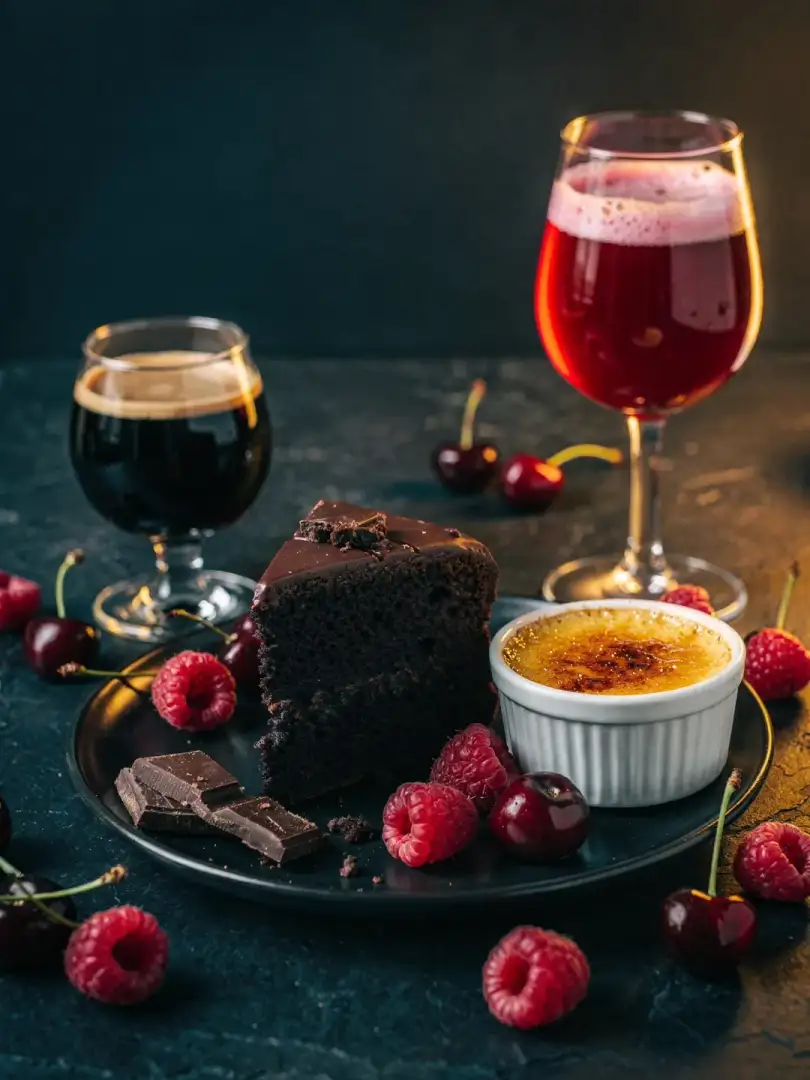
Sweets and Chocolate
Beer with Dessert and Chocolate
A beer served with dessert should be at least as sweet as the dessert itself, or it will taste thin and bitter by comparison. Imperial stout and porter pair well with dark chocolate, kriek or framboise with fruit desserts, and doppelbock, eisbock, or barley wine with caramel and nut flavors.
The Sweetness Rule: Why the Beer Must Be Sweeter Than the Dessert
Sugar changes the palate. After a spoonful of mousse or crème brûlée, any dry drink suddenly tastes sour and thin, and bitterness becomes more pronounced. Wine lovers know this rule from dessert wine, and it applies to beer just the same. A beer served with dessert therefore needs residual sweetness — malt sugar left unfermented by the yeast — or bold roasted and fruity flavors that read as sweet on the palate.
Beers with high original gravity — the proportion of dissolved malt solids before fermentation — work especially well here. According to the BJCP style guidelines, a doppelbock starts at 17.5°P, an imperial stout at 18.2°P, and an English barley wine at 19.3°P. These beers remain full-bodied even after fermentation. With an alcohol content often ranging from 8 to 12%, a small glass is enough — treat them more like a dessert wine than a thirst quencher.
Which Beer Pairs with Chocolate?
Dark chocolate and roasted malt are made in similar ways: cocoa beans are roasted, just as roasted malt is. An imperial stout with notes of coffee, cocoa, and licorice mirrors a high-cocoa-content chocolate almost note for note. A porter is lighter and pairs well with brownies or chocolate cake, while a Baltic porter — cold-fermented and smooth — suits pralines with nougat.
Contrast works too. A kriek, a lambic brewed with sour cherries, brings acidity and red fruit to chocolate, like a Black Forest cake in a glass. Milk chocolate is sweeter and softer; it pairs well with a dubbel showing raisin and caramel notes, or a dunkelweizen with banana character. With white chocolate, made almost entirely of cocoa butter, sugar, and milk, fruity sour beers often work better than dark ones.
Fruit, Cake, and Ice Cream: Fruit Beers, Weizenbock, and Milk Stout
Fruit desserts call for fruit in the glass. A framboise, a lambic brewed with raspberries, pairs beautifully with berry tart, panna cotta with raspberries, or red berry compote. Traditional oude kriek is dry and sour; many commercial krieks are sweetened, and per the sweetness rule, the sweeter version usually suits dessert better. For apple strudel or baked apple with cinnamon, a weizenbock with banana, clove, and dried fruit notes echoes the spices.
A playful trick with a dedicated fan base is a scoop of vanilla ice cream in stout: it creates a beer float, part drink, part dessert, where roasted malt and vanilla merge like coffee and cream. Cheesecake pairs well with a fruit beer or a witbier with orange peel, which lightens the richness of the cream cheese. Tiramisu harmonizes with a milk stout, brewed with lactose that brewer's yeast can't ferment, leaving the beer with natural sweetness.
Caramel, Nuts, and Pastry: The Hour of the Strong Beers
With crème brûlée, nut cake, or gingerbread, the malty strong beers show their strength. A doppelbock at 7 to 10% brings notes of bread crust and caramel, while an eisbock offers even greater concentration. To make eisbock, part of the water in the beer is frozen out and the ice removed, leaving alcohol and malt more concentrated behind — the result lands at 9 to 14% ABV.
English barley wine — despite its name, actually a beer — combines honey, dried fruit, and a noticeable hop bitterness of 35 to 70 IBU. That bitterness keeps it fresh even alongside sweet pastries. A Belgian quadrupel, classified by the BJCP as a Belgian Dark Strong Ale, pairs with fig, raisin, and rock candy notes to complement Christstollen and fruit bread. What they all have in common is high alcohol content, so they're served with dessert in small glasses and modest pours.