Fish and Sea
Which Beer Goes with Fish and Seafood?
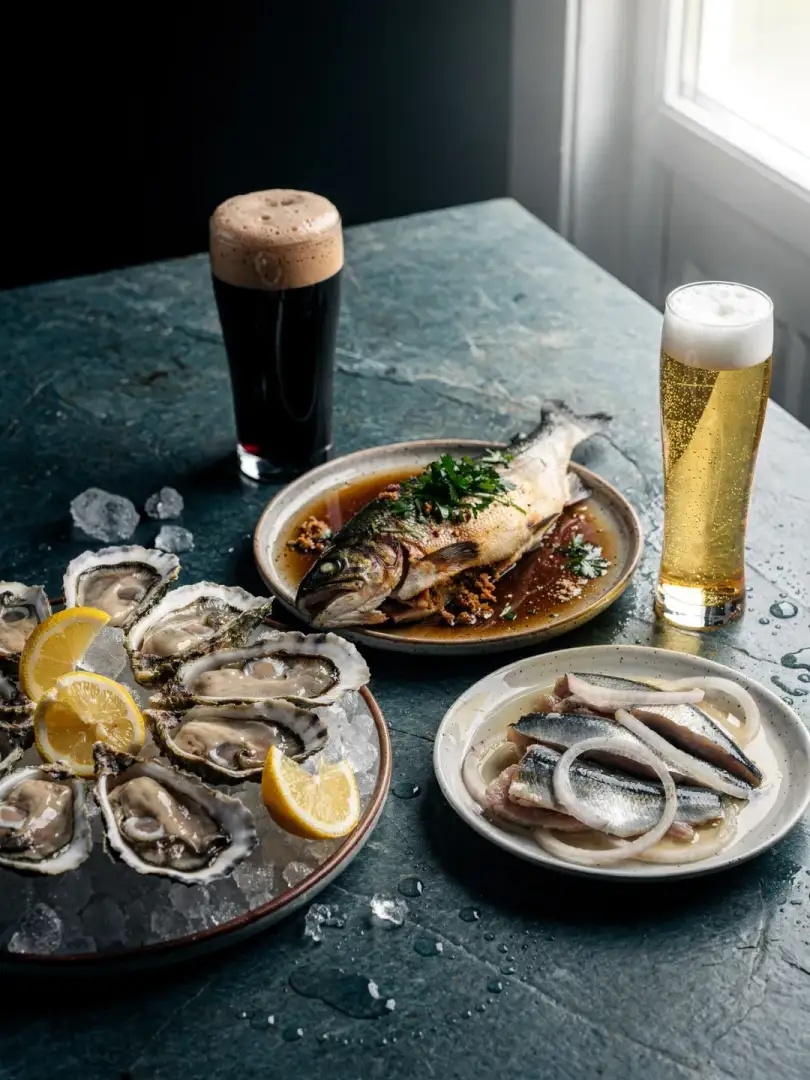
Pale, lean beers with little bitterness suit fish well: Kölsch, Helles, witbier, or pilsner. The fattier and richer the fish, the more body the beer may have. With oysters, a dry stout has proven itself; with smoked fish, a smoked beer or a porter.
Delicate Fish: Which Beer Goes with Trout, Pike-Perch, and Plaice?
White, lean fish like pike-perch, plaice, or trout taste fine and slightly sweet. Strong bitterness or roasted malt would mask that immediately. Beers that stay delicate work well instead: a Kölsch with its lean, lightly fruity character, a Helles with gentle malt, or a witbier whose coriander and orange peel act like a squeeze of lemon. With butter or cream sauce, a pilsner works well too, its hops cutting through the fat.
Kölsch and Helles look nearly identical in the glass and are often confused as a result. Kölsch is top-fermented, meaning it's fermented with a yeast that works at warmer temperatures and leaves light fruity notes. Helles is bottom-fermented, fermented cold, and tastes rounder and maltier. With trout meunière in brown butter, the Helles feels softer; with steamed pike-perch and herbs, the Kölsch feels fresher.
Fish and Chips, Fried Fish, and Matjes Herring
Fried fish needs freshness, because a batter coating fried in hot fat is a fat film waiting to happen. In Britain, an ale traditionally accompanies fish and chips. A Best Bitter at 3.8 to 4.6% has enough hops to cut through the fat and enough malt to match the browned batter. In Germany, a pilsner usually takes on this role with fried fish.
Matjes and Bismarck herring are salty, fatty, and often pickled with a tangy edge. A bitter, dry pilsner stands up to that well. Because salt dampens bitterness, the pilsner tastes milder next to the herring than it would alone in the glass, and the carbonation carries the fish fat away. With matjes in cream sauce, apples, and onions, a Kellerbier also works well, being softer and gentler on the cream.
Oysters and Stout: How the Pairing Came About
Oysters and stout are considered a classic among beer connoisseurs. In 19th-century London, oysters were a cheap everyday food, porter and stout the everyday beer, and both ended up on the same table in the same pub. A dark beer with an oyster may seem surprising, but the flavors support each other: the dry roasted malt of an Irish stout at 3.8 to 5% and 25 to 45 IBU stands opposite the salty, iodine-like taste of the sea without overwhelming it.
Stout and porter are often confused. The word "stout" originally just meant "strong"; a "stout porter" was a robust London porter, later shortened to stout. Ireland made the style famous, but didn't invent it. Today, an Irish stout usually tastes drier and more roasty, while an English porter is softer and more chocolatey. The dry style suits oysters better. Those who don't care for dark beer can reach for a gueuze instead, whose acidity acts like lemon.
Salmon, Shrimp, and Smoked Fish
Salmon is fattier and richer than pike-perch, and when grilled or cured, it can handle more body. A Vienna lager with a light caramel note or a saison with peppery yeast suits grilled salmon, while a witbier pairs well with gravlax and dill. Smoked salmon, smoked eel, and smoked herring call for smoke or roast: a rauchbier echoes the smoke, while a porter provides a dark counterpoint.
Shrimp, mussels, and crab taste sweet and mild. In Belgium, mussels often arrive at the table in a broth of beer or white wine, served with fries and a witbier. Garlic shrimp pairs well with a pilsner, while grilled chili shrimp calls for a wheat beer, whose light sweetness tempers the heat. A gose with salt and coriander makes an unusual yet fitting partner for ceviche, raw fish cured in lime juice.