Meat and Smoke
Beer with Roast Meat, Grilled Meat, and Sausage
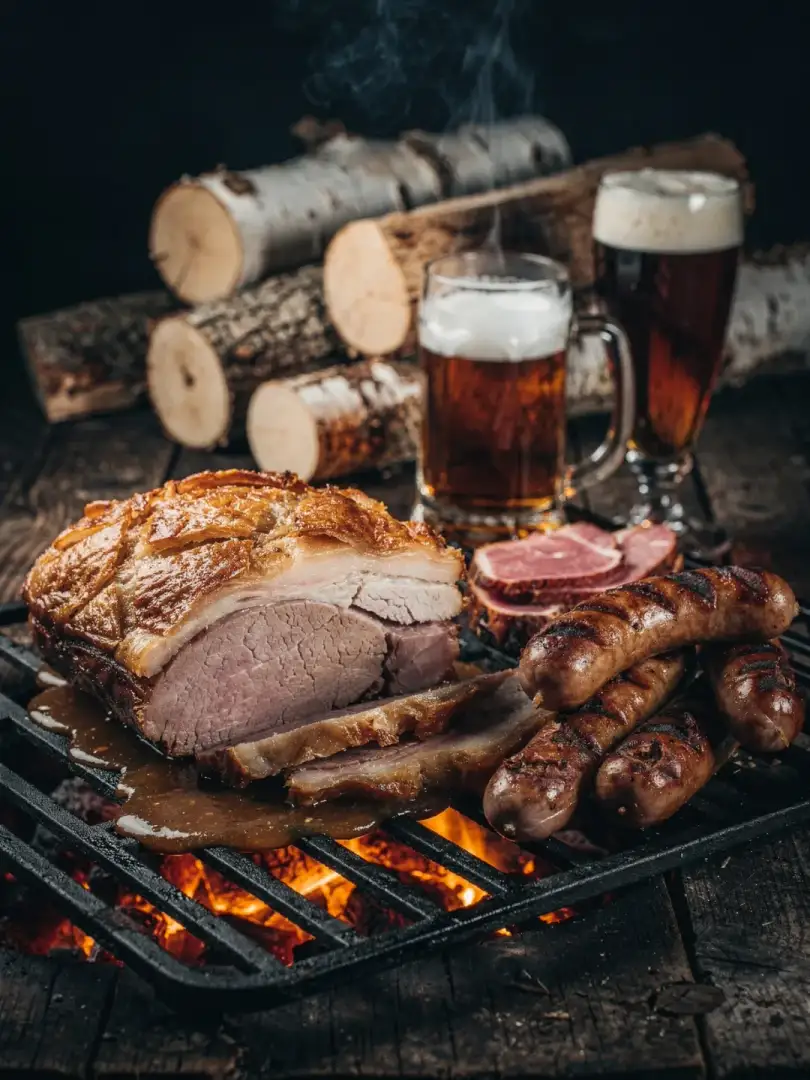
Roast meat, grilled meat, and sausage pair well with beers whose malt echoes the browned crust: Dunkel, Märzen, smoked beer, and bock. With fatty meat and sausage, carbonation and hops help by rinsing fat off the palate, as with a pilsner or a Kellerbier.
Roast Pork and Dunkel: Why Crust and Malt Belong Together
In Bavaria, roast pork with crackling crust and a Munich Dunkel have shared the same table for generations. There's a chemical reason for this. The crust forms through the Maillard reaction, the browning of sugar and protein under high heat. The same reaction colors Munich malt on the kiln and gives Dunkel its bread and nut notes. On the palate, two results of the same process meet.
Dunkel is lightly hopped (18 to 28 IBU) and malt-forward, but not sweet, so it doesn't drown out the gravy. A Märzen with a full body also suits ham hock or crackling roast well. A Schwarzbier, despite its nearly black color, tastes drier and more roasty than a Dunkel. Its roast character recalls bittersweet chocolate and pairs better with quickly seared meat with a dark crust than with a juicy braise.
Which Beer Goes Well with Grilling?
On the grill, smoke and roasted flavors enter the picture. This is where Bamberg smoked beer shows what it can do: its malt is dried over beechwood fire and absorbs the smoke in the process. With ribs, grilled pork belly, or smoked ham, a clear echo emerges. First-timers tasting smoked beer often describe it as ham in a glass; next to grilled food, it suddenly feels completely natural.
For steak with a dark crust, beers with roasted malt and body work well, such as a porter or an Altbier, whose hop bitterness of 25 to 50 IBU and robust malt can carry the meat. For grilled food with a sweet barbecue sauce, a Vienna lager or a Märzen works better, because their caramel notes pick up on the sweetness of the sauce. A very bitter IPA, on the other hand, can feel harsh next to charred spots: bitter meets bitter.
Bratwurst, Leberkäse, and Weisswurst: The Right Beer for Sausage
Sausage is fatty, salty, and often heavily seasoned with marjoram, pepper, or nutmeg. This is where the freshness rule comes in. A pilsner, a Helles, or a Franconian Kellerbier cut through the fat. With Nuremberg bratwurst and sauerkraut, Kellerbier works especially well, because its mild yeast character and malt round off the sourness of the cabbage. With Leberkäse and sweet mustard, a Helles is enough.
Weisswurst has its own tradition. In Munich, it's part of the Weisswurstfrühstück, served with a pretzel, sweet mustard, and Hefeweizen. The Hefeweizen's banana and clove notes pick up on the parsley and lemon zest in the sausage, and the sweet mustard gives it a counterweight. There's a saying that Weisswurst shouldn't hear the noon bell. It dates from the days before refrigeration and is now a tradition, not a rule.
Venison, Lamb, and Braised Dishes
Venison, lamb, and long-braised beef come with rich, often slightly sweet sauces featuring red wine, juniper, or lingonberry. A doppelbock at 7 to 10% with dried fruit notes can keep pace here. Its malt sweetness picks up on the lingonberry and sauce, while its alcohol carries the seasoning. A Belgian Dubbel achieves something similar, with more yeast-driven fruit and a hint of raisin.
With lamb seasoned with rosemary and garlic, a British bitter or an Altbier works well: assertive, malty, but not heavy. A good test for any pairing of meat and beer is the second bite. If it tastes fresh again after the sip, and the beer still tastes like itself after the bite, the pairing is right. If one overshadows the other, a step up or down the strength ladder usually helps.