A Hybrid
Where Does Lager Yeast Come From? Hansen, Carlsberg, and a Hybrid
Lager yeast is a hybrid: Saccharomyces pastorianus arose from a cross between the ale yeast Saccharomyces cerevisiae and the cold-loving Saccharomyces eubayanus. The first pure culture was achieved by Emil Christian Hansen in 1883 at Carlsberg, using yeast that originated in Munich.
Lager Beer Before Science: Bavaria's Cold Cellars
Bottom-fermented beer is far older in Bavaria than knowledge of its yeast. A Bavarian brewing regulation from 1553 permitted brewing only between Michaelmas on September 29 and St. George's Day on April 23. In summer, the risk was too great that warm fermentation would spoil the beer. Brewing took place in the cold season, with storage in deep cellars often cooled with ice from lakes and ponds.
Under these conditions, yeasts that tolerated cold had an advantage. Over generations, brewers passed on the yeast from the last good brew. Without knowing it, they thus bred a yeast that worked cleanly at low temperatures and settled at the bottom. The name lager beer recalls this long storage in the cellar.
Who Discovered Lager Yeast? Spaten, Carlsberg, Hansen
Danish brewer J. C. Jacobsen received bottom-fermenting yeast from the Spaten brewery in Munich in 1845. Two years later, he founded the Carlsberg brewery near Copenhagen and brewed beer there in the Bavarian style. The Munich yeast had thus arrived in Scandinavia.
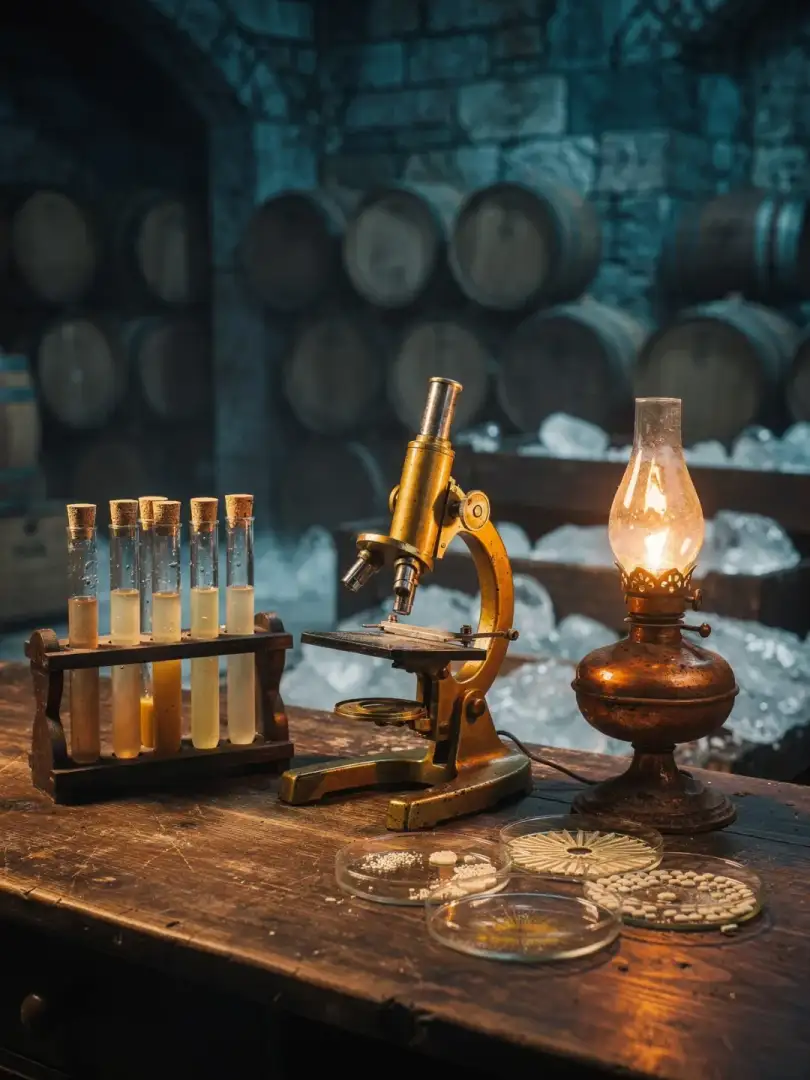
Back then, every batch of yeast was a mixture. Alongside the actual brewing yeast lived wild yeasts and bacteria that could make beer cloudy, sour, or bitter. Breweries repeatedly struggled with spoiled batches and didn't know why. Emil Christian Hansen, head of the physiological department at the Carlsberg Laboratory, developed a method to grow a pure culture from a single cell.
In 1883, he used this method to isolate the first pure culture of a bottom-fermenting yeast, later known as Unterhefe No. I. It was identical to the yeast from Munich. According to Carlsberg's own account, the brewery shared its pure culture with other breweries rather than keeping it to itself. Within a few decades, pure-culture yeast became standard in breweries. Hansen didn't invent lager yeast. He cleaned it up.
Is Lager Yeast a Hybrid? What Genetics Reveals
For a long time, it remained a mystery why lager yeast tolerates cold so well, given that Saccharomyces cerevisiae tends to prefer warmth. The answer came from genetics. Saccharomyces pastorianus carries two sets of genetic material within it, one from the familiar ale yeast and one from a cold-loving relative.
In 2011, researchers described this second parent species from forests in Patagonia, Argentina, and named it Saccharomyces eubayanus. Its genome matched 99.5 percent with the portion of lager yeast not derived from cerevisiae. Saccharomyces eubayanus was later also found in Tibet, North America, and other regions of the world.
This doesn't mean lager yeast comes from Patagonia. Patagonia is simply where the parent species was first discovered. Where and when the two species crossed remains an open question to this day. What's certain is that the hybrid made its career in the breweries of Central Europe and spread from there around the world.
Why Lager Yeast Tastes So Clean
From its cold-loving parent, lager yeast inherited the ability to ferment vigorously at 8 to 10 °C. From the ale yeast comes the tool to thoroughly break down the malt sugars maltose and maltotriose. This combination explains the clean flavor of lager beer. At low temperature, the yeast produces few esters and barely any higher alcohols, letting malt and hops take center stage.
Geneticists today distinguish two groups of lager yeast, named after historical strains Saaz type and Frohberg type. Saaz yeasts tolerate cold especially well but ferment less thoroughly. Frohberg yeasts are more vigorous and are found in most lager beers worldwide. The Weihenstephan yeast 34/70 belongs to the Frohberg type and is one of the most widely used lager yeasts anywhere.
For breweries, pure culture yeast had a tangible benefit. A strain that works cleanly can be kept unchanged over years and stored in yeast banks. This makes a brand's flavor repeatable, batch after batch, year after year. Many of the world's great lager beers thus trace back to just a few closely related strains.
So anyone holding a Pils, a Helles, or a Märzen in their glass is drinking the result of centuries of unconscious selective breeding in Bavarian cellars. The science of the 19th and 21st centuries merely explained this yeast; brewers, selecting by feel, created it.