Wheat Beer Aromas
Banana and Clove: Esters and Phenols from Wheat Beer Yeast
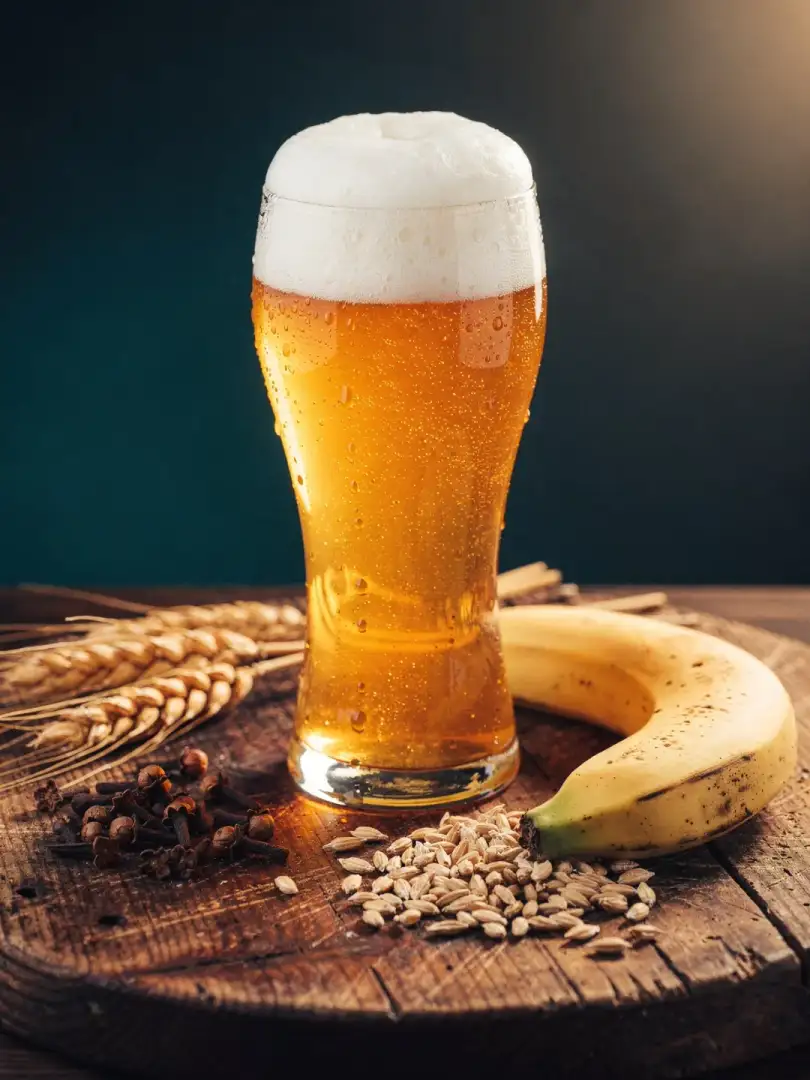
Banana and clove in wheat beer come from the yeast, not from the wheat: Bavarian wheat beer yeast produces isoamyl acetate, an ester with a banana scent, and 4-vinylguaiacol, a phenol with a clove scent. Brewers steer the balance between the two through temperature, mashing, and fermentation vessel.
Where Does the Banana Flavor in Wheat Beer Come From?
Wheat malt itself tastes of bread and grain, not of fruit. Fermented with a neutral yeast, a wheat beer would seem fairly plain. The typical aroma arises because Bavarian wheat beer yeasts produce particularly large amounts of isoamyl acetate. This ester forms in the yeast cell from isoamyl alcohol, a higher alcohol, and acetic acid. The same compound is found in ripe bananas.
How much isoamyl acetate forms depends heavily on fermentation management. A warmer fermentation, around 20°C (68°F), encourages ester formation. A smaller amount of pitching yeast is also considered a lever, since the cells then have to grow more vigorously. Classically, wheat beer was fermented in open, shallow vessels, where barely any pressure weighs on the yeast. High pressure in closed, tall tanks, by contrast, noticeably slows ester formation.
Where does the clove note come from? Ferulic acid and 4-vinylguaiacol
The clove note has a different origin. Malt contains ferulic acid, a plant compound from the cell walls of the grain. Wheat beer yeasts possess enzymes that convert this acid into 4-vinylguaiacol. This phenol smells of cloves, sometimes with a hint of smoke or vanilla. Experts call yeasts with this ability POF-positive, after the English term phenolic off-flavor.
The clunky name reveals the lager brewer's perspective. In a Pils or Helles, a clove aroma would be a flaw. Most cultured yeasts lost this ability over the course of domestication, meaning centuries of being passed down in breweries. Wheat yeasts, many Belgian yeasts, and almost all wild yeasts have retained it. What counts as an off-flavor in a Pils is a defining stylistic trait in wheat beer.
Brewers can set the stage for the clove note as early as the mash. A rest at around 45°C (113°F), the ferulic acid rest, releases more ferulic acid from the malt. The yeast then has more raw material for its phenol. If this rest is skipped, the banana note comes through more strongly.
Banana or clove: how breweries control the balance
Every Bavarian wheat beer brewery has its own profile. Some beers smell strongly of banana, others lean more toward clove and spice, and still others show notes of bubblegum or citrus. The differences arise from yeast strain, fermentation temperature, fermentation vessel, and mashing regime. Many breweries have nurtured their house strains for decades and guard them closely.
As a rough rule: warmth and open fermentation push the beer toward banana, while a strong ferulic acid rest and cooler fermentation push it toward clove. A well-balanced wheat beer keeps both in suspension, so that no single note becomes overbearing. In a Weizenbock, the strong sibling of wheat beer, the yeast-derived aromas often stand out even more due to the higher alcohol content.
For bottle conditioning, another step comes into play. Classic Hefeweizen gets fresh yeast and a dose of unfermented wort, called speise, at bottling. The beer continues to ferment in the bottle and builds up its vigorous carbonation. This liveliness, the sparkling sense of freshness on the tongue, is part of the style.
Weissbier, witbier, American wheat: what the yeast reveals
Belgian witbier is often mistaken for German wheat beer. Both are pale, hazy, and contain wheat. Witbier, however, typically uses unmalted wheat along with coriander and bitter orange peel, and a Belgian yeast that produces less banana. The spiced impression comes largely from the spices themselves. In German wheat beer, by contrast, banana and clove are purely the yeast's work, with no spices added at all.
Kristallweizen is a filtered wheat beer. The yeast has already developed its aroma during fermentation, so despite its clarity it still smells of banana and clove, just a bit more muted. A wheat beer fermented with neutral ale yeast, as is common in the US under the name American wheat, barely tastes of banana at all. This comparison shows just how much of wheat beer's character hinges on the yeast.
Belgian tripels and saisons, too, often carry clove-like or peppery phenols, because their yeasts are also POF-positive. So finding clove in the glass doesn't automatically mean wheat is involved. In wheat beer, the wheat provides foam, body, and a slightly tart freshness, while the yeast supplies the spice-like aroma.