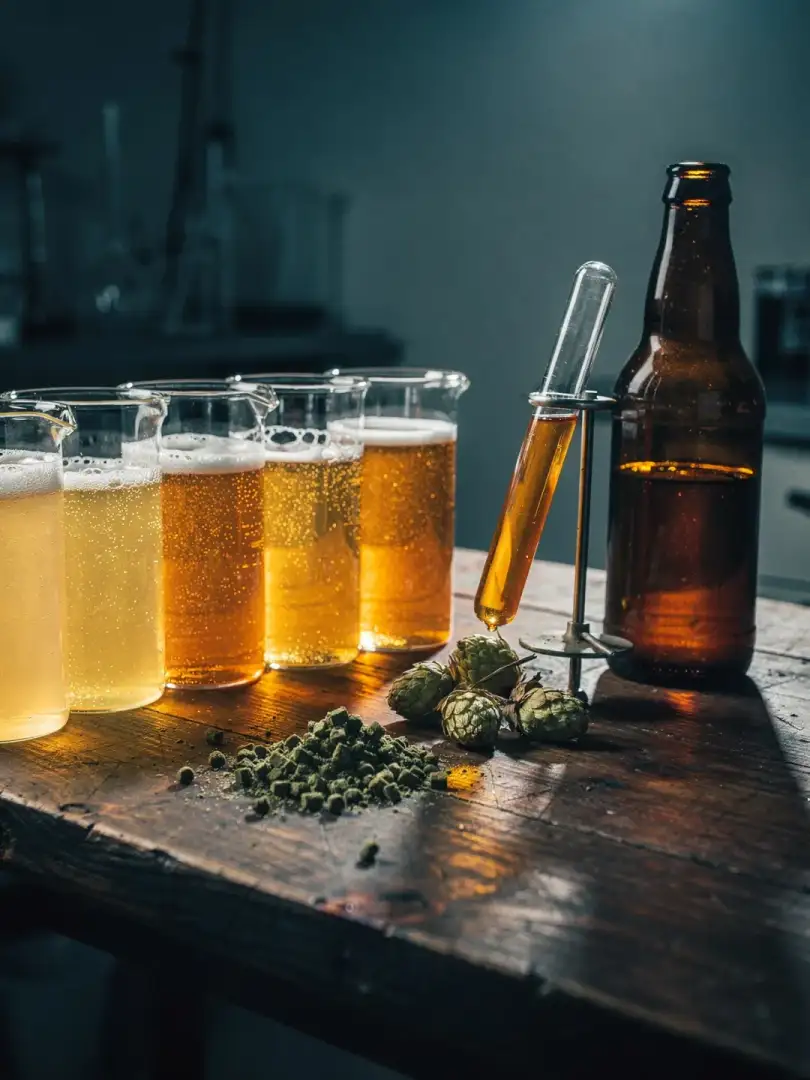
Measuring Bitterness
What Does IBU Mean? Bitterness and Alpha Acids Explained
IBU stands for International Bitterness Units and measures how much bitter hop compound is dissolved in the beer. One IBU corresponds to roughly one milligram of iso-alpha acid per liter. However, the number alone doesn't reveal how bitter a beer actually tastes.
Alpha Acids: Where Beer's Bitterness Comes From
The lupulin in the cone contains alpha acids, which chemists call humulone, cohumulone, and adhumulone. In their raw state they're barely bitter and dissolve poorly in water. Only when the wort, the sweet extract from the malt, is boiled do their molecules rearrange. Experts call this isomerization. The resulting iso-alpha acids dissolve well and taste distinctly bitter.
This conversion takes heat and time. After an hour of boiling, only part of the alpha acids has converted and made it into the finished beer; much of it remains stuck to the sediment, the yeast, or the foam. Brewers generally estimate a yield of a quarter to a third. Hops added just before the end of the boil therefore contribute a lot of aroma and comparatively little bitterness.
Beta acids, the second resin component, barely convert during boiling. Via breakdown products, they contribute only a little to bitterness, most notably in hops that have been stored for a while.
What Exactly Does IBU Mean, and How Is It Measured?
Measurement happens in a lab. Acidified beer is shaken with a solvent, and the bittering compounds are determined using ultraviolet light. The method is internationally standardized, hence the name. In Europe you'll often see EBU, the unit used by the European Brewery Convention; the values are practically identical.
Many small breweries don't measure at all, but calculate instead. Formulas estimate a value from the amount of hops, alpha acid content, boil time, and wort strength. Such figures on labels are approximations. According to common style guidelines, a Munich Helles usually comes in under 25 IBU, a German Pilsner often between 25 and 40, and many IPAs between 40 and 70. Above roughly 100 IBU, barely any more bitterness can dissolve into the beer, so higher numbers are usually calculated rather than measured.
Why the Same IBU Value Can Taste Differently Bitter
A doppelbock with 25 IBU can seem almost sweet, while a lean Pilsner with the same value tastes crisp. The reason lies in the malt. Residual sugar and roasted notes buffer the bitterness, while a dry beer lets it stand out unobstructed. Brewers therefore relate bitterness to the original gravity, the proportion of dissolved substances in the wort before fermentation. The American measure BU:GU divides IBU by the wort's gravity points. Values around 1 are considered distinctly crisp, values around 0.5 balanced.
Water matters too. Sulfate-rich brewing water makes bitterness feel drier and longer-lasting, while very soft water makes it seem rounder. Pilsner Urquell is brewed with notably soft water, and its bitterness feels soft despite high values. Brewers also hold that varieties high in cohumulone taste harsher and more bitter than those with less. This is scientifically disputed, but variety choice shapes the impression nonetheless.
Kölsch, Altbier, and Pilsner: Bitterness as a Distinguishing Feature
With Kölsch and Altbier, bitterness helps tell them apart. Both are top-fermented, meaning they're brewed with a warm-fermenting yeast and then cold-aged. Kölsch is pale, lean, and only lightly bitter. Düsseldorf Altbier is copper to dark brown, contains more heavily kilned malt, and is often noticeably more bitter; some Altbiers reach bitterness levels comparable to a Pilsner.
Between Pilsner and Kölsch lie differences in yeast and hop quantity. A Kölsch with Pilsner-level bitterness would be atypical for the style. A Pilsner with Helles-level bitterness, on the other hand, would have lost its defining trait, even if color and fermentation stayed the same.
Light, Age, and the Skunky Note in Beer
Iso-alpha acids are light-sensitive. When ultraviolet or blue light hits beer, they break down with the help of riboflavin, a vitamin from the malt. This produces 3-methyl-2-butene-1-thiol, a compound that smells like skunk or cabbage and is noticeable even in tiny traces. Brown bottles largely block this light, while green and clear bottles barely do.
Beer also loses bitterness with age. An IPA that's sat warm on a shelf for months tastes flatter and sweeter than the label promises. The number on the bottle describes the state at bottling, not in the glass.