Plant and Cone
What Is Hops? Plant, Cone, Lupulin
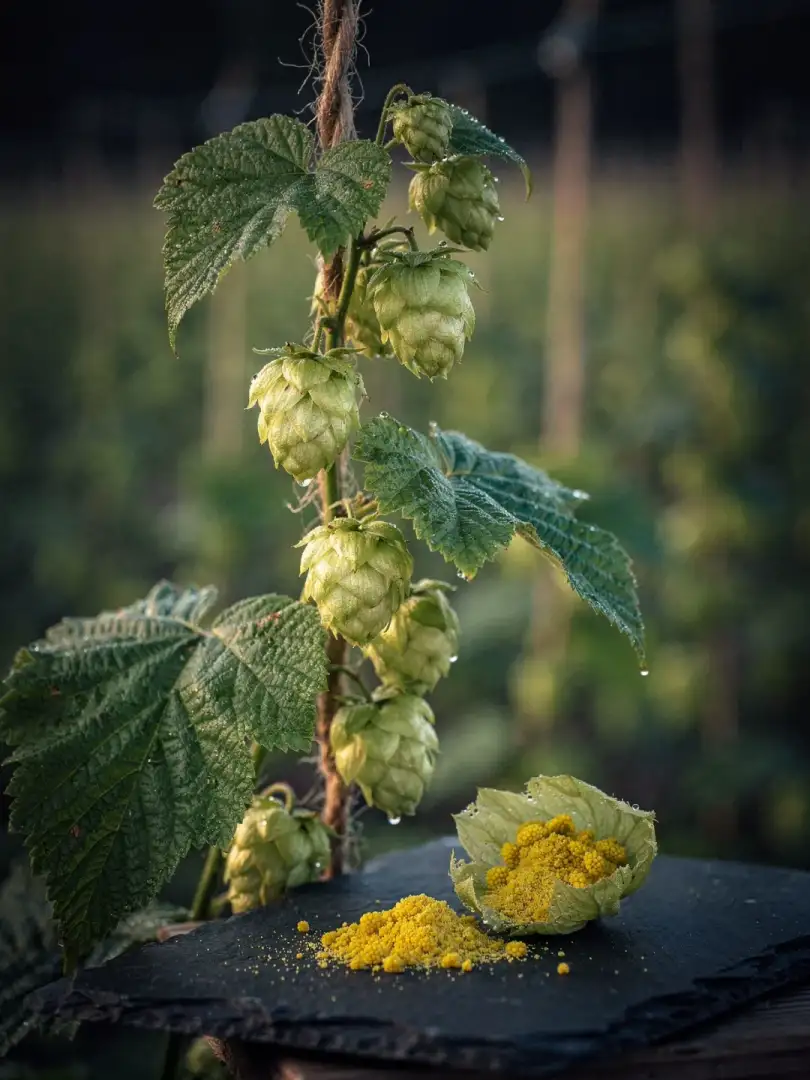
Hops are a climbing plant from the hemp family. Their female flower clusters, called cones, give beer bitterness, aroma, and shelf life. The key ingredient is a yellow, sticky powder inside them: lupulin.
Hops as a Plant: Humulus lupulus and Its Relatives
Botanists call the true hop plant Humulus lupulus. It belongs to the hemp family, making it a distant relative of cannabis, though it has no intoxicating effect since it lacks cannabis's active compounds. The plant is perennial. A sturdy rootstock overwinters underground, and every spring new shoots, called bines, sprout from it. In a single season they can climb up to seven meters high, then die back above ground in autumn.
Hops grow wild in floodplain forests, along streambanks, and at the edges of woods, from Europe to Western Asia; North America has its own wild varieties. The bines always twist clockwise around their support and cling on with tiny hooked hairs. Anyone who has ever brushed an arm against a wild hop plant knows the rough, almost scratchy feel against the skin.
Why Only Female Hop Plants Go Into Beer
Hops are dioecious, meaning there are separate male and female plants. Only the female plants are used, since they alone produce the cone-shaped flower clusters. A cone is roughly the size of a thumb joint. It consists of many overlapping, shingle-like bracts arranged along a zigzag central axis called the strig.
In German growing regions, wild male plants are removed from the vicinity of hop gardens. Pollinated cones form seeds, which add weight but no desirable aroma, and brewers pay more for seedless hops. In England, by contrast, seeded hops were long cultivated as well. A beer drinker can barely taste the difference, but for the trade it's a quality marker.
Lupulin: The Yellow Powder That Matters Most
Pull apart a ripe cone and a sticky, golden-yellow dust clings to your fingers. These are the lupulin glands, tiny resin granules at the base of the bracts. They contain almost everything a brewer is after: the bittering compounds from the alpha and beta acid groups, and the essential oils that carry the aroma. The green remainder of the cone mainly contributes tannins, known as polyphenols, and plant fiber.
The amounts vary widely from variety to variety. Fine aroma varieties often contain just three to five percent alpha acid by dry weight, while modern bittering varieties can reach fifteen percent or more. Oil content typically ranges from half a milliliter to three milliliters per 100 grams. These figures appear on every bag of hops, and brewers use them to calculate how much hops to add to the brew.
Why Does Beer Need Hops?
Without hops, beer would be a sweet, quickly spoiling malt drink. Hops balance out the sweetness of the malt, and even a few grams per hectoliter can noticeably change the impression. There's also a protective effect: hop acids inhibit many bacteria, especially those that produce lactic acid and turn beer sour. This is a major reason hops won out over other bittering herbs in the Middle Ages. Hildegard of Bingen wrote as early as the 12th century that hops made beverages more durable.
Hops also help with foam. Their bittering compounds bind with protein from the malt and stabilize the bubbles, which is why heavily hopped beers often carry a firm, clinging head. The tannins from the leaf material also bind protein during boiling, helping the beer turn clear later on.
Hops in the Glass: Pilsner, Helles, and Wheat Beer Compared
Hop content is what sets apart neighbors that look alike at first glance. Pilsner and Helles are both pale, bottom-fermented lagers, meaning they're brewed with a yeast that works at cool temperatures and settles at the bottom of the tank. Pilsner shows its hops openly: crisp, dry, with a floral-herbal aroma. Helles relies on malt, with hops staying in the background, just rounding things out.
In Bavarian wheat beer, the characteristic banana and clove notes come from the top-fermenting yeast, not from the hops. Wheat beers are therefore usually lightly hopped, with the bitterness there only to keep the sweetness in check. If you want to understand where a flavor comes from, the best question to ask is: does it come from malt, yeast, or hops? The following stops show just how much hops alone can contribute.