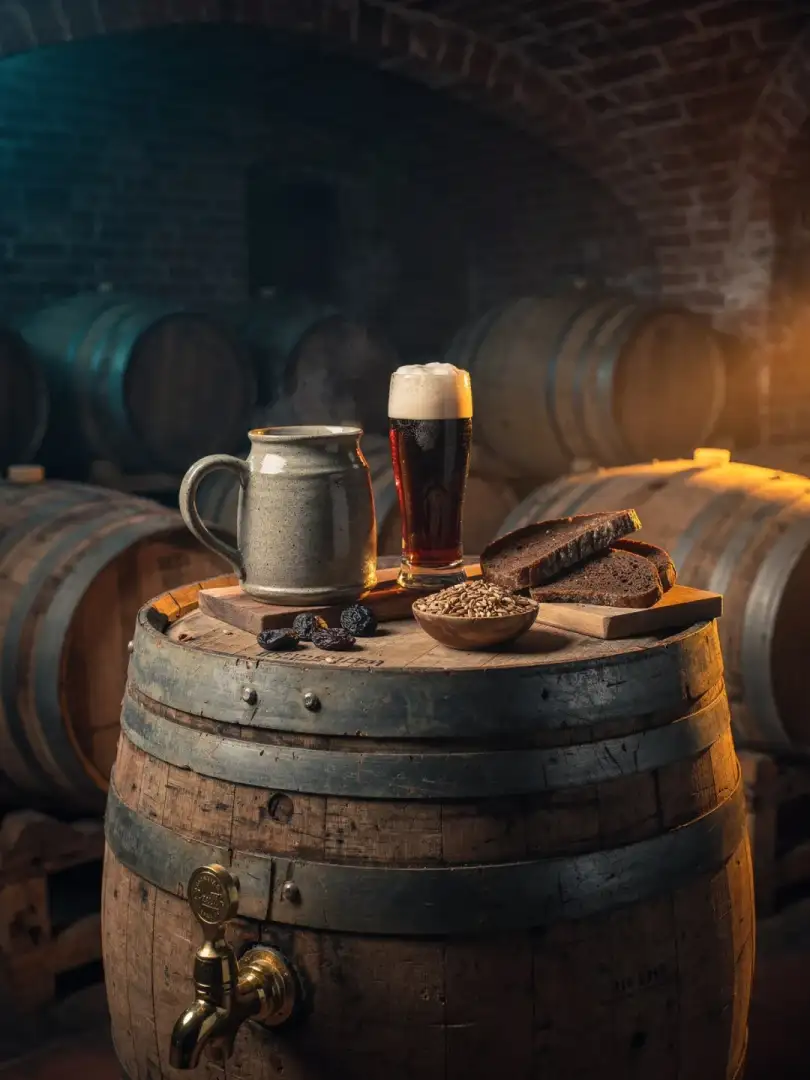
Beer for Lent
Fastenbier and Salvator: Where Does Doppelbock Come From?
Fastenbier refers to strong beers traditionally served during Lent, the fasting period before Easter. The most famous line traces back to the Paulaner monks of Munich and their Salvator, the original doppelbock. Under German law, "Starkbier" (strong beer) means a beer with at least 16 percent original gravity.
Fastenbier: why did monks drink strong beer during Lent?
The forty days before Easter were, in the Middle Ages, a time of abstinence. Meat, and often eggs and dairy too, were off the table, and many monasteries ate only once a day. For monks who were also working in the fields or workshops, this was hard going.
Under church law, an old principle applied: "Liquida non frangunt ieiunium"—liquids do not break the fast. A strong, malt-rich beer therefore provided energy without counting as food. To this day, popular tradition calls such beer "liquid bread." That's a figure of speech, not a nutritional fact: a strong beer doesn't replace a meal—what it mainly delivers is alcohol and residual sugars.
A popular tale has it that monks once sent a barrel of strong beer to Rome so the Pope could test it. Along the way, the beer supposedly spoiled, and the Pope, finding it undrinkable, permitted it as a form of penance. There's no evidence for this episode. It's a legend, fondly retold at beer-tapping ceremonies.
Salvator: the strong beer of the Paulaner monks
The Paulaners are a mendicant order, named after Saint Francis of Paola. Their monastery, Neudeck ob der Au, stood on the edge of what was then Munich. By February 24, 1634 at the latest, the brothers were brewing beer there for their own use. At first, they weren't permitted to sell it to the public.
In 1751, the monks were officially granted permission to serve beer on the feast day of their order's founder. According to tradition, they offered the first sip to Elector Maximilian III. From 1773 onward, the monk Valentin Stephan Still, known in the order as Brother Barnabas, shaped the recipe that the brewery still draws on today. After secularization, the brewer Franz Xaver Zacherl took over the former monastery brewery in 1806 and continued the strong beer under the name Salvator.
The name means "Savior" or "Redeemer" and traces back to the monks' "Sankt-Vater-Bier" (Holy Father's beer). Today, Salvator is a protected trademark of Paulaner. Other breweries therefore use their own names ending in "-ator," such as Optimator or Celebrator. That ending has itself become a recognizable marker of a doppelbock. To this day, the Starkbieranstich at Munich's Nockherberg opens the spring season, complete with its satirical political speech.
What is a doppelbock? Original gravity and the law
Under German law, what counts is original gravity—the proportion of dissolved substances from the malt, chiefly sugars, present in the wort before fermentation, expressed as a percentage or in degrees Plato. Under the Biersteuergesetz (beer tax law), only beers with at least 16 percent original gravity may be called "Starkbier" or "Bockbier."
There's no separate legal term for "doppelbock." By brewing convention, it's generally at least 18 percent original gravity. The international BJCP style guidelines put doppelbock at 17.5 to 26.4 degrees Plato, 7 to 10% ABV, and just 16 to 26 bitterness units. Bitterness units, or IBU, measure the bittering compounds from hops. Color ranges from deep gold to very dark brown.
In terms of flavor, malt takes center stage: bread crust, caramel, dried fruit, sometimes a hint of chocolate. The bottom-fermenting yeast stays in the background. Long cold storage rounds the beer out and softens the alcohol.
Doppelbock or Belgian abbey beer?
The two are often lumped together, since both come from monasteries and both are strong. But a doppelbock is a lager: bottom-fermented, cool-fermented, brewed without sugar, with a clean malt profile. A Belgian dubbel or quadrupel is top-fermented, often contains dark sugar, and shows fruity, spicy yeast character—notes like plum, banana or clove.
What they share is a high alcohol content. A half-liter of doppelbock contains roughly as much alcohol as a full liter of a standard Helles. When tasting it, small glasses and a meal are your best friends. Today it's served during Lent mainly out of tradition—it has little to do with fasting in the original sense.