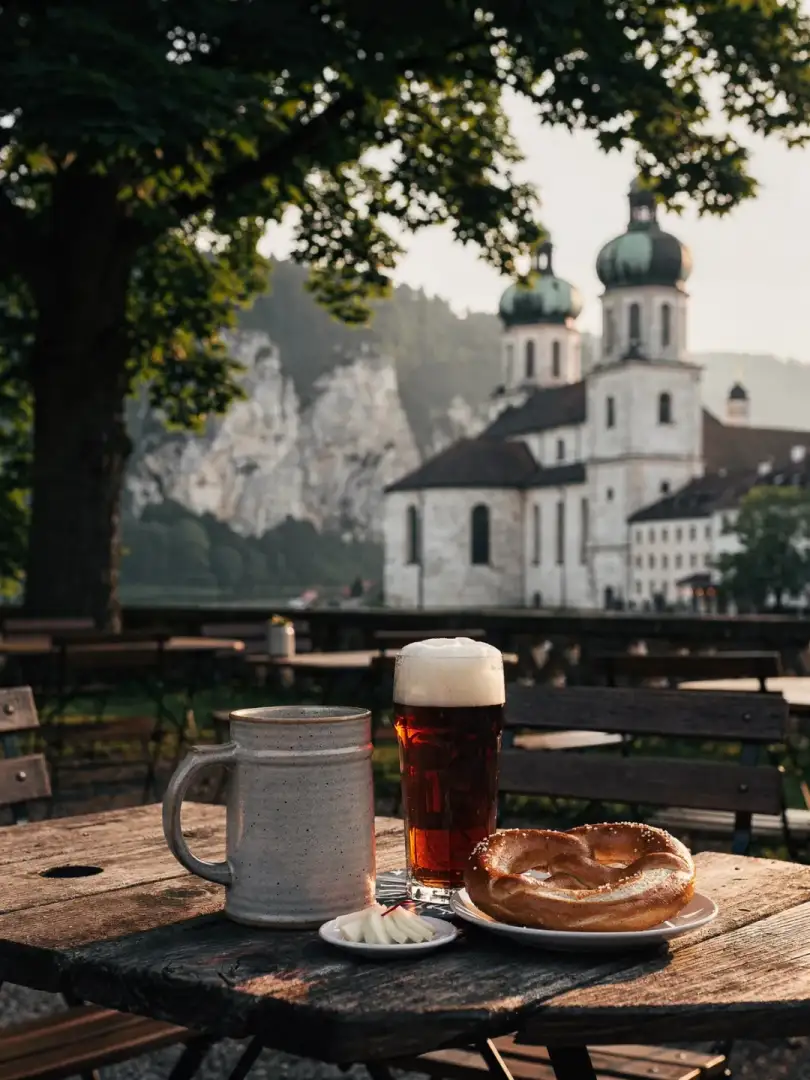
Benedictines in Bavaria
Monastery breweries in Germany: Weltenburg, Andechs, Ettal
Germany has no Trappist beer bearing the logo, but it does have monastery breweries with a long history. Weltenburg on the Danube, Andechs above Lake Ammersee and Ettal near Oberammergau all belong to Benedictine abbeys. They brew Bavarian styles like Helles, Dunkel, Weißbier and Bock, not Belgian-style abbey beers.
Weltenburg: monastery beer at the Danube gorge
Where the Danube squeezes through tall limestone cliffs near Kelheim lies Weltenburg Abbey, a Benedictine monastery. Its brewery traces its roots to the year 1050 and calls itself the oldest monastery brewery in the world. Whether that title holds up is hard to verify. Weihenstephan near Freising claims an even earlier date of 1040, though historians dispute it. Weihenstephan, moreover, has not been a monastery since secularization.
Weltenburg is best known for its Barock Dunkel. It's a Munich-style Dunkel—a bottom-fermented dark lager with notes of bread crust and light caramel. Since 1973, most of Weltenburg's bottled beer has not been brewed at the monastery but at the Bischofshof brewery in Regensburg. Because Bischofshof will stop brewing at the end of 2026, the brands will pass to Schneider Weisse in Kelheim on January 1, 2027; brewing will continue at the monastery itself. At the abbey, brewing is mainly done for its own beer garden.
A visit here combines landscape and beer. Many guests arrive by boat through the Danube gorge and then settle into the monastery courtyard. Order a Dunkel there, and you'll get a beer brewed just a few meters away. In shops, though, the bottle usually comes from the partner brewery, even if the label shows the monastery.
Andechs: pilgrimage and doppelbock
The Holy Mountain of Andechs, above Lake Ammersee, has been a site of pilgrimage since the Middle Ages. The monastery brewery dates its origins, by its own account, to 1455. It belongs to St. Bonifaz Abbey, a Benedictine community with houses in Munich and Andechs.
Many visitors come less for the church than for the Bräustüberl with its view of the foothills of the Alps. On tap you'll find Helles, Weißbier and a dark doppelbock, among others. Andechs shows just how closely pilgrimage, hospitality and brewing are intertwined at a monastery. Pilgrims have always needed food and drink, and the monastery supplied both.
Ettal: brewery in the monastery courtyard
Ettal Abbey, a Benedictine monastery, lies in a high valley near Oberammergau. Emperor Louis the Bavarian founded it in 1330. The monastery brewery cites 1609 as its founding year, though brewing reportedly took place there even earlier, according to the monastery. By its own account, it's one of the few breweries still run by monks.
Its history wasn't entirely unbroken either. During secularization in 1803, Ettal was dissolved and its buildings passed into secular hands. Only about a hundred years later did Benedictines move back in. So the brewery itself is old, but today's community is younger than the founding year might suggest.
Brewing takes place right in the monastery courtyard, and visitors can see the brewery on guided tours. The range spans from Helles to Dunkel to a strong Bock. Stop four describes how this relates to Benediktiner Weißbier, which is brewed in Hesse.
What distinguishes German monastery beer from Belgian?
The biggest difference lies in style and in law. Bavarian monasteries mostly brew with bottom fermentation. Bottom-fermenting yeast works at cool temperatures, roughly between six and twelve degrees Celsius, producing clean, malt-forward beers with little fruitiness. Belgian monasteries favor top-fermenting yeasts with spicy, fruity aromas.
Then there's sugar. In Belgium, light or dark sugar is standard in tripels and dubbels, since it adds alcohol without making the beer heavy. In Germany, sugar is permitted under beer law only in top-fermented beer, and in Bavaria, not even then. A Bavarian monastery beer therefore relies on malt alone for its strength, with no added sugar.
Anyone looking for monastery beer in Germany will mainly find Helles, Dunkel, Weißbier and Bock. The monasteries cultivate the styles of their own region rather than Belgian models. A label bearing the word "Kloster" (monastery) says little on its own: genuine monastery breweries name their monastery as owner or brewing site.
It helps to check the address and the manufacturer information. Some breweries carry the word "Kloster" in their name because they grew out of a monastery dissolved long ago. That's honest history, but no indication of present-day monks. Others remain in the hands of an abbey to this day. Both are entitled to call themselves a monastery brewery—there's no seal like the Trappist one to tell the two apart.