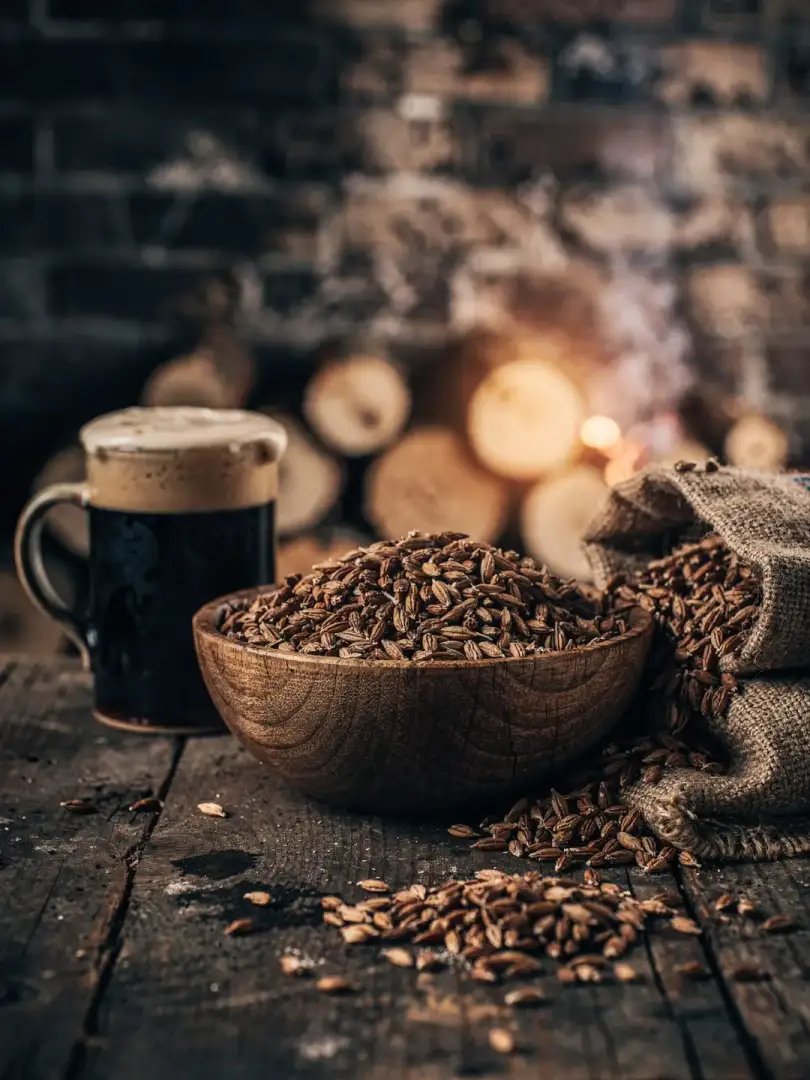
Fire in the grain
Smoked malt: beech, oak, peat, and alder
Smoked malt is made when smoke passes through the germinated grain on the kiln. Once nearly every malt smelled this way; today it's a specialty: beechwood smoke defines Bamberg's Rauchbier, oakwood smoke defines Polish Grodziskie, and peat smoke above all defines Scotch whisky. The wood determines how the smoke tastes in the beer.
Why did almost every beer used to taste smoky?
For a long time, maltsters dried their green malt over open fire. Wood, straw, or peat burned beneath the kiln, and the smoke passed directly through the moist grain. The malt absorbed smoke compounds—chemically, mainly phenols, ring-shaped compounds that smell of wood fire, ham, or a smokehouse. A certain smoky note was therefore a natural part of beer for centuries.
That changed when maltsters began working with coke and later with indirectly heated kilns. There, only heated air flows through the malt, while the combustion gases stay separate. This made completely smoke-free, very pale malts possible for the first time—the prerequisite for pale beers like Pils. Smoked malt thus went from being the rule to the exception, and anyone using it today does so deliberately.
Beechwood smoke: what defines Bamberg's Rauchbier?
In Bamberg, smoke never went away. The best-known address is Schlenkerla, run by the Heller-Bräu Trum brewery, which has been family-owned for six generations. The brewery runs its own malthouse. According to the brewery, it burns beech logs from the Franconian Jura that have been seasoned for at least three years. The smoke passes through the green malt, which rests on a wire screen above the fire.
The Aecht Schlenkerla Rauchbier Märzen is bottom-fermented and dark. First-time drinkers often think of smoked ham. By the second glass, malt sweetness and a light bitterness come forward, and the smoke feels rounder. Beechwood smoke is considered comparatively mild and balanced. Other breweries buy their beechwood-smoked malt from maltsters who produce it in bulk, blending it in varying proportions with pale malt.
Oak and wheat: Poland's Grodziskie
A very different smoked beer comes from Grodzisk Wielkopolski in western Poland. Grodziskie is brewed from wheat malt smoked over oakwood. It's pale gold, light, low in alcohol, and very lively on the palate. The earliest mentions date to the early 14th century, and in 1601 a municipal statute set rules for how the beer had to be brewed to ensure its quality.
Production declined after World War II and ended in the 1990s. Starting in 2011, Poland's homebrewers' association gathered historical knowledge and sought a maltster to revive the missing oak-smoked wheat malt. Today, breweries in Poland and elsewhere are brewing it once again. Oak smoke comes across as drier and sharper than beechwood smoke, and in the light wheat beer it stands out distinctly.
Peat, alder, cherrywood: smoke used with a careful hand
Peated malt is best known from Scotland. Distilleries on Islay use it to kiln the malt for their smoky whiskies. In beer, peat is tricky. Even small amounts can taste medicinal or iodine-like, and many tasters find that off-putting. The common assumption that Scottish ales must taste of peat applies whisky knowledge to beer where it doesn't really belong.
American breweries have brought other woods into play. Alaskan Brewing Company smokes malt over alderwood for its Smoked Porter, and American maltsters offer cherrywood-smoked malt. Fruitwood gives a sweeter, softer smoke. For all smoked malts, the proportion in the recipe decides whether the smoke is just a hint or whether it dominates the beer.
Not every smoky note comes from smoked malt. Heavily roasted malt can recall burnt bread or ash without ever having seen a fire. Certain yeasts produce spicy phenols that bring to mind clove or even incense. In Weissbier that's intentional; in a Pils it would be a flaw. So when tasters notice smoke, they first ask about the style: in a Rauchbier it belongs there, but in a pale lager it more likely points to an infection or a brewing process that doesn't suit the style.