Colour and flavour
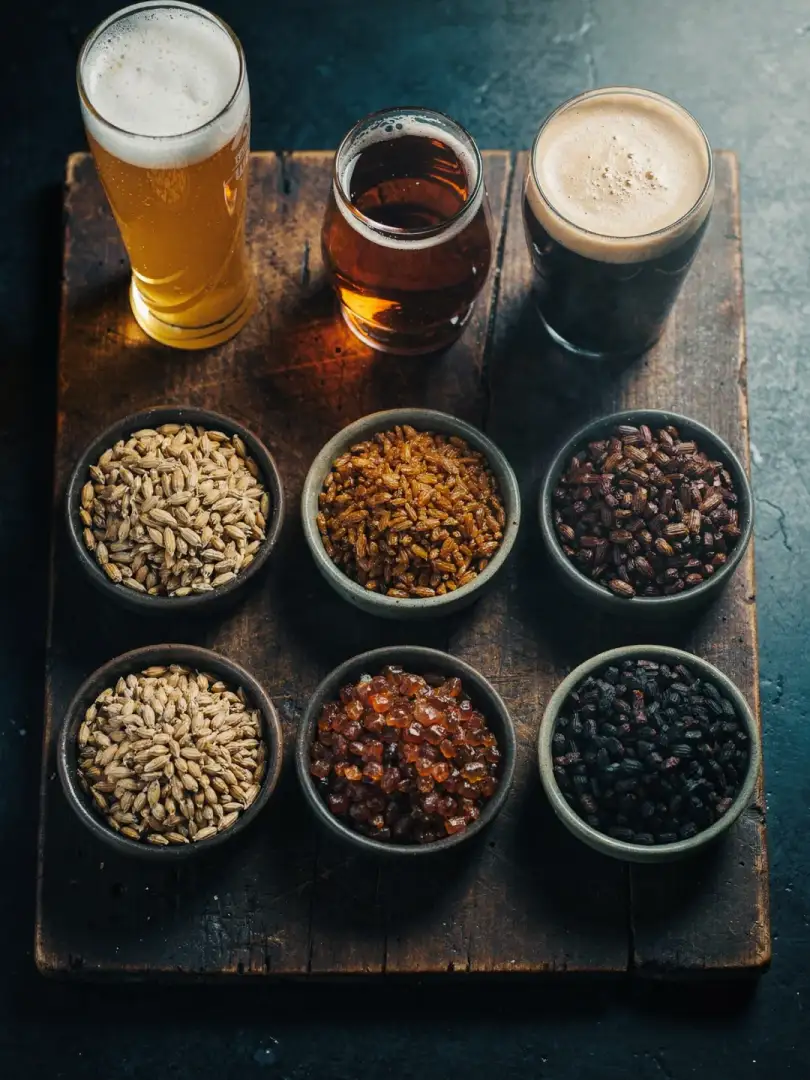
Malt types: pilsner, Munich, caramel, roasted
Malt types differ mainly in how hot and how long the kernel is kilned or roasted. Pilsner malt stays pale and enzyme-rich, Munich malt tastes of bread crust, caramel malt of honey and caramel, roasted malt of coffee. Their combination creates the colour and character of every beer style.
Base malt and specialty malt: what determines the amount?
Almost every recipe rests on a base malt. It makes up the bulk of the grist, that is, the total malt bill for a brew, and supplies the enzymes that convert starch into sugar during mashing. The most important base malts are very pale pilsner malt, the slightly more robust British pale ale malt, golden Vienna malt, and darker Munich malt. A German pilsner is often made almost entirely from pilsner malt.
Specialty malts are added in small proportions, from one percent up to about a fifth of the grist. They contribute colour, sweetness, roasted flavours, or foam, but due to the intense heat they've been exposed to, they carry hardly any enzymes. A beer made entirely from caramel or roasted malt would fail to convert in the mash. So when reading a recipe: the base malt sets the overall direction, while the specialty malts add the accents.
Malt colour in EBC: what the number means
Maltsters and brewers measure color in EBC, named after the European Brewery Convention, an association of European brewing scientists. The higher the number, the darker the malt. In the US, the unit SRM is more common; one EBC value corresponds to roughly double the SRM value. Pilsner malt sits around 3 to 5 EBC, Vienna malt a bit higher, and Munich malt roughly between 15 and 25 EBC depending on type.
Specialty malts span a much wider range. Pale caramel malts start in the single digits, while dark ones reach several hundred EBC. Roasted malts sit at around 1,000 EBC and above. Just a few percent of these can turn an entire beer black. The color of the finished beer is therefore no measure of its strength: a Schwarzbier can be lighter in body than a golden Bockbier.
Caramel malt: sugar already in the grain
For caramel malt, the green malt goes into a roasting drum while still moist, instead of onto the kiln. At around 60 to 75 degrees Celsius, the enzymes are still active and convert the starch inside the sealed grain into sugar. The grain essentially mashes itself. The temperature then rises, the sugar caramelizes, and the kernel turns glassy and hard. The longer and hotter the roast, the darker the malt, and the flavor shifts from honey toward toffee and dried fruit.
Some of these sugars can't be fermented by the yeast. They remain in the beer, contributing sweetness, body, and stable foam. Brewers therefore use very pale caramel malts even in Pils or Helles to boost fullness and head retention without changing the color. Darker caramel malts define Märzen, reddish lagers, and many Amber Ales.
Roasted malt and roasted barley: Porter, Stout, and Schwarzbier
Roasted malt is made by heating fully kilned malt in a drum to over 200 degrees Celsius. Depending on the degree of roast, it's called chocolate malt or black malt and tastes of cocoa, coffee, or burnt bread. A process for very dark malt was patented by London's Daniel Wheeler in 1817. It supplied porter brewers with a malt that delivered lots of color from a small amount.
In Irish-style stout, the dry, slightly sharp roasted note often comes from unmalted, roasted barley. In a beer brewed in Germany, this wouldn't be allowed, since it isn't malt. German Schwarzbier is therefore colored with roasted malt made from barley malt. Brewers often use dehusked roasted malt, where the husk is removed before roasting. It tastes milder and less bitter, resulting in a black beer that, in the mouth, resembles a Helles with a cocoa note more than an espresso.
The line between Porter and Stout is blurry today. Stout originally just meant strong—a Stout Porter was simply a stronger Porter. Even so, the malt bill often tells them apart: Porter tends to lean on chocolate malt and a softer roast, while Stout more often uses roasted barley and a drier edge.