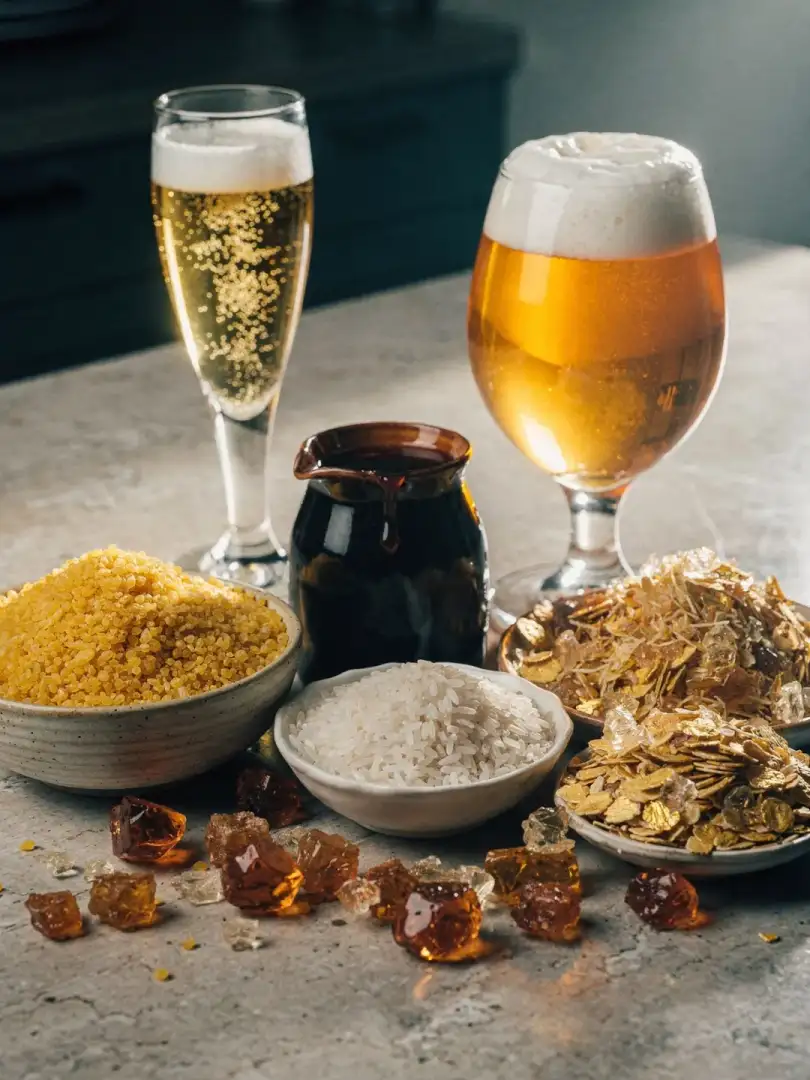
Additions to malt
Raw grain: corn, rice, and sugar in beer
Raw grain means unmalted grain such as corn, rice, or raw wheat that replaces part of the malt. In English, such ingredients—sugar included—are called adjuncts. They lighten and thin out a beer or give Belgian styles strength without heaviness. In a beer brewed in Germany, they are largely prohibited.
What is raw grain, and how does it end up in beer?
Unmalted grain has never germinated and therefore brings no enzymes of its own. Its starch is converted to sugar in the brewhouse by the enzymes from the barley malt alongside it. Corn and rice have a quirk here: their starch gelatinizes—that is, swells and dissolves—only at higher temperatures than barley's does. Large breweries therefore pre-cook them in a separate vessel, the cereal cooker, before adding the hot mash to the main malt mash.
There are more convenient routes. Flaked grains are already steamed and rolled, so they can go straight into the mash. Syrups and sugar are added only when the wort is boiled in the kettle and need no enzymes at all. Manufacturers rarely state how much raw grain a beer contains on the label. In many international lagers, though, it replaces a significant share of the malt.
Raw grain doesn't automatically mean cheap, mass-market beer. Belgian Lambic brewers traditionally use unmalted wheat, Belgian Witbier relies on raw wheat, and Irish stouts on roasted raw barley. In these styles, the raw grain is part of the signature. It lends the beer haze, mouthfeel, or a roasted note that malt alone couldn't achieve in the same way. What matters, then, is why a brewer reaches for raw grain: to cut costs, or to shape a flavor.
Corn and rice: why American lager tastes so pale
In the 19th century, German immigrants brought lager beer to the US. There, they mainly found six-row barley, which was higher in protein than the barley back home. Beer made purely from this malt tended toward haze and tasted heavier. Corn and rice diluted the protein, and the enzyme reserves of six-row barley were enough to convert them as well. The result was a very pale, light lager that shaped the American beer market for a long time.
Anheuser-Busch lists rice as an ingredient for Budweiser, many Mexican lagers contain corn, and Japanese lagers often contain rice. These beers have little malt aroma, a light body, and a clean, short finish. That's not a flaw but the goal: they're meant to be drunk very cold and refreshing. Anyone looking for bread, honey, or caramel in the glass will find it more in beers brewed with plenty of malt.
Sugar in beer: candi sugar in Belgium, invert sugar in England
Sugar ferments almost completely. It raises the alcohol content without leaving behind body or sweetness. Belgian brewers put this to deliberate use. A Tripel, usually around 8 to 9 percent alcohol, feels drier and lighter than its strength would suggest, thanks to candi sugar. Dark candi syrup gives some Dubbels and Quadrupels both color and notes of raisin and caramel at the same time.
In England, invert sugar—household sugar split into glucose and fructose—has long been common in Bitter and Mild. Lactose, or milk sugar, plays a special role. Brewer's yeast can't ferment it, so its sweetness stays in the beer. This is how Milk Stout gets its soft, sweet character despite the roasted malt. Honey, maple syrup, or molasses also turn up in recipes, especially among adventurous breweries.
What does German beer law permit when it comes to raw grain and sugar?
For bottom-fermented beer from Germany, the rule is: only barley malt, hops, yeast, and water. A German Pils or Helles therefore contains neither corn, rice, nor sugar. For top-fermented beer, the law additionally permits other malts as well as technically pure cane, beet, invert, and starch sugar, along with colorants made from them. This doesn't apply in Bavaria: there, sugar is excluded even from top-fermented beer.
Raw grains such as corn, rice, or unmalted barley count as malt substitutes and remain prohibited, even if a state authority approves a special beer with other ingredients. Home brewers producing up to 200 liters a year are exempt. Imported beers containing corn or rice may still be sold as beer. This follows from the 1987 ruling by the European Court of Justice and is now set out in Section 1, Paragraph 2 of the Beer Ordinance.