The eye drinks too
Color, clarity, and foam in beer
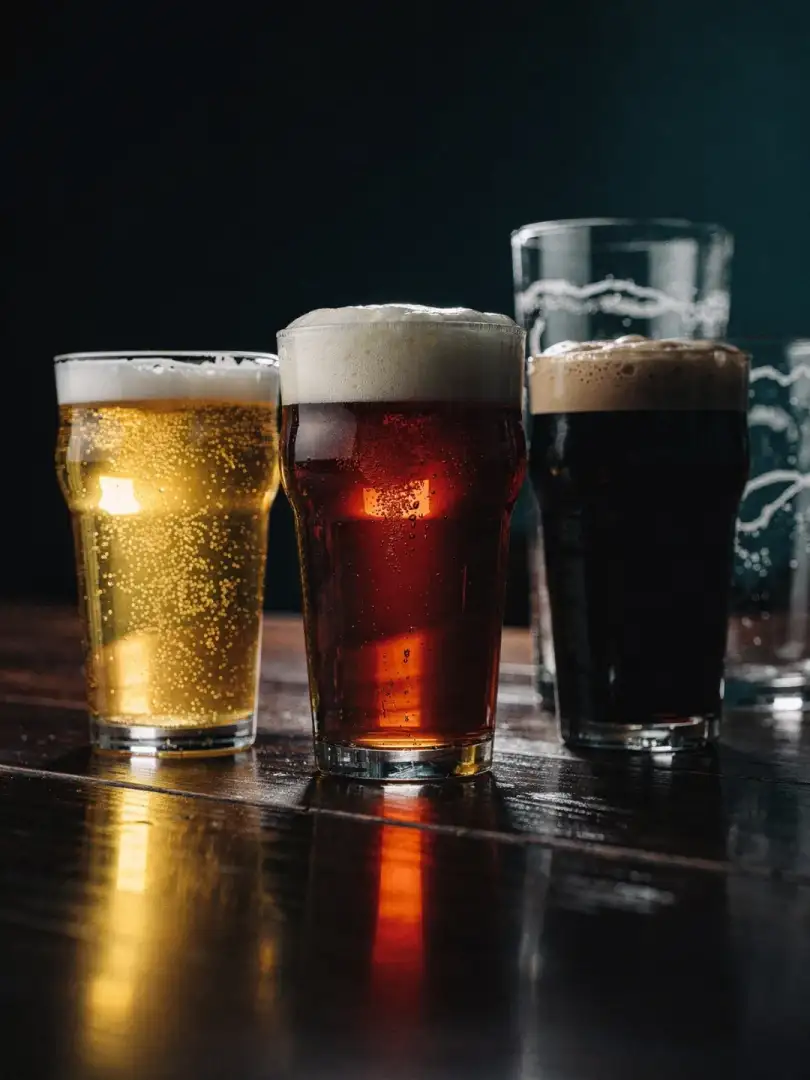
Color, clarity, and foam are the first things a beer reveals. The color comes almost entirely from the malt, the haze usually from yeast and protein, the foam from protein, hops, and carbonation. A careful look tells you a lot about the style in the glass before the first sip.
Where does beer's color come from? Malt and EBC
A beer's color is created during kilning, the process of drying germinated grain with hot air. The higher the temperature, the darker the malt becomes, and later the darker the beer. Boiling the wort adds a bit more color, since sugar and protein react with each other and brown.
Color is measured in Europe in EBC. The abbreviation stands for European Brewery Convention, a brewing science association. Low values mean pale. A German Pils sits at 4 to 8 EBC according to the BJCP, a Märzen at 16 to 33, a Schwarzbier at 37 to 59, and an Irish Stout at 49 to 79. In the US, color is measured in SRM, roughly half the EBC value.
But color says little about strength. A Schwarzbier often has less alcohol than a golden Tripel. Dark doesn't mean sweet either: a Schwarzbier tastes dry with a light roasty edge, while a Munich Dunkel leans more toward bread crust. Looking into the glass, the hue also matters. Reddish highlights suggest caramel or Munich malt, while a deep, opaque black points to roasted malt.
Clear or hazy? What haze reveals about a beer
A pristine beer is crystal clear. That's achieved through long, cold conditioning or filtration. Under the Kölsch Convention, Kölsch must be clear, as must most Pils beers. A Hefeweizen, by contrast, is intentionally hazy, since the yeast remains in the beer. In a Kristallweizen it's filtered out, though the style remains a wheat beer.
Not every haze is intentional. A chill haze forms when protein and tannins bind together at low temperatures. It often disappears again once the beer warms up a bit. A milky veil in a beer that should be clear, however, can point to an infection from unwanted microorganisms. In that case, a closer look at aroma and taste is worthwhile.
Newer styles have turned haze into a signature feature. A Hazy IPA, also called a NEIPA, is cloudy like fruit juice thanks to plenty of oats, wheat, and late hop additions. Comparing it to a clear West Coast IPA makes the stylistic difference obvious right away.
What makes good beer foam?
Foam consists of carbon dioxide bubbles wrapped in a thin film of protein and hop bittering compounds. The more of these substances a beer contains, the more stable and fine-pored the foam head becomes. Wheat malt brings along plenty of foam-building protein, which is why a tall, creamy head piles up on a wheat beer.
Experts assess three things: how much foam forms, how fine the bubbles are, and how long it lasts. If a pattern of foam rings clings to the glass while drinking, that's called lacing, or 'Brussels lace.' It shows a clean glass and a beer with enough foam-forming protein.
The color of the foam reveals something too. Over pale beers it stands snow-white; over dark beers, porters, or stouts it's cream to light brown, since roasted malt tints the bubble film. Coarse, large bubbles that burst quickly often point to too much free carbonation or too little protein. A dense, fine-pored foam that clings like cream when the glass is tilted, on the other hand, is considered a sign of careful work from the brewhouse all the way to the tap.
Fat is foam's biggest enemy. Lip balm, frying grease on your fingers, or detergent residue can collapse a head in seconds. A beer with very little carbonation also barely foams, such as an English cask ale. There, that's simply the style, not a flaw.