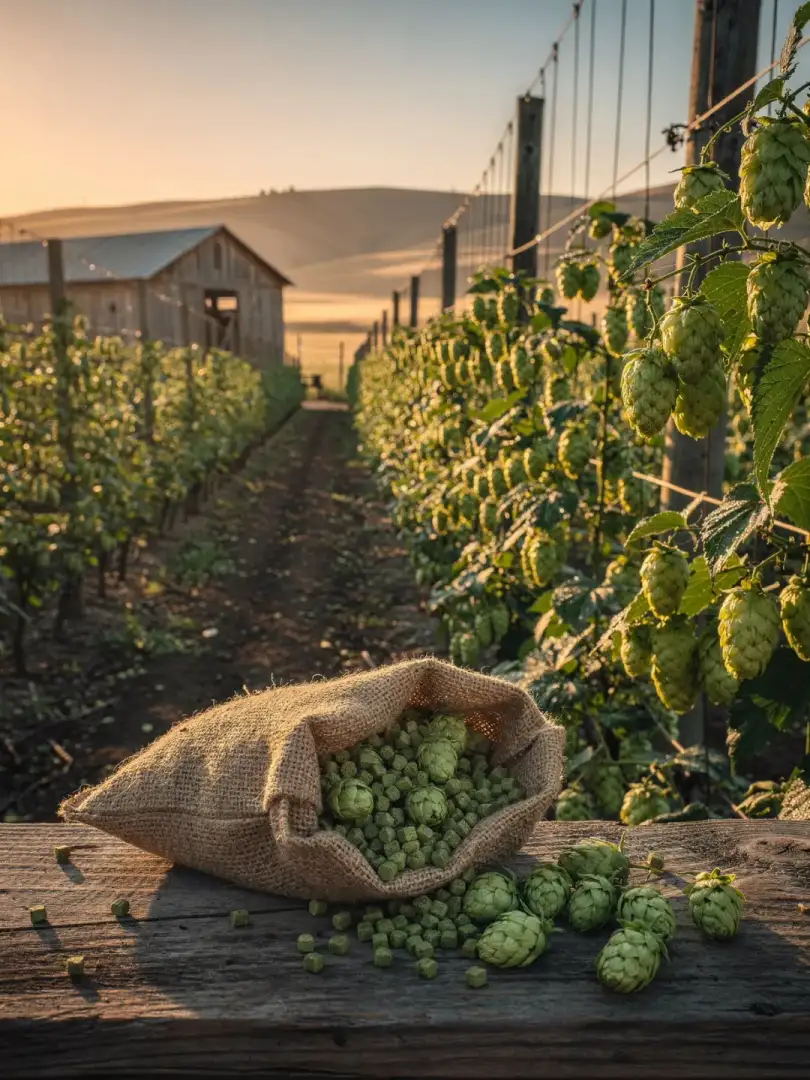
From the Pacific Northwest
Hops
Where do the hops for Chicago beer come from? From the Pacific Northwest of the US, mainly the Yakima Valley in Washington, as well as Oregon and Idaho. No hop gardens grow in Chicago itself; the cones travel thousands of miles into the city as dried pellets or whole cones. The US grows hops on roughly 17,000 hectares and produces about 40 percent of the world's alpha acid supply.
Alpha acid is the compound in hops that brings bitterness to beer. It's measured in IBUs, International Bitterness Units. A pale ale typically falls between 30 and 50 IBU by style guidelines, an American IPA between 40 and 70. Aroma, on the other hand, comes from hop oils, which evaporate during long boiling. That's why brewers add a lot of hops late in the boil, or add them after fermentation entirely.
Adding hops after fermentation is called dry hopping. The hops sit for several days in the finished, cool beer, releasing their aroma without adding more bitterness. Half Acre's Daisy Cutter Pale Ale is a textbook example of this style: it's fragrant with citrus and resin and ranks among the city's best-known beers.
Varieties mostly come from American breeding programs. Cascade, introduced in 1972, brought grapefruit aroma to the fore; later came Centennial, Simcoe, Citra, and Mosaic. Citra and Mosaic deliver tropical fruit notes like mango and passion fruit, while Simcoe brings pine resin.
In an imperial stout, hops serve a different purpose. Here they keep the malt's sweetness in check and support the beer through long aging. You barely taste them, yet without hops the beer would feel cloying. This is the opposite end of the spectrum from an IPA's hop aroma, even though both styles come from the same city.