The cut
Heads, heart, and tails: what's cut away and why
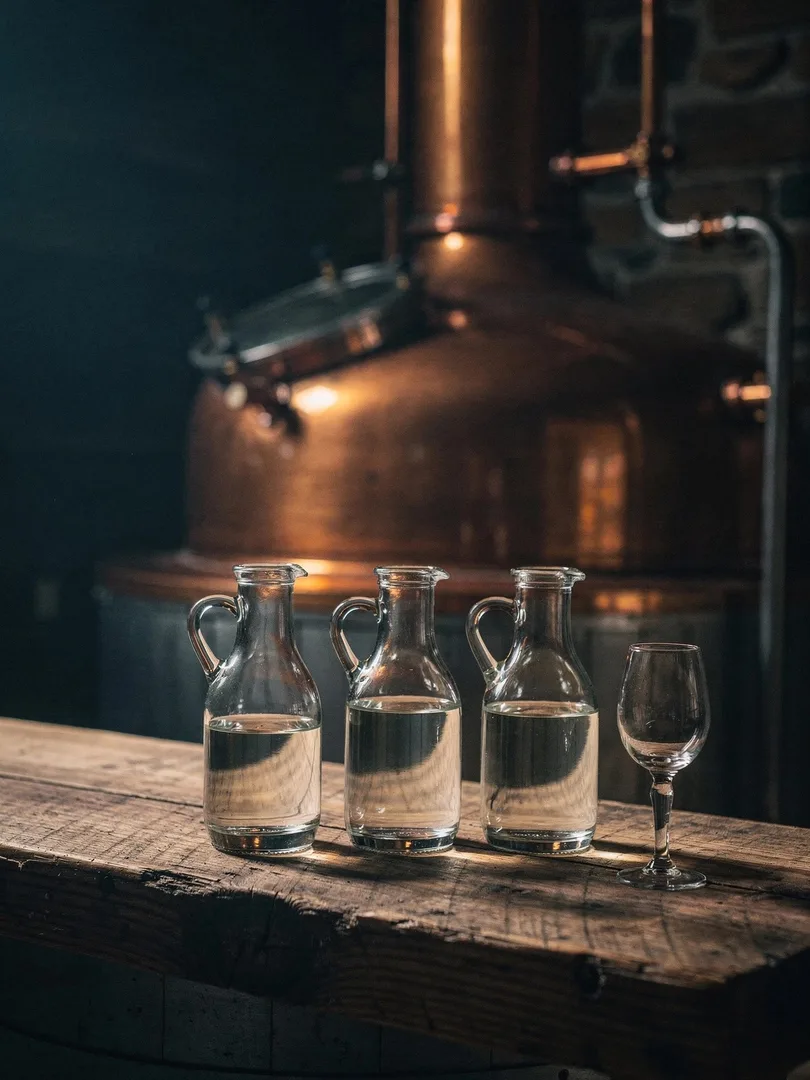
During distillation, the distillate is separated into three parts: the heads, containing sharp, highly volatile substances, are cut away; the heart, or middle run, becomes the spirit; the tails, containing heavy, fusel-like substances, are collected and often redistilled. Where the cuts are made shapes the style.
Why is the distillate separated at all?
A fermented mash contains far more than water and alcohol. It holds aldehydes, esters, higher alcohols, acids, and hundreds of other substances. They don't all evaporate at the same time. Highly volatile substances come off early, heavy substances come late, and many aromas fall somewhere in between. The distillate therefore changes from the first drop to the last.
The distiller makes use of this progression. He collects the distillate in separate vessels, switching between them at certain points. These switches are called cuts. A spirit from a pot still or enrichment column has two of these: one between the heads and the heart, and one between the heart and the tails. In a column, by contrast, the fractions are drawn off at different plates.
In terms of volume, the heads are small, the tails considerably larger, and the heart falls in between. At the still's head or at the outlet, thermometers and alcohol meters show how the vapor is changing. These readings give the distiller reference points, but every mash behaves a little differently. A ripe Williams pear calls for different cuts than a tart plum, and a wine for brandy calls for yet different ones again. Good distilleries therefore have no fixed recipes.
The heads: the front end with the solvent-like smell
What drips first from the condenser is called the heads. It smells sharp, like glue or nail polish remover. Mainly responsible are acetaldehyde and ethyl acetate, also known as acetic ester. These substances boil at a lower temperature than ethanol and therefore collect at the start. In the finished spirit, they would come across as harsh and unclean.
The specification for Zuger Kirsch / Rigi Kirsch AOP doesn't describe the cut with a number, but with the nose: the heads are cut away for as long as they smell of acetaldehyde and ethyl acetate. This wording shows nicely how distilling works. Measuring devices help, but the sense of smell has the final say.
It's often said that toxic methanol disappears along with the heads. This is only partly true. Methanol comes from the pectin in the fruit and is spread across a large part of the distillation run. Cutting away the heads can reduce the level, but not eliminate it. More on this is explained in the section on methanol.
The heart: the core of the spirit
After the heads comes the heart, also called the middle run or spirit run. It smells clean and distinctly of the fruit. This is what becomes the finished spirit. At the start it's strong, and as distillation proceeds, the alcohol content of the distillate coming off declines. For Zuger Kirsch, the heart must average at least 68% ABV.
How wide the heart cut is made is a stylistic decision. A narrow cut yields a very pure, elegant spirit, but costs yield. A wide cut brings more volume and more body, but risks unclean notes. Many distillers therefore taste small samples continuously and decide by nose and palate when the tails begin.
The tails: heavy substances at the end
Toward the end of the run, the distillate grows weaker and increasingly smells of fusel, like wet cardboard, soap, or cooked vegetables. This is the tails, also called the feints. They contain higher alcohols, known as fusel oils, along with other low-volatility substances. In small amounts, some of these contribute to a spirit's body; in large amounts, they make it coarse and dull.
The tails are usually not discarded. For Zuger Kirsch, they must be redistilled separately. In Cognac, heads and tails fractions may be added back into a later distillation run so that the alcohol they contain isn't lost. In this way, some of the alcohol passes through the pot still more than once.
The cut is therefore the point where craft and style show most clearly. Two distilleries can distill the same mash and yet bottle very different spirits, simply because they cut differently. So when you taste a spirit, you're also tasting the decisions made at the condenser.