Three Protected Origins
Calvados, Pays d'Auge, Domfrontais: The Three AOCs
Calvados comes in three protected designations: Calvados, Calvados Pays d'Auge and Calvados Domfrontais. They differ in pear content, distillation method and minimum ageing. Pays d'Auge is distilled only twice in a pot still, while Domfrontais is distilled only in a column still and must contain at least 30% pears.
Calvados AOC: The Largest Region with Free Choice of Distillation
The base appellation covers the largest area and accounts for the bulk of all bottles produced. Both cider from cider apples and perry from perry pears are permitted, with no fixed pear ratio required. Producers have a choice when it comes to distillation. They can run the cider through a pot still twice, what the French call "à repasse," or distil it in a column still in a single, continuous pass. The column must be made of copper, have several plates, and may process no more than 250 hectolitres of cider in 24 hours.
This cap keeps distillation at an artisanal scale, even at large houses. All three designations share certain rules: the distillate must stay below 72% ABV, it must mature in oak, and it must be bottled at a minimum of 40% ABV. For the base appellation, two years in cask is sufficient. So a label that simply reads Calvados tells you little about the production method. Houses therefore often specify the still themselves, since for many connoisseurs it carries a promise of quality.
Calvados Pays d'Auge: Double-Distilled in the Pot Still
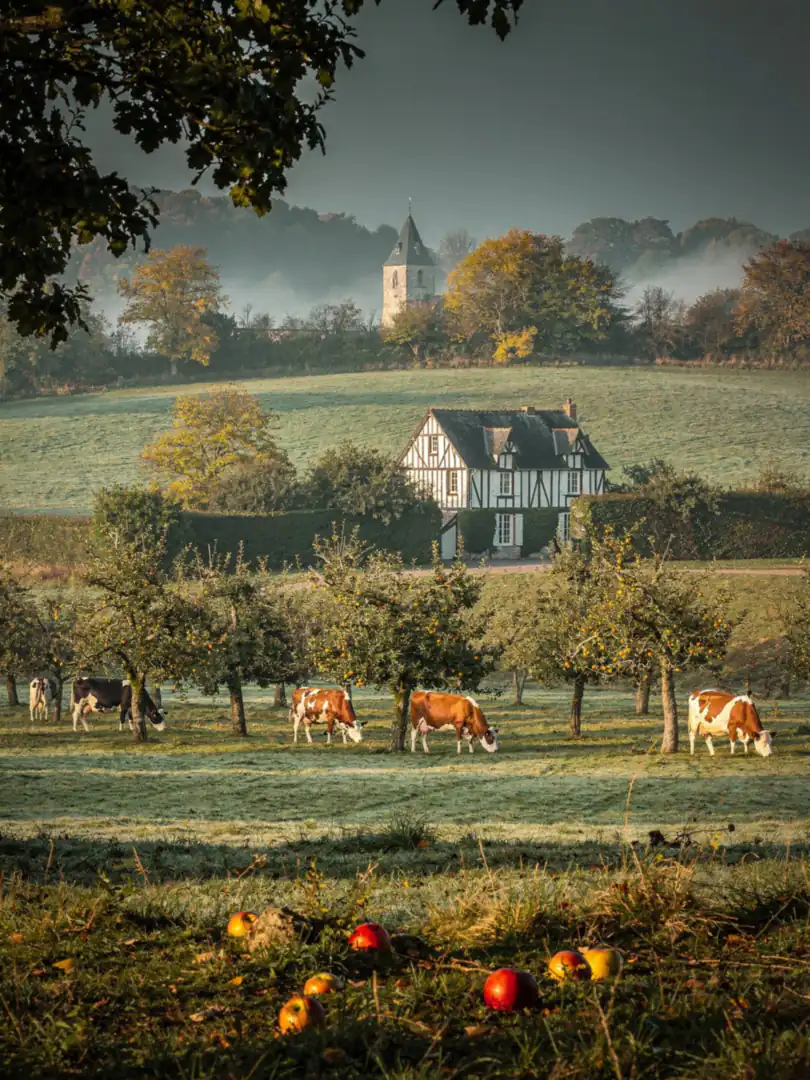
The Pays d'Auge lies in eastern Normandy, around Lisieux and Pont-l'Évêque, a hilly landscape of half-timbered farms, pastures and old standard orchards. Here the strictest distillation rules apply. Only double distillation in a pot still is permitted; column stills are excluded. The cider may contain at most 30% perry pears, so apples clearly set the tone. And fermentation must last longer: the current specification requires a minimum of 42 days, compared with 21 previously.
The long fermentation and the double pass through the pot still are meant to produce a dense, layered spirit that can withstand many years in cask. Well-known names from the region include Boulard, in business since 1825 according to its own history, Roger Groult, distilling since 1860, and Christian Drouin in Coquainvilliers, founded in 1960. Père Magloire in Pont-l'Évêque cites 1821 as the start of its distilling tradition. Such dates come from the producers themselves and should be read as company claims.
Calvados Domfrontais: Pears and the Column Still
To the south, around the town of Domfront, enormous old pear trees grow in heavy soils. This defines the smallest of the three designations. Calvados Domfrontais must contain at least 30% perry pears, and many producers use considerably more. The region's signature variety is Plant de Blanc, a pear that's barely edible raw because it's astringent and high in tannin. In perry and in the finished spirit, it contributes freshness, acidity and a bright, floral aroma.
In Domfrontais, distillation happens exclusively in a column still. At first this seems to contradict the Pays d'Auge approach, but it's intentional: the single, continuous pass better preserves the delicate pear aromas. To ensure the spirit still gains depth, the specification requires a minimum of three years in oak cask, one year longer than for the other two designations. Those familiar with Armagnac will spot a parallel, since single-pass column distillation is also the main method used there.
Which Calvados Origin Is the Best?
The law recognises no hierarchy among them. The three appellations describe styles, not quality tiers. A well-made column-distilled Calvados can come across as fresher and fruitier than some pot-still examples, while an aged Pays d'Auge shows more weight and length. What matters most is the fruit, the care taken during fermentation, the casks, and patience in the cellar. The age statement on the label, too, often says more about the flavour than the designation of origin alone.
One peculiarity concerns ageing. It may take place anywhere within the broader area covered by the older designation "Eau-de-vie de cidre de Normandie," established by decree in 1963. This designation remains its own protected name in the EU register today, as does "Eau-de-vie de poiré de Normandie" for pure pear brandy. Both are spirits distilled from cider or perry made in Normandy, but neither may be called Calvados, since they don't have to meet the rules of the appellations.