Rest Without Wood
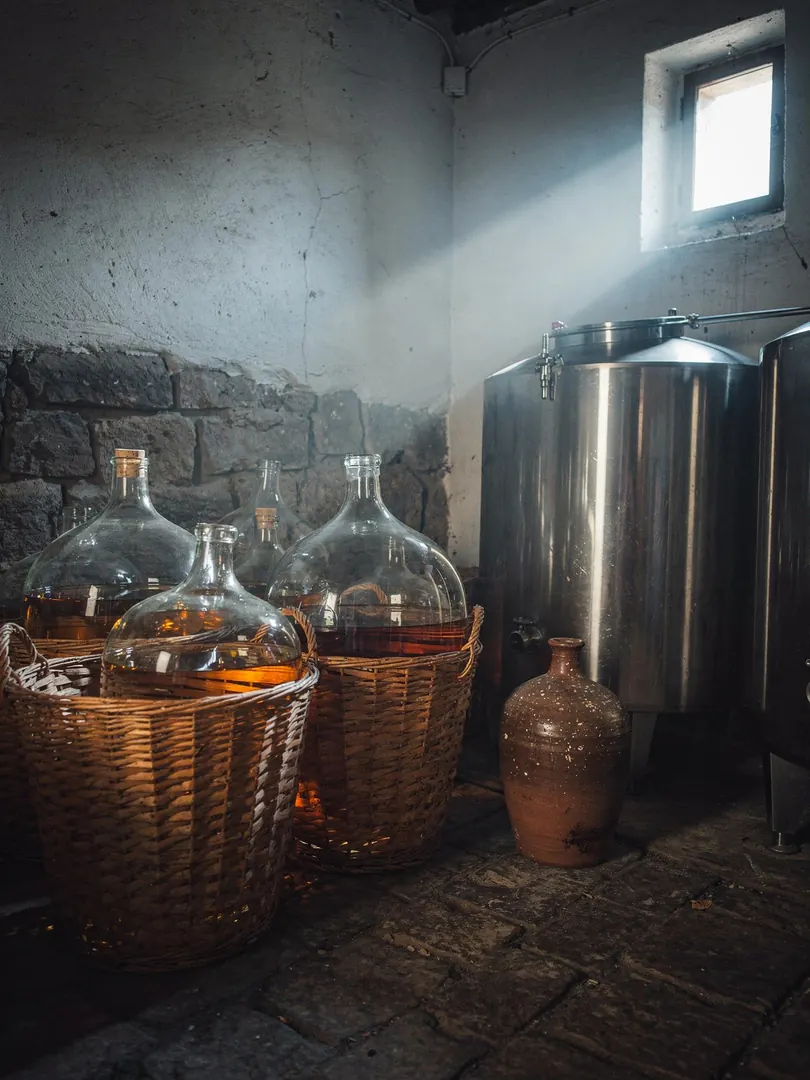
Glass Demijohn, Stainless Steel, Earthenware: Maturation Without Wood
Without wood, a spirit rests in glass demijohns, stainless steel tanks, or, in earlier times, earthenware. These vessels release neither color nor flavor, yet the distillate still rounds out over months of rest. Zuger Kirsch must be stored for at least six months, Pisco from Peru for at least three.
Why a Freshly Distilled Spirit Needs to Rest
Right after distillation, a spirit often tastes sharp and unsettled. Distillers say it's "fiery" or not yet "married." The aroma feels disjointed, with individual notes sticking out. After a few months of rest, the same spirit becomes rounder, and the fruit character feels more integrated.
What exactly happens during this process is only partly understood. Highly volatile compounds escape if the vessel isn't completely sealed. Acids and alcohol slowly react to form esters, which are fruity-smelling compounds. A touch of oxygen in the vessel alters certain aromas. After the spirit is reduced with water to drinking strength, the blend also needs time to settle.
How long a spirit rests is generally up to the distiller. Many let their fruit brandies sit for six months or longer, and some kirschwassers rest considerably longer than that. By law, there's no minimum resting period set for fruit spirit.
Glass Demijohn, Stainless Steel, Earthenware: Comparing the Vessels
The glass demijohn is the classic vessel of small distilleries. We're talking about bulbous glass bottles ranging from a few liters up to roughly fifty, often housed in a wicker basket or plastic sleeve, known in French as dame-jeanne or bonbonne. Glass is completely neutral, it releases nothing and absorbs nothing. Its drawback is light. In stone fruit spirits, light exposure can turn trace amounts of hydrocyanic acid into ethyl carbamate, a substance classified as carcinogenic. That's why glass demijohns belong in a dark room.
Stainless steel tanks are now standard in larger distilleries. They hold hundreds or thousands of liters, are easy to clean, and block out light. In terms of flavor, they behave just like glass, remaining neutral.
Earthenware and clay were common in the past, before glass and steel became cheap. Today they're a rarer sight. In Peru, clay vessels are still among the containers explicitly approved for resting Pisco.
What the Rules Require: Zuger Kirsch, Pisco, Blanche Armagnac
Some regional regulations set a minimum resting period. The specification for Zuger Kirsch or Rigi Kirsch, a Swiss Protected Designation of Origin (PDO), requires storage of at least six months after distillation. It's sold at a minimum of 40% ABV. The specification doesn't require wood aging.
For Pisco from Peru, the national standard requires a rest of at least three months in containers that don't alter its properties, such as glass, stainless steel, or clay. Wood is excluded, as is water: the spirit is distilled directly to drinking strength, between 38 and 48% ABV.
France also has a regulated colorless wine spirit. Blanche Armagnac must rest for at least three months in a vessel that imparts no color, and may not be colored. It belongs to the Armagnac AOC, though it's not a separate entry in the EU register.
Paradis: Where Old Cognacs Stop Aging in Glass
Glass also plays a role at the other end of maturation. Many Cognac houses have a special cellar known as the Paradis. There, very old distillates that the cellar master has transferred from cask into glass demijohns are stored. The reason: beyond a certain point, further time in wood would only make the spirit bitter and dry.
In glass, the spirit retains the state it had reached at the moment of transfer. Nothing more evaporates through the vessel wall, and no further wood character is added. Such reserves later serve as seasoning for blends.
For connoisseurs, there's a simple lesson here. Maturation in the true sense only happens in wood. In glass, a spirit grows calmer, but not older in flavor. The same holds true for the bottle sitting in your own cabinet, more on that in the final stop of this journey.