Greece and Cyprus
Tsipouro, Tsikoudia, Zivania: pomace brandy from Greece and Cyprus
Tsipouro and Tsikoudia are Greek pomace brandies, while Zivania is Cyprus's pomace brandy. Tsipouro comes both with and without anise, while Tsikoudia from Crete is distilled without anise. Despite the similar-sounding nickname Raki, they shouldn't be confused with Turkish Rakı, an anise-flavored spirit.
What is Tsipouro? Greece's pomace brandy
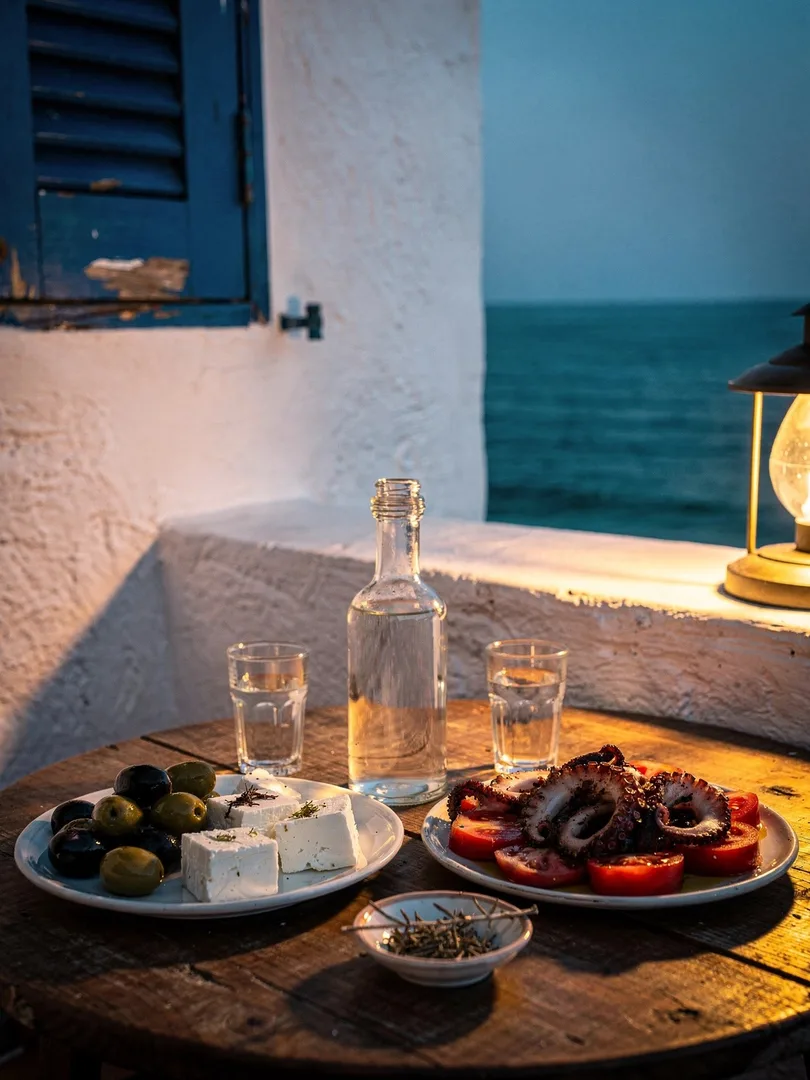
In northern Greece, a carafe of Tsipouro is often ordered to accompany meze, the small plates of olives, cheese, and grilled fish. It's distilled from the pomace left after pressing and legally falls into the same EU category as Grappa and Marc. Distillation begins after the grape harvest; in many villages, gathering around the still in autumn was long a shared community event.
Several Greek pomace brandies are registered in the EU register: Tsipouro from Macedonia, from Thessaly, and from Tyrnavos, Tsikoudia from Crete, along with a broader designation 'Tsikoudia / Tsipouro.' Tyrnavos is a small town in Thessaly with its own protected status. According to the technical file, at least half of the pomace there must come from designated grape varieties, chief among them Moschato Tyrnavou, a Muscat variety.
Tsipouro with or without anise?
The most common question about Tsipouro concerns anise. Both versions exist. For Tsipouro from Tyrnavos, the technical file describes flavoring with anise, fennel, or star anise as common practice; the seeds are added during distillation there. In northern Greece, anise-flavored Tsipouro is widespread, while it's noticeably rarer in the south. Without anise, Tsipouro tastes purely of pomace and grape; with anise, it resembles Ouzo.
Still, the two shouldn't be confused. Ouzo is an anise-flavored spirit in which anise takes center stage, and the alcohol base doesn't have to come from pomace. Tsipouro is first and foremost a pomace brandy; the anise version is a regional variation. If you want to taste the grape itself, ask for Tsipouro without anise — in Greek, 'χωρίς γλυκάνισο.'
In Greece, Tsipouro is almost never drunk alone. In Volos and other towns in Thessaly, there are dedicated establishments for it, the Tsipouradika: you order a small bottle, and with each round, a new plate of meze arrives. The brandy accompanies the meal rather than closing it. When diluted with water, anise-flavored Tsipouro turns milky and cloudy, while Tsipouro without anise stays clear.
Tsikoudia and Raki: the name on Crete
On Crete, guests are often served a small glass of clear spirit after a meal, unasked, with the claim that it's Raki. What's actually meant is Tsikoudia, Crete's pomace brandy, protected as Tsikoudia of Crete. It's distilled without anise and is colorless. In autumn, families and neighbors on the island gather around the still as the harvest's pomace is processed.
The nickname Raki is misleading. Turkish Rakı is an anise-flavored spirit based on grape distillate and is traditionally drunk diluted with water, turning milky. Rakija, meanwhile, is the umbrella term in the Balkans for fruit and grape brandies, ranging from Šljivovica made from plums to Loza made from grapes. Tsikoudia is neither of these — it's an anise-free pomace brandy that just happens to share a colloquial name.
Zivania: Cyprus's pomace brandy
Cyprus has its own pomace brandy, Zivania, registered in the EU register as a geographical indication. It's distilled from a mixture of grape pomace and dry local wine, primarily from the native varieties Xynisteri, a white grape, and Mavro, a red grape. A Cypriot law from 1965 describes it as a product of the first distillation of wine, grapes, and pomace.
Zivania is colorless and potent, and in Cyprus it's typically enjoyed well-chilled from small glasses alongside meze. According to tradition, it was once used as a home remedy for rubbing on sore muscles and treating colds, though no proven healing effect exists. For classification purposes, what matters is this: Zivania is a pomace brandy with a wine component, not a wine brandy, and it typically doesn't age in wood.