Pomace in the East
Chacha and Törkölypálinka: pomace brandy in Georgia, Hungary, and the Balkans
Chacha is Georgia's pomace brandy and was registered there in 2011 as the country's first geographical indication. Törkölypálinka is Hungary's pomace brandy, made from Hungarian pomace. In the Balkans, pomace features in some Rakija, though many grape-based spirits there are legally classified as fruit brandy or wine distillate.
What is Chacha? Georgia's pomace brandy
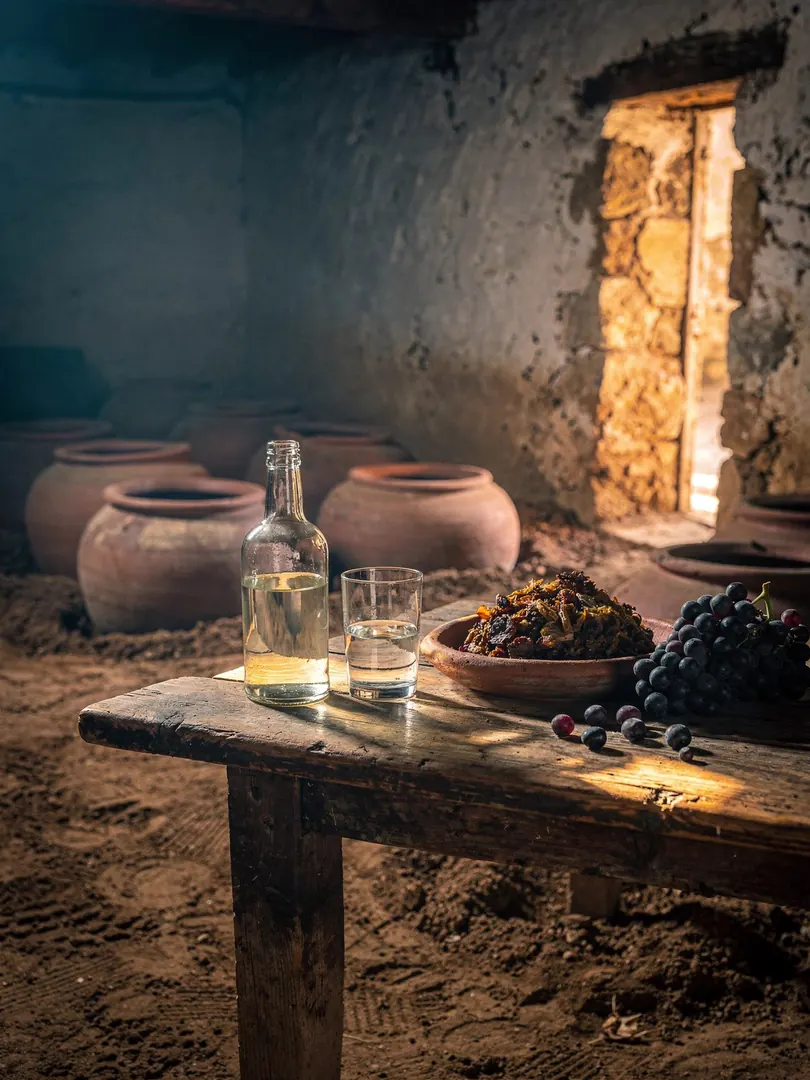
Georgia is one of the oldest wine-producing countries in the world, and wherever large amounts of wine are pressed, large amounts of pomace remain. From this, Georgians have distilled Chacha for generations — a clear, potent spirit that's often homemade and served at celebrations. The raw material is grape pomace, and for the protected designation of origin from 2011, exclusively so.
On December 13, 2011, Chacha was registered with the Georgian patent office Sakpatenti as the country's first geographical indication. Chacha does not appear in the EU's eAmbrosia register. However, names from non-EU countries can be protected within the EU through bilateral agreements, and the register doesn't fully capture such cases. For a reliable judgment on EU protection, checking the register alone is therefore not sufficient.
Chacha has little in common with Georgian brandy. Brandy, produced in Georgia by houses such as Sarajishvili since 1884, is distilled from wine and aged in oak. Chacha, by contrast, comes from pomace and is usually drunk young and colorless; aged chacha with a wood-derived color does exist, but it remains the exception.
Home-distilled chacha from a family cellar is often poured at high strength and isn't officially tested. Travelers offered such chacha should keep this in mind: a properly produced pomace brandy stays within legal limits for methanol, but there's no way to know this for an uncontrolled, unregulated distillate. Commercially sold chacha carries a clear alcohol content statement and comes from certified production.
Törkölypálinka: Hungary's Pomace Brandy
In Hungary, most people associate pálinka with brandies distilled from plums, apricots, or pears. Alongside these stands törkölypálinka, literally "pomace pálinka." Hungary regulates both under the same 2008 law, Act LXXIII on Pálinka and Törkölypálinka. Under this law, only spirit distilled from grape pomace grown in Hungary, in accordance with EU rules for pomace spirit, may be called törkölypálinka; fermentation, distillation, maturation, and bottling must all take place in Hungary.
Pomace to which sugar has been added is excluded. This clearly distinguishes törkölypálinka from fruit-based pálinka, which is classified as a fruit spirit. Both names are registered in the EU register as geographical indications, with törkölypálinka falling under the pomace spirit category and pálinka under the fruit spirit category.
Pomace in the Balkans: Komovica, Loza, and Grozdova
In the Balkans, nearly all spirits go by the name rakija, and this umbrella term tends to obscure the differences between them. A spirit distilled from pomace is often called komovica there. There are also spirits made from whole grapes or from wine, and for these in particular, a look at the EU register proves helpful. Hrvatska loza, the Croatian loza, is registered there as a grape spirit, not as a pomace spirit.
Bulgaria shows this even more clearly. The country's ten protected grape rakias, from places like Karlovo, Sliven, or Pomorie, appear in the register under the Spirit Drink category, meaning they're wine distillates. A name containing the word for grape therefore tells you little about whether wine, whole grapes, or pomace went into the still.
How to spot genuine pomace brandy on the shelf
With so many names in play, the sales denomination, the legally required term on the label, is what helps. If it reads pomace brandy, marc, grappa, orujo, tsipouro, or törkölypálinka, the raw material is pomace. Brandy or wine spirit means wine was the raw material, while fruit brandy means whole fruit.
On bottles from countries outside the EU, such as Georgian chacha, this designation for the European market usually appears as an addition on the back label. If it's missing, or if the label simply says spirit drink, caution is warranted: the bottle may contain a blended alcohol instead.