Points and judges
How are spirits rated? The 20-point and 100-point scales
Spirits are rated blind according to fixed criteria, usually on a 20-point or 100-point scale. What's assessed is aroma and purity, character and fruitiness, taste, and balance and harmony. For Zuger and Rigi Kirsch, a commission decides every year whether a spirit may carry the name.
How are spirits rated? Blind and by criteria
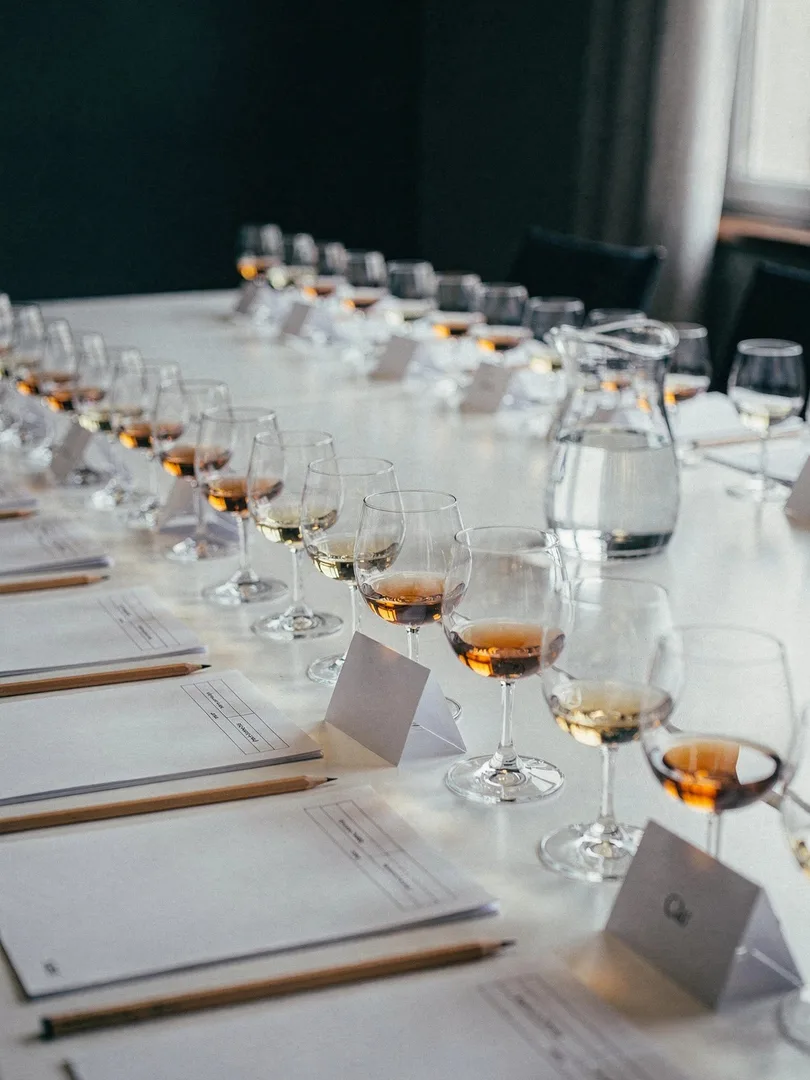
A serious evaluation begins with nobody knowing what's in the glass. The samples stand anonymously side by side, numbered rather than labeled. That way, neither a well-known name nor an attractive bottle can sway the judgment. Experts call this blind tasting.
Then it's assessed according to fixed criteria. For Zuger Kirsch and Rigi Kirsch, a protected designation of origin in Switzerland, the code of practice names at least four criteria: aroma and purity, character and fruitiness, taste, and balance and harmony. Purity means no off-notes such as solvent, vinegar, or must can be found. Character means the spirit clearly smells and tastes of its fruit. Harmony describes how alcohol, aroma, and body come together.
The 20-point scale and the 100-point scale
The older and simpler method is the 20-point scale. In the classic Swiss form, as described by the trade journal Agrarforschung, each of four criteria can earn up to five points: for cleanliness of aroma, typicity of the fruit, taste, and harmony. A spirit scoring 20 points would be flawless in all four areas.
The 100-point scale breaks down the same questions more finely. With it, judges can capture small differences between two good spirits more precisely than with just five levels per criterion. Many international competitions use the 100-point scale. However, how they distribute points across aroma, taste, and overall impression, and at what score a medal is awarded, is decided by each organizer individually.
For Zuger and Rigi Kirsch, both systems are permitted, each based on the scales developed by Agroscope, the Swiss federal agricultural research center. For recognition, a spirit needs at least 16 out of 20 or at least 80 out of 100 points. Both thresholds therefore sit at four-fifths of the maximum score.
The Zug tasting commission: who decides on the name
Most origin rules for spirits define where the fruit comes from and how the spirit is distilled. Zuger and Rigi Kirsch go a step further. Here, the finished product is also sensorially assessed every year, in a blind tasting of anonymous samples.
The tasting commission is appointed by the group that applied for protection. It must include cherry producers, distillers, consumers, and sensory specialists, meaning experts in trained sensory evaluation. Recognized experts train the members. The details are set out in a scoring regulation based on the rules of Distisuisse, Switzerland's national spirits competition.
Anyone who falls short of the minimum score may not sell their kirsch as Zuger Kirsch or Rigi Kirsch. The spirit isn't spoiled, it simply doesn't meet the requirement for the designation of origin.
Putting medals and scores in perspective
Many bottles carry medals from competitions. They indicate that the spirit achieved a certain score in a specific competition at a specific point in time. That's useful information, but no guarantee for every later bottling. Producers enter their spirits voluntarily, and by no means do all good distilleries take part. A missing medal, therefore, means nothing.
Anyone tasting at home can use the same criteria as a guide. Does the spirit smell clean? Can I recognize the fruit? How does it taste, and does everything come together? A few notes on these questions turn a small glass into a mini tasting, and after a few samples, your own judgment sharpens noticeably.