Diluting with care
A drop of water in your spirit?
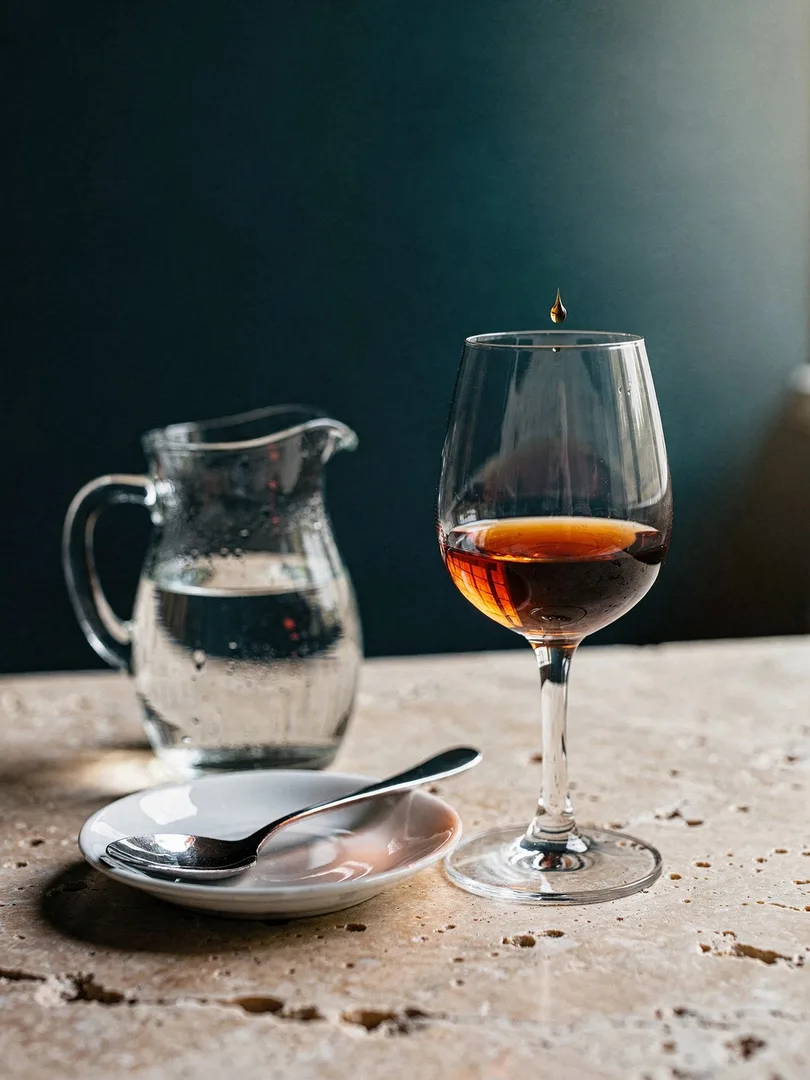
A few drops of water can open up a spirit: they soften the alcoholic sharpness, and some aromas come through more clearly. With fruit brandies around 40 percent, this is rarely needed, but with robust cask-strength spirits, it's worth trying. What matters is still, low-mineral water in small amounts.
Water in the spirit: what actually happens
Alcohol numbs the nose. At high strengths it masks finer aromas, and some people then perceive only sharpness. A little water lowers the alcohol content in the glass, the sharpness fades, and aromas that were previously hidden become noticeable.
For whisky, there's a widely cited study on this. In 2017, Swedish chemists Björn Karlsson and Ran Friedman showed in the journal Scientific Reports, using computer simulations, that the smoky aroma compound guaiacol concentrates more strongly at the liquid's surface at lower alcohol levels. There it can evaporate more easily and be detected by smell. The finding applies to one specific compound in whisky. It can't be applied to every fruit brandy, but it does explain why water can change the aroma at all.
Every spirit is already made with water
Adding water to a spirit is essentially continuing what the distiller started. A fresh distillate comes off the still at a much higher strength than it will later be in the bottle. For Zuger Kirsch, the heart, the drinkable part of the distillate, must average at least 68 percent alcohol. It reaches drinking strength through proofing down, meaning dilution with water.
Which water is used matters a great deal to many distillers. The Zug code of practice prescribes softened, demineralized water or spring water with low mineral content, so that no limescale and no inherent flavor clouds the spirit. A well-known exception is Peruvian Pisco: it's distilled directly to drinking strength without any water added, and bottled at 38 to 48 percent.
Legally, minimum values apply for sale: 37.5 percent for fruit brandy, fruit eau-de-vie, and pomace brandy, 36 percent for brandy, 40 percent for Cognac and Calvados. What you dilute yourself in the glass is, of course, your own business.
When a drop of water helps, and when it doesn't
Water does the most good with very robust spirits. Some Cognacs, Armagnacs, or oak-aged fruit brandies are bottled undiluted straight from the cask, well above 50 percent. Here, a few drops often open up aromas that would otherwise be hidden behind the alcohol.
With a fine fruit brandy bottled at 40 to 42 percent, the distiller has usually chosen the drinking strength deliberately. Additional water then tends to make the spirit thin and watery. Anyone wanting to try it should add the water drop by drop, ideally with a teaspoon or pipette, and compare it against a second glass without water. Carbonated water and lime-heavy tap water aren't suitable, as they bring their own notes along.
Cloudiness, ice, and anise: where the limits lie
A fruit brandy stays clear even when water is added. It's different with anise spirits like Turkish Rakı, Greek Ouzo, or French Pastis. Their essential oils dissolve in alcohol but poorly in water, so they turn milky and cloudy when diluted. Rakı is made from grapes, but it's an anise spirit, not a brandy.
Ice cubes aren't a good substitute for a drop of water. They release their water unevenly and chill the spirit so much that the aroma falls silent. If you want to dilute a spirit to understand it better, stick with water. If you want it cold and refreshing, you're better off with a long drink or cocktail.
Water alongside the glass: the most important companion when tasting
Whether water belongs in the spirit is a matter of taste. That water stands alongside it is a given at any serious tasting. A sip of still water between two samples rinses alcohol and lingering aromas from the mouth, so the next spirit isn't overshadowed by the previous one.
Anyone tasting several spirits in a row also notices how quickly the senses tire. Water, a short break, and a piece of neutral white bread help keep your judgment fresh. There's also a simple rule: every glass of spirit should be matched by at least one glass of water. This is easier on the body and makes the tasting more honest, since you can keep distinguishing clearly for longer.