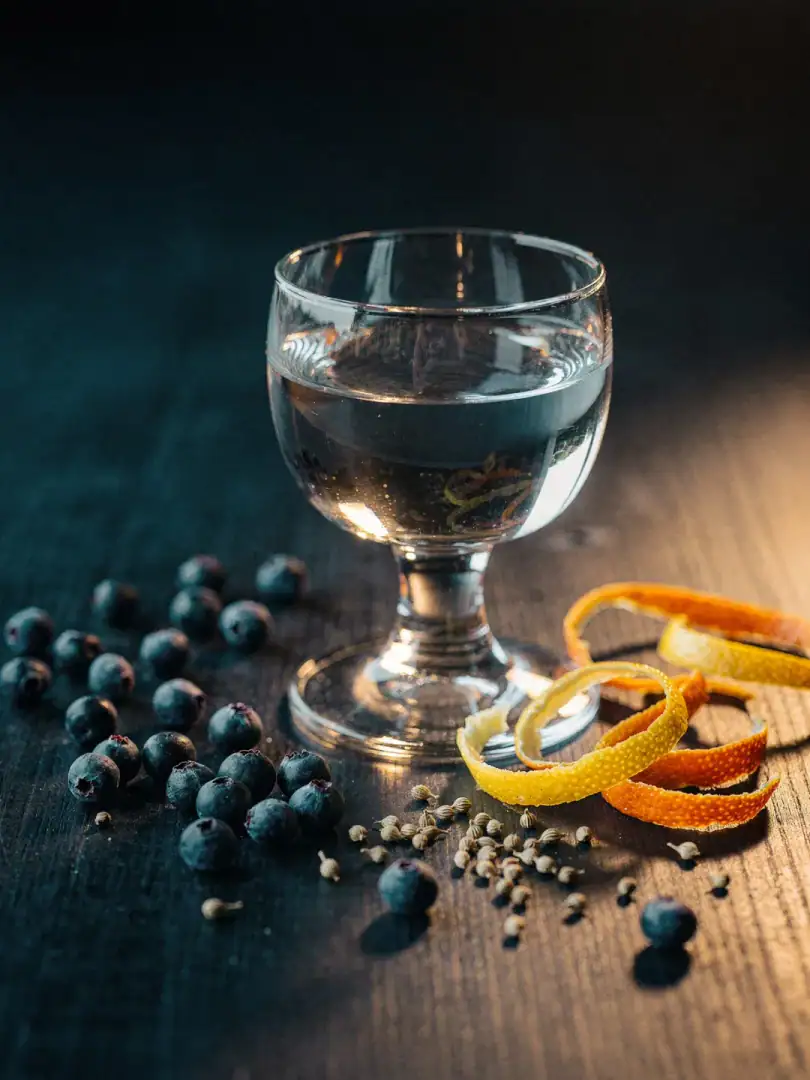
Recognizing Juniper, Organizing Aromas
Nose
Most of what we perceive as flavor actually comes through the nose. Learning to recognize juniper specifically and organize aromas makes tasting gin a much more deliberate process.
Why the Nose Matters More Than the Tongue
The tongue only distinguishes a few basic tastes: sweet, sour, bitter, salty, and savory. Everything beyond that — citrus, herbs, spices, florals — we perceive through our sense of smell, even while drinking. Aroma compounds rise up through the throat to the nose when swallowing, a process known as retronasal smelling. That's why it's worth smelling deliberately before every sip: what the nose picks up beforehand is usually just confirmed later in the mouth.
When smelling, it helps not to hold the glass directly under your nose, but to start at a distance and gradually move closer. Inhaling too deeply or too quickly numbs the olfactory receptors with alcohol vapor, leaving you barely able to smell anything for a moment afterward. Short, calm breaths reveal more than a single deep inhale.
Recognizing Juniper as the Foundation
Juniper is the ingredient that must define every gin by definition — without its aroma, the spirit wouldn't be gin at all. Juniper smells resinous, slightly pine-like, sometimes reminiscent of a coniferous forest, with a subtle sharpness in the background. In many classic gins, such as those in the London Dry style, this note stands clearly in the foreground and remains noticeable even after citrus or herbal notes appear.
Not every gin brings juniper forward equally. More modern styles often work with a subdued juniper character, letting citrus fruits, florals, or cucumber take the lead instead. That's not a flaw, but a stylistic choice by the distillery. If you search for and name the juniper first when smelling, you've already answered the most important question of gin nosing: is it the backbone here, or just one of several equally weighted ingredients?
Organizing Aromas into Groups
After identifying the juniper, it's worth sorting the remaining aromas into broad groups rather than trying to guess every single botanical. Typical groups include: citrus (orange peel, lemon, grapefruit), spices (coriander, cardamom, allspice), earthy notes (angelica root, licorice), and florals (iris, lavender, elderflower). This grouping is entirely sufficient for a solid assessment, even without being able to name every ingredient exactly.
It also helps to pay attention to the order in which aromas appear: some notes emerge immediately, others only after a few seconds. This sequence reveals a lot about the recipe — gins with many different botanicals often show a succession of aromas, while simpler recipes release everything at once. Taking notes like "juniper first, then citrus, finally a touch of pepper" trains your nose further with every tasting.
Training Your Own Nose
Like any sense, the nose can be trained. If you regularly smell individual ingredients deliberately — fresh juniper, lemon peel, coriander seeds — you store these impressions in memory and recognize them much faster later on in gin. A simple exercise is to briefly smell the raw botanicals themselves before a tasting, if they're available, and then search for those impressions in the finished gin.
Comparison also helps with training. Smelling two gins with clearly different styles one after another makes it easier to notice differences than smelling a single gin in isolation. Over time, recognizing individual aromas becomes a habit, much like learning new words in a language. At first it requires conscious concentration, but later the recognition happens almost automatically. If you like, keep a small scent journal noting which botanicals you identified in which gin. After a few weeks, looking back will show just how much more confident your nose has become.