Column or Pot
Distillation
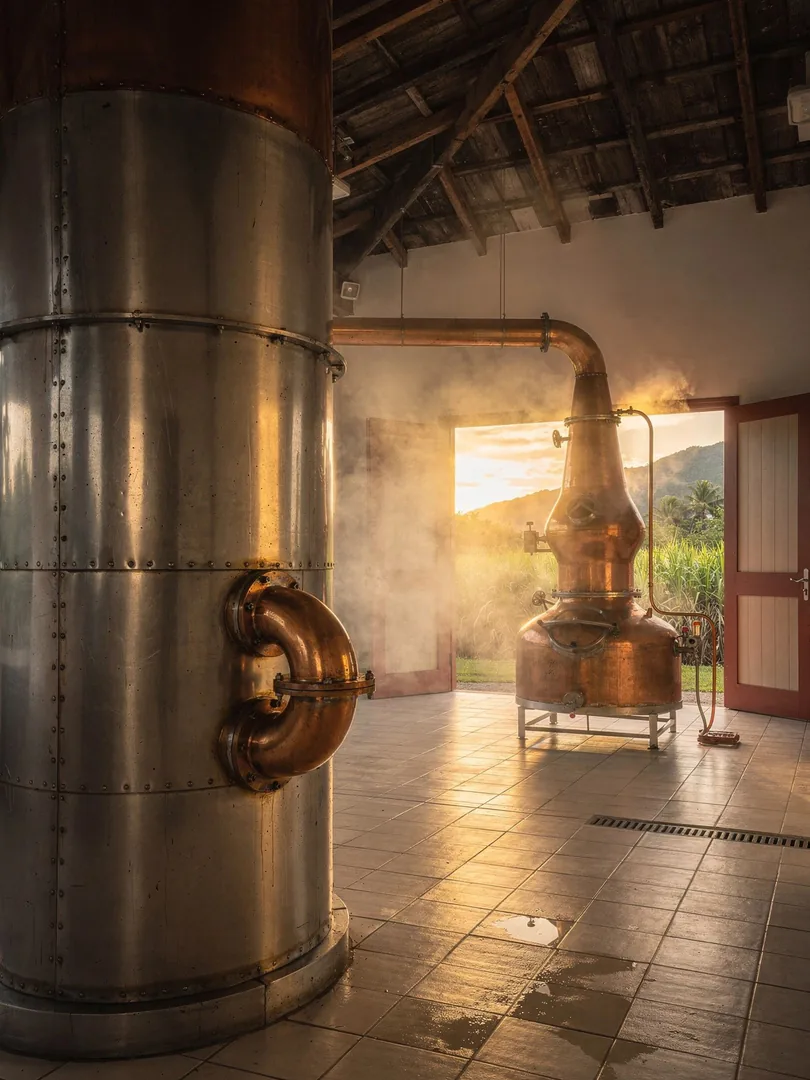
A stainless steel column stands in the still house at Reimonenq in Sainte-Rose. Steam rises through plates where the alcohol becomes more concentrated with each stage, and a high-proof distillate flows out at the top. Only the alcohol and volatile aroma compounds rise; water and residues remain in the kettle. The system runs continuously as long as mash keeps flowing in.
The pot still, by contrast, works in batches: fill, heat, collect, empty. From each batch, only the heart is separated out, with the heads and tails collected separately. The distillate is usually heavier and oilier. The Rhum de la Guadeloupe PGI allows both methods — columns as well as pot stills with a column attachment, whose kettles may hold no more than 30 hectoliters.
In the French Antilles, the Creole column has become the standard — a column with few plates that deliberately doesn't filter out all the aroma. The rum retains notes of cane, grass, and pepper. Neutral spirit would be the opposite: in the EU, rum must stay below 96 percent alcohol, and the PGI requires a minimum level of aroma compounds.
After distillation, the spirit is brought down to drinking strength with water. White agricole usually goes into the bottle at 40 to just over 50 percent, with the PGI setting 40 percent as the minimum. How much it's diluted shapes the profile: at 40 percent a rum feels milder, at 50 percent the aromas stay more pronounced. What remains in the column, the vinasse, is a boiled-out, sour liquid with no alcohol.
The houses each set their own accents. Bologne carries the state label Entreprise du Patrimoine Vivant, which recognizes living craftsmanship. Longueteau organizes its range into lines such as Classique, Harmonie, Genesis, and Parcellaires, the last name pointing to single parcels. Karukera doesn't distill itself but sources distillate from distilleries on the island and focuses on aging and finishing.