Short or Long
Fermentation
Twenty-four to forty-eight hours — that's how long sugarcane juice ferments at Reimonenq in Sainte-Rose, according to the house. That's short, fitting for a juice that spoils if left waiting. At Montebello in Petit-Bourg, by contrast, Grégory Marsolle has favored a long fermentation since 2016.
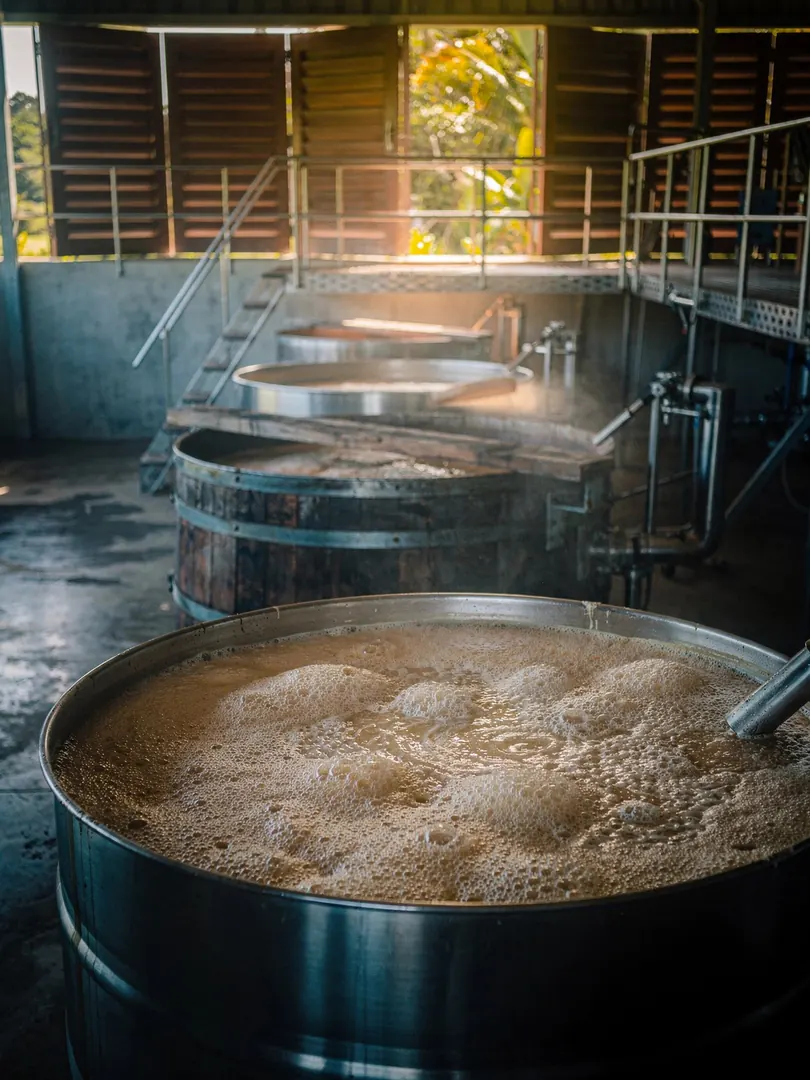
Fermentation begins as soon as yeast reaches the sugar in the juice. These single-celled organisms consume sugar and release alcohol, carbon dioxide, and heat; the vat foams and smells of bread and fruit. The warmer the juice, the faster the yeast works. It either comes from the surface of the cane, in which case it's called wild yeast, or it's added as a cultured strain. Wild yeasts bring diversity, cultured yeasts bring consistency.
Heat is the real challenge in the tropics. If fermentation runs too hot, the yeast dies off or produces unwanted byproducts. That's why stainless steel vats are common — they can be cooled and kept clean — while wooden vats harbor their own microorganisms and shape the mash more distinctly. After one to two days, the juice has become a thin, cloudy mash, a cane wine of just a few percent alcohol.
Esters arise from the interplay of yeast and fermentation time. These are compounds formed from acids and alcohol, carrying fruit and floral notes. They are not an added ingredient but a byproduct of fermentation that cannot be added afterward. Esters belong to the volatile compounds measured in grams per hectoliter of pure alcohol. Rhum de la Guadeloupe must reach at least 225 grams, as required by the PGI specification.
In the glass, the difference shows like this: a short fermentation preserves the grassy, fresh character of the cane. A longer fermentation brings in fruit, spice, and florals, making the rum broader. Both approaches can be found on Basse-Terre, and neither is inherently better — they simply aim at different palates.