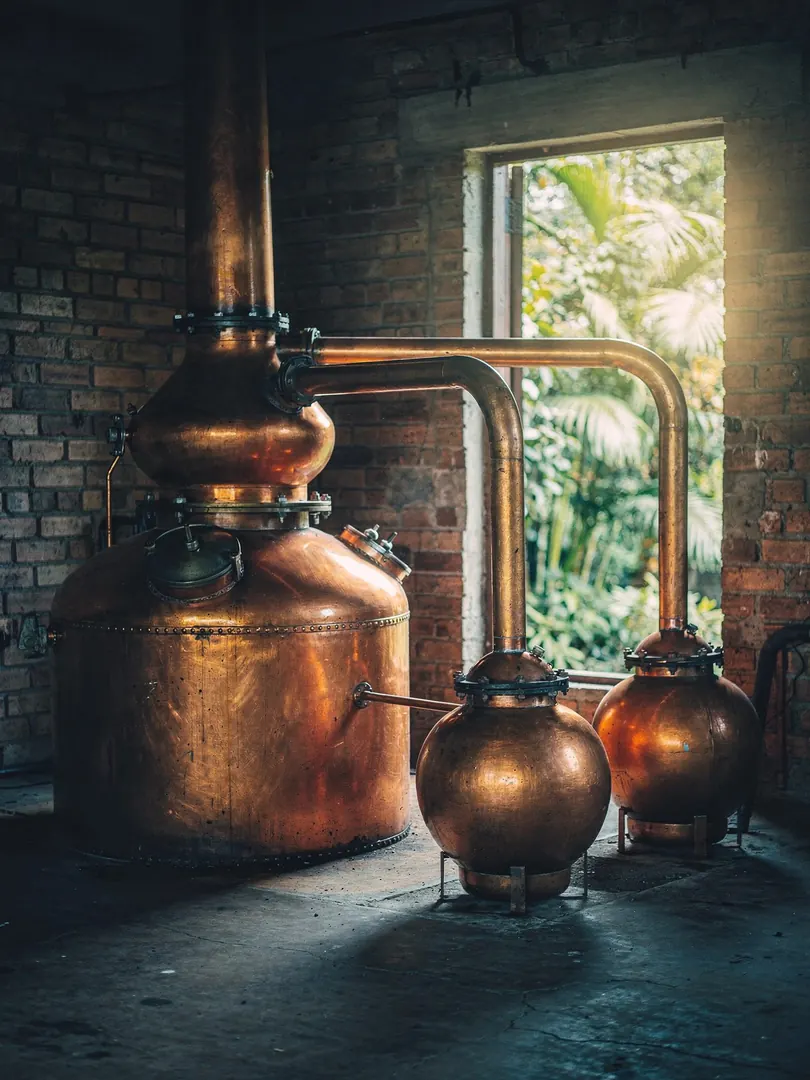
Pot Still & Retorts
Pot Still and Double Retort: Stills for Heavy Rum
A pot still is a copper still that distills rum in batches, letting many flavor compounds pass into the distillate. In Jamaica and Barbados, two retorts are often attached behind it: this double retort achieves in a single run what would otherwise require two separate distillations.
How Does a Pot Still Work for Rum?
The simple pot still looks like a large kettle with a neck. The wash sits at the bottom, while above it the head narrows into a pipe leading to the condenser. As the still heats, alcohol-rich vapor rises, is cooled, and drips out as distillate. After a few hours, the alcohol has been drawn from the kettle. The still is then emptied and recharged. Distillers call this batch distillation.
A single run only brings the wash up to a moderate strength. Scotch whisky distillers therefore distill twice: the first run yields low wines (weak raw distillate), the second produces the final spirit. Rum often took a different path. Instead of heating the kettle twice, distillers attached additional vessels, through which the vapor is further enriched on its way to the condenser.
What Is a Double Retort?
A retort is a sealed copper vessel positioned between the kettle and the condenser. In a double retort, there are two in sequence. Before the run begins, the distiller fills the first retort with weak distillate from previous runs, and the second with stronger distillate. Industry sources cite roughly 30 to 35 percent for the first, and 55 to 75 percent for the second. Vapor from the kettle bubbles through both liquids, heating them and picking up alcohol and aroma compounds.
This produces, in a single run, a distillate that can range from about 80 to 85 percent depending on the distillery, sometimes higher. The weaker fractions from the beginning and end of the run flow back into the retorts. Each batch thus carries something forward from the one before. This cycle saves energy and time but demands experience. Fill the retorts incorrectly, and you shift the flavor profile of an entire day's distillation.
Why Pot Still Rum Tastes Heavier
A pot still separates coarsely. It has few plates or trays where heavy compounds could be held back. As a result, more esters, acids, and higher alcohols make it into the rum than with a tall column. The result feels oily on the palate and smells of overripe banana, pineapple, leather, or glue. Even after many years in cask, such a rum still clearly carries the signature of its distillation.
Fermentation, however, lays the foundation. Long, bacteria-rich fermentations, as practiced in some Jamaican distilleries, produce abundant esters, and the pot still preserves them. A short, clean fermentation remains comparatively restrained even when run through a pot still. The still therefore amplifies what was established in the fermentation vat. The ester levels this produces, and how they're measured, are explained in the journey through fermentation and esters.
Where Is Rum Pot-Distilled?
Jamaica is the best-known example. Hampden Estate in Trelawny distills its rums in copper double-retort pot stills, and other houses on the island work similarly. The Jamaica Rum geographical indication, registered in 2016, doesn't mandate pot stills, though. It permits both pot stills and columns, as well as blends of the two. Pot still rum is Jamaica's reputation, not its requirement.
In Barbados, distilleries such as Foursquare and Mount Gay run pot stills and columns side by side, blending both distillates. In Guyana, pot stills are even made of wood—a unique feature with its own dedicated section. Small pot stills are also found in Haiti, where clairin distillers distill sugarcane juice in simple setups, and among many young distilleries in Europe and North America that deliberately prioritize body over volume.