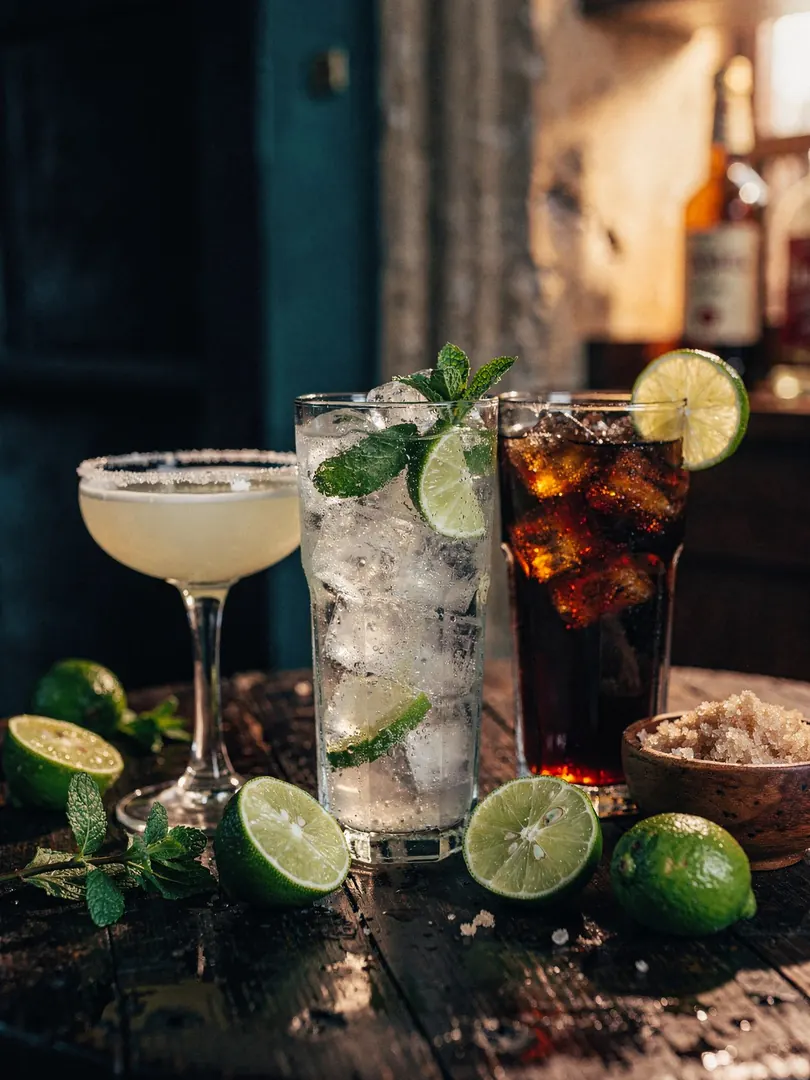
Cuba's three classics
Daiquirí, Mojito, Cuba Libre: the rum classics
The three best-known rum classics all come from Cuba: the Daiquirí is a sour made with white rum, lime, and sugar; the Mojito adds mint and soda; the Cuba Libre is rum with cola and lime. All three build on light, column-distilled Spanish-style rum.
What is a Daiquirí? Rum, lime, sugar
The Daiquirí follows the simplest formula at the bar: something strong, something sour, something sweet. A tried-and-true ratio is about 6 cl white rum, 2 to 3 cl freshly squeezed lime juice, and 1.5 to 2 cl sugar syrup. Everything is shaken hard with plenty of ice and strained without ice into a pre-chilled coupe. Shaking chills the drink, dilutes it by roughly a quarter, and whips in fine air bubbles.
A Frozen Daiquirí made in a blender is a different drink altogether. There, the crushed ice turns the drink into a slush, and the cold mutes aroma and sweetness, which is why it needs more sugar. The shaken classic, by contrast, reveals every flaw. If the juice is old or the rum harsh, you'll taste it immediately. Bartenders often use it as a benchmark for testing a new bottle.
Who invented the Daiquirí? What the legend says
According to legend, American mining engineer Jennings Cox mixed the drink around 1900 near the town of Daiquirí east of Santiago de Cuba. Cox ran an iron ore mine there starting in 1897. When he supposedly ran out of gin and vermouth for a guest, he reached for rum, limes, and sugar instead, and the drink took the town's name. The story can't be verified. Sailors and laborers in the Caribbean had long been drinking rum with lime and sugar anyway.
The Daiquirí became famous in Havana. At the Floridita bar, Constantino Ribalaigua, an immigrant from Catalonia, started working there in 1914 and owned it from 1918. He standardized the measurements, added maraschino in certain variations, and served it with finely crushed ice. Ernest Hemingway was a regular there, and this story still serves as marketing for the Daiquirí today.
Mojito and Cuba Libre: how do they differ?
At its core, the Mojito is a Daiquirí in a tall glass, lengthened with soda water and flavored with mint. Its forerunner is said to be the Draque, a mix of sugarcane spirit, sugar, lime, and mint, allegedly named after the seafarer Francis Drake. Writer Ramón de Palma mentions a “Draquecito” in a story from 1833. Exactly when this became the Mojito, nobody knows for sure. Today, the bar La Bodeguita del Medio in Havana is considered its home.
For the mint, the rule is: press, don't crush. Tearing the leaves releases bitter compounds from the leaf veins, giving the drink a grassy taste. It's better to gently press the mint with sugar and lime juice, then add rum and crushed ice, and top with soda.
The Cuba Libre is the simplest of the three. According to legend, it originated around 1900 in Havana, when American soldiers—and cola along with them—arrived on the island after the Spanish-American War. The name echoes the independence cry “¡Cuba libre!”, meaning “Free Cuba.” What sets it apart from rum and cola is the lime. The juice of half a lime along with the squeezed-out shell in the glass provide acidity and bitterness that give the cola's sweetness some definition.
Why light rum? What defines the Spanish style
All three classics come from a rum culture built on lightness. According to the specification Cuba submitted for EU protection, Cuban rum is made exclusively from molasses, ferments for only 24 to 26 hours, and is distilled in continuously running columns. Part of it then ages in barrels, gets blended with filtered, nearly neutral distillate, and is aged again. The result is a rum with few congeners, letting lime, mint, and sugar take center stage.
White doesn't mean unaged. Many light rums have spent years in barrels and were decolorized with activated charcoal. Conversely, a dark rum isn't automatically old, since caramel coloring for color adjustment is permitted. Something else matters for the cocktail too: some light rums are lightly sweetened, up to 20 grams per liter in the EU. In that case, the Daiquirí needs slightly less syrup. Using a Jamaican rum yields a fruitier, more powerful Daiquirí. That's not a bastardization—it's a variation with its own character.