Martinique's everyday drink
Ti' Punch: how do you drink Rhum agricole on Martinique?
On Martinique, Ti' Punch is drunk from a small glass: white Rhum agricole, a piece of lime with the peel, and a spoonful of cane sugar syrup, briefly stirred, often without ice. The Creole name means “little punch,” and traditionally everyone mixes their own.
What is a Ti' Punch? Ingredients and preparation
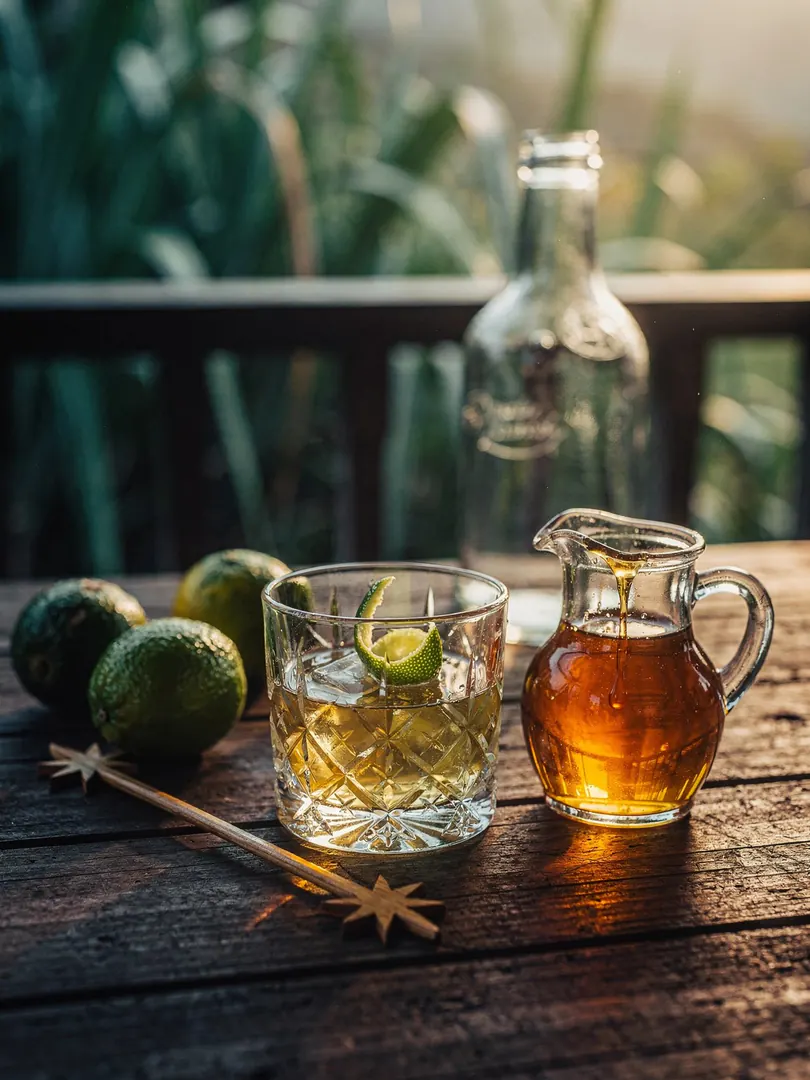
A Ti' Punch has three ingredients and needs no measuring cup. Typical proportions are about 4 to 5 cl Rhum agricole blanc, a teaspoon of sirop de canne, and a small piece of lime. It's cut coin-sized from the side of the fruit, with plenty of peel and little flesh. Squeezing it over the glass releases juice and the peel's essential oils into the drink.
Syrup and lime go into the glass first, then the rhum. It's stirred with a bar spoon or a bois lélé, a swizzle stick made from a branch with several short side shoots fanning out star-like at one end. Rolled between the palms, it quickly disperses the thick syrup. Ice is allowed, but isn't traditional. Many drink Ti' Punch at room temperature as an aperitif before the meal.
Chacun prépare sa propre mort: the custom at the table
A phrase that sounds more dramatic than intended belongs with Ti' Punch: “Chacun prépare sa propre mort,” everyone prepares their own death. Hosts put the bottle, limes, syrup, and glasses on the table but don't mix the drinks themselves. Everyone decides for themselves how much rhum, acidity, and sweetness they want.
Behind the saying lies a sober truth. A Ti' Punch is almost undiluted rhum, since without shaking and with little or no ice, hardly any water gets added. At 5 cl with 50% ABV, that's 2.5 cl of pure alcohol, roughly 20 grams. That's about equivalent to half a liter of beer. Anyone mixing their own should keep that math in mind.
Why Rhum agricole? What sets it apart from molasses rum
Ti' Punch is so simple that the rum alone sets the tone. Rhum agricole is made from freshly pressed sugarcane juice, not from molasses, the thick byproduct of sugar refining. On Martinique, the AOC—a controlled designation of origin under French law—mandates open fermentation vats, fermentation of no more than 120 hours, and a Creole column still with a copper enriching section. The distillate leaves the column at 65 to 75% ABV, retaining much of the raw material's character.
That's why a Rhum agricole blanc tastes of freshly cut cane, grass, pepper, and blossoms, while a white molasses rum tends toward neutral or caramel notes. An AOC blanc must rest in tank for at least six weeks after distillation and is bottled at a minimum of 40% ABV. Many bottlings intended for Ti' Punch come in at 50 or 55%. The lime picks up the green notes, while the syrup rounds off the sharpness.
The word “agricole” may only appear on rum from the French overseas departments and Madeira within the EU. A cane-juice rum from Haiti or Mauritius might taste just as good in a Ti' Punch, but it can't carry that name here. On Guadeloupe and Marie-Galante, where Rhum agricole is protected as a geographical indication rather than an AOC, Ti' Punch is just as much a part of daily life as it is on Martinique.
Syrup, cane sugar, or vieux: the variations
Older recipes call for cane sugar instead of syrup. It dissolves only slowly in strong alcohol, so it requires long stirring, and a residue often remains at the bottom. Sirop de canne, a thick syrup made from cane sugar and water, blends instantly and lends a round, slightly caramelized note. Plain white table sugar also works, but tastes flatter.
With an aged rhum, a vieux, Ti' Punch becomes a calmer drink. In that case, many use less lime or skip it altogether so the vanilla and wood notes don't get overwhelmed by acidity. Despite similar ingredients, Ti' Punch has little in common with a Daiquirí: there, shaking dilutes the drink, while here the rhum stays nearly undiluted.