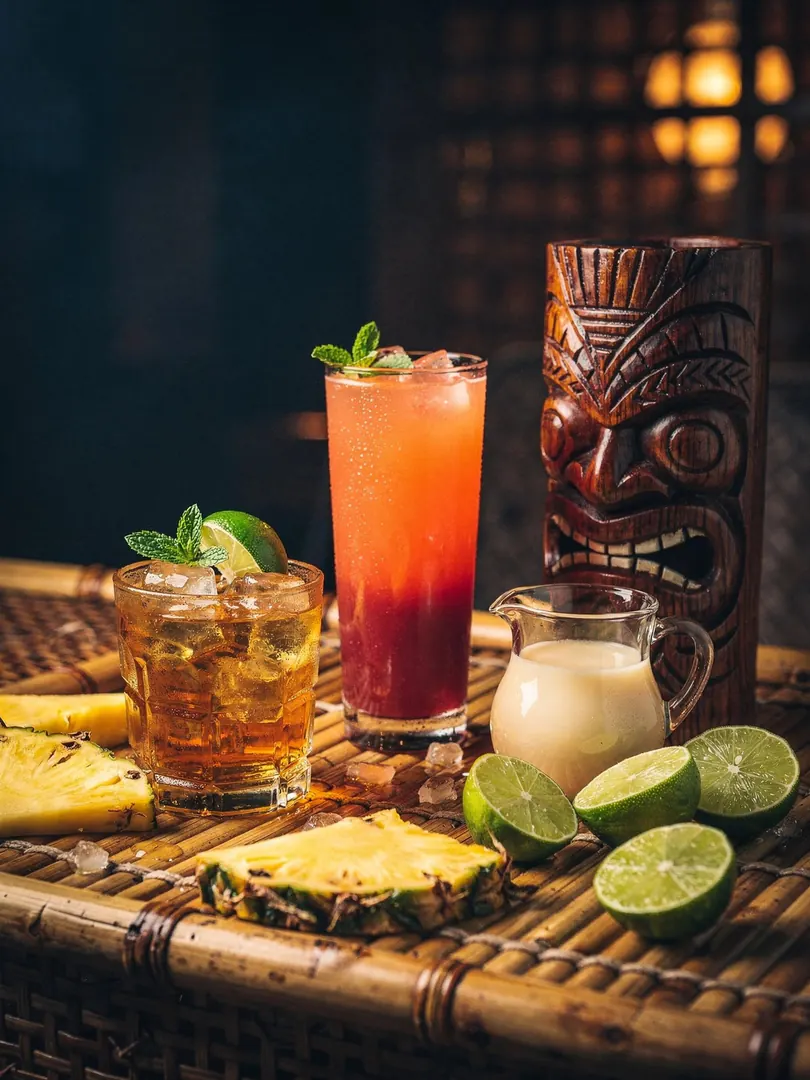
South Seas, made in California
Tiki cocktails: Mai Tai, Zombie, Painkiller
Tiki cocktails aren't island drinks at all—they're an invention of American bars starting in 1933: several rums, lime, spiced syrups, and fruit juice in one glass, served against an invented South Seas backdrop. The best known are the Mai Tai, Zombie, and Painkiller, and nearly every origin story attached to them is legend.
Where did Tiki begin? Don the Beachcomber and Trader Vic
The Tiki wave began in Los Angeles. Ernest Raymond Beaumont Gantt, who later went by Donn Beach, opened his bar Don the Beachcomber in Hollywood in 1933. That same year, Prohibition—the nationwide alcohol ban in the US—ended, and Caribbean rum was cheap to come by. Gantt decorated with bamboo, fishing nets, and torches, inventing a version of the South Seas that never existed anywhere.
His most famous imitator was Victor Bergeron of Oakland, known as Trader Vic. Both went on to open more bars, and after World War II, Tiki became a craze in the US. The carved figures and masks borrowed freely from Polynesian cultures. Today, this appropriation is viewed critically, while the drinks themselves are considered classics of the bartender's craft.
What defines a Tiki drink is above all the rum blend. Instead of a single type, Gantt combined two or three: a heavy Jamaican rum for fruit, a Demerara rum from Guyana for depth and caramel, a light rum for freshness. To that he added lime, grapefruit, spiced syrups, and bitters. Each type covers a different angle, and together they create an aroma no single bottle can deliver on its own.
Mai Tai: what's in the original?
According to Trader Vic's own account, the Mai Tai was created in 1944 in Oakland. He mixed 17-year-old Jamaican rum from J. Wray & Nephew with fresh lime, orange curaçao, orgeat (an almond syrup), and a bit of rock candy syrup. Guests from Tahiti are said to have exclaimed, "Maita'i roa ae!", roughly meaning "very good." That, at least according to legend, is where the name comes from. Donn Beach later claimed to have mixed a Mai Tai as early as 1933, though with a different recipe.
The original contains neither pineapple juice nor grenadine. These ingredients came later with the hotel versions in Hawaii, which made the drink sweeter and more colorful. When the 17-year-old rum became scarce, Trader Vic reportedly replaced it with a blend of Jamaican rum and rum from Martinique. A good Mai Tai still relies today on aged, unsweetened Jamaican rum, often rounded out with a rhum agricole.
Zombie: Why only two per guest?
The Zombie is Donn Beach's most famous drink. According to legend, he mixed it in 1934 for a hungover guest who needed something invigorating before a business meeting. He kept the recipe secret, allegedly even from his own staff, who worked with bottles labeled in code. Only decades later did tiki researchers reconstruct a 1934 version from old notebooks.
This version contains three rums, including an overproof above 70% ABV, along with lime, grapefruit, falernum, cinnamon syrup, grenadine, absinthe, and Angostura bitters. Altogether, a single glass holds well over 10 cl of rum—more alcohol than in three ordinary long drinks. The bar reportedly served no more than two per guest. That was part marketing, part caution.
Painkiller: the youngest tiki classic
The Painkiller doesn't come from California, but from the Caribbean. According to legend, it was created in the early 1970s at the Soggy Dollar Bar on White Bay on Jost Van Dyke, one of the British Virgin Islands. There was no dock there—guests swam ashore and paid with soggy bills. The inventor is said to be the bar's owner, Daphne Henderson, who kept her recipe to herself.
Charles Tobias, the founder of Pusser's, reportedly worked his way toward the blend: four parts pineapple juice, one part cream of coconut, one part orange juice, rum to taste, and nutmeg on top. Pusser's trademarked the name and recipe in the US in 1989 and took action in 2011 against a New York bar called Painkiller that poured other rums. Following a settlement, the bar changed its name. In terms of flavor, the Painkiller is a coconut-pineapple drink carried by a bold Navy-style rum blend.