Five ingredients, countless islands
Punch: from Planter's Punch to Caribbean Rum Punch
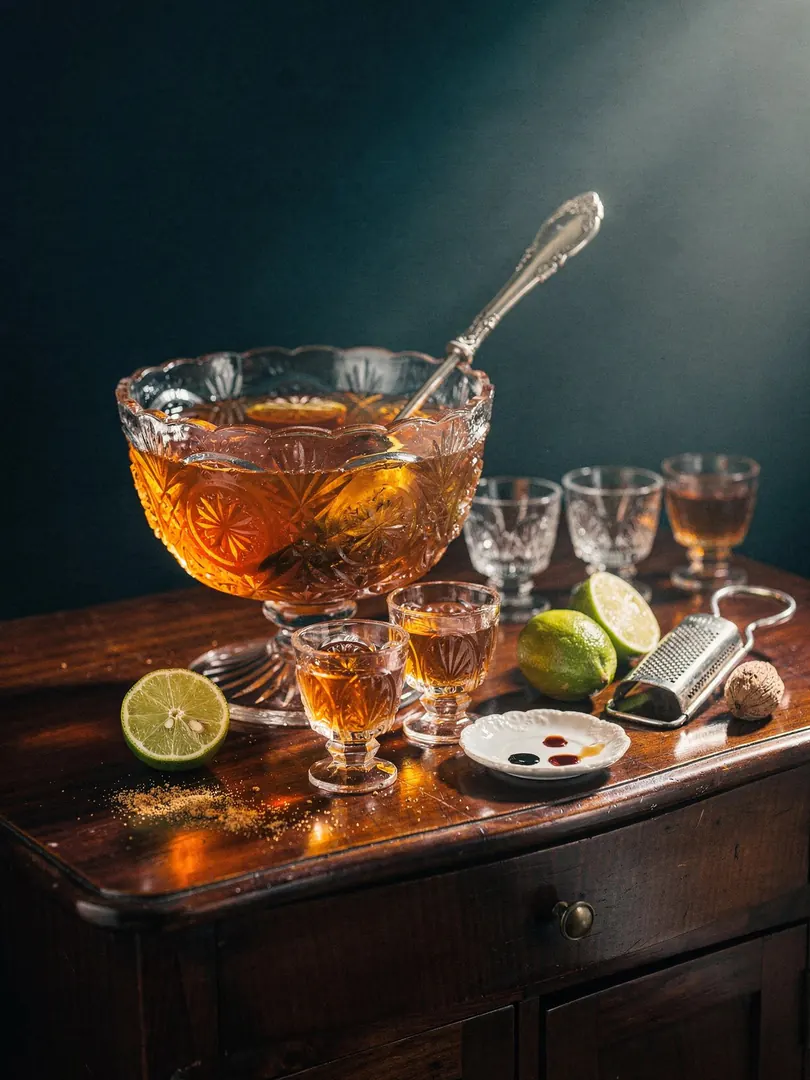
Punch is the oldest way to mix rum: spirit, citrus juice, sugar, water, and spice. Planter's Punch and the Caribbean Rum Punches still follow this blueprint today, typically with aromatic Jamaican rum, lime, sugar syrup, water or juice, and nutmeg.
Where does punch come from? The bowl before the cocktail
Long before cocktails existed, sailors, traders, and planters drank punch from large bowls. The word is documented in English sources since the 17th century, first in connection with trading voyages to the East Indies. The base there was arrack, an Asian spirit made from sugarcane, rice, or palm sap depending on the region. In the Caribbean and the North American colonies, the cheaper rum soon took its place.
It's often said that punch derives from the Hindi word “panch,” meaning five, referring to the five ingredients. That sounds plausible, but it's not confirmed. What's certain is the idea behind it: something strong gets combined with something sour, sweet, water, and spice to create a drink for many. The bowl sat at the center, the mixture was milder than straight rum, and it lasted through a long evening.
Planter's Punch: what does the rhyme mean?
No punch is as closely tied to a mnemonic verse as Planter's Punch. The most commonly quoted version today goes: “One of sour, two of sweet, three of strong, four of weak.” Sour is lime juice, sweet is sugar syrup, strong is rum, weak is water, ice, or juice. The verse appeared in print in several variations. The Kansas City Star published a shorter version in 1903, while the New York Times ran one in 1908 with two parts sour, one and a half parts sweet, three parts strong, and four parts weak, explicitly calling for “Old Jamaica.”
The rhyme, then, is a memory aid, not a law. Anyone taking the modern version literally ends up with 3 cl lime, 6 cl syrup, 9 cl rum, and 12 cl water—a very sweet drink. Today's bartenders use less sugar and measure the water via the ice. It's seasoned with a few dashes of Angostura and freshly grated nutmeg.
Which rum belongs in a punch?
Punch can handle a lot of water, which is why it needs a rum with character. The classic choice is pot-still Jamaican rum. Long fermentations and pot stills—which work batch by batch—leave behind plenty of esters. These aroma compounds smell of banana, pineapple, and ripe fruit and remain detectable even at fourfold dilution. A light column-still rum would nearly vanish in the glass.
The 2016 Jamaica Rum geographical indication permits only water and caramel coloring after distillation. Jamaican rum is therefore unsweetened, meaning the sweetness in punch comes entirely from the syrup and can be precisely controlled. An aged rum brings vanilla and wood, while a white Jamaican rum offers more fresh fruit and a noticeable sharpness. Many recipes blend both.
Rum Punch across the islands: one blueprint, countless recipes
Nearly every island has its own Rum Punch, and no two are alike. On Barbados, it's typically lime, sugar, water, Angostura, and nutmeg—fairly close to the old rhyme. In the French Antilles, the fruitier relative is called Planteur: rhum, several fruit juices, cane sugar syrup, and spices like cinnamon or vanilla.
Mixing for guests is best done the old way, in a bowl. Lime juice, syrup, and rum can be stirred together ahead of time, while the water goes in just before serving, as cold as possible. One large ice block, rather than many small cubes, chills without watering down the punch within the hour. Nutmeg should be grated directly over the glass, since its aroma fades quickly.
The hot punch found at German winter markets is a distant relative with a different method. It's heated with tea, wine, or juice, and the rum is added only at the end. That's the subject of the chapter on hot rum drinks.