Fruity Aroma, Quantified
What Are Esters in Rum and How Are They Measured?
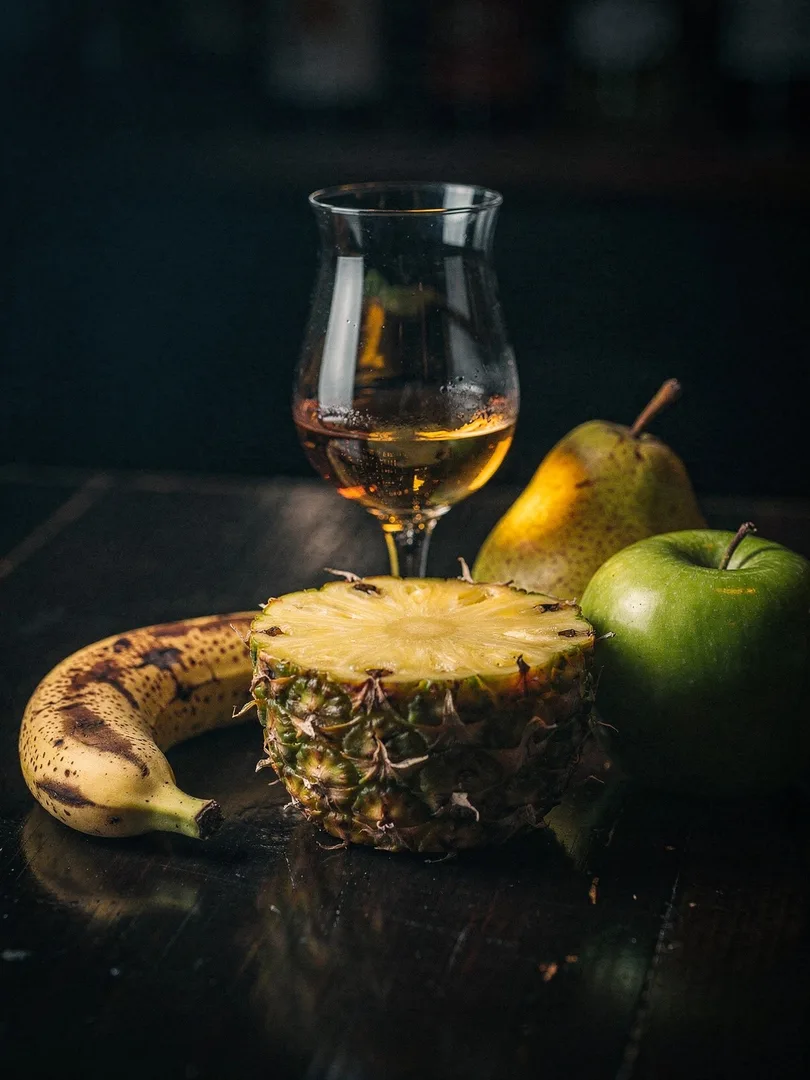
Esters are aromatic compounds formed when an acid reacts with an alcohol; in rum they smell of banana, pineapple, pear, or glue. They're measured in grams per hectoliter of pure alcohol (g/hl p.a.), once by titration, now mostly by gas chromatography.
Esters in Rum: How They Form
An ester forms when an acid molecule and an alcohol molecule combine, releasing water in the process. Rum has plenty of alcohol on hand, chiefly ethanol. That's why most rum esters are ethyl esters, such as ethyl acetate from acetic acid or ethyl butyrate from butyric acid.
Esters form in three places. Yeast creates some of them directly during fermentation itself, including isoamyl acetate, which smells distinctly of banana. A second surge follows in the still: heat and acidity speed up the reaction between the acids from fermentation and the alcohol. The third and slowest pathway runs through the cask. Over years, acids and alcohol continue to react, which is why old rums often smell fruitier and rounder than young ones.
Ethyl acetate almost always makes up the largest share. In small amounts it's fruity; in large amounts it recalls nail polish remover or glue. A study of rum, whisky, and cachaça found ethyl acetate to be the dominant ester, with ethyl lactate, an ester with a mild, slightly creamy note, in second place for rum.
What Does g/hl p.a. Mean?
The unit looks cumbersome, but it's practical. Grams per hectoliter of pure alcohol relates the amount of a substance not to the bottle as a whole, but to the alcohol it contains. This lets you directly compare a 63%-ABV cask-strength rum with a 40%-ABV bottling. Diluting a rum with water doesn't change the value.
A simple calculation makes the scale tangible. One hectoliter of pure alcohol fits into 250 liters of rum at 40 percent. If this rum has 225 grams of congeners per hectoliter of pure alcohol, that works out to 0.9 grams per liter. So an entire aroma profile emerges from less than one gram per liter. Incidentally, English texts write the unit as gr/hlAA or g/hl AA.
How do you measure esters? Titration and gas chromatography
The classic method is titration after saponification. A sample is boiled with excess sodium hydroxide, which splits the esters. Acid is then used to determine how much lye was consumed. This yields the total ester content, usually expressed as ethyl acetate. This figure says a lot about a rum's intensity, but nothing about which esters are actually present.
Gas chromatography, by contrast, separates every compound individually. The sample is vaporized and passed through a thin column, in which each compound travels at a different speed. This way you can identify ethyl acetate, ethyl butyrate, or ethyl hexanoate separately. For the question of why two rums with the same total value smell completely different, this is the better answer. The old Jamaican ester classes, however, are based on total values, as shown in the entry on High-Ester Rum.
The 225 threshold: volatile congeners in EU law
In legal texts, a broader term often appears: volatile congeners. This refers to all volatile substances except ethanol and methanol. Besides esters, these include acids, aldehydes, and higher alcohols. The EU permits the designation "traditionnel" only for rum with a registered geographical indication that contains at least 225 g/hl p.a. of these, was distilled below 90 percent, and was not sweetened.
The AOC Martinique sets tiered minimums: 225 for blanc, 250 for élevé sous bois, and 325 for vieux. The higher value for aged rum results from wood maturation, during which further compounds are added and concentrated. At the very top sits Grand arôme with at least 800. For comparison: the specification for Demerara Rum states less than 30 g/hl p.a. congeners and less than 10 g/hl esters for light qualities.