Time Shapes Style
Short or Long Fermentation: From 24 Hours to Two Weeks
Rum ferments anywhere from about a day to more than two weeks, depending on style. Short fermentations, like Cuba's 24 to 26 hours, produce clean, light distillates. Long fermentations, as in Jamaica, give bacteria time to form acids that later become fruity esters.
Why Fermentation Length Determines Rum Style
The actual alcoholic fermentation is often over quickly. A vigorous yeast will have consumed most of the sugar in diluted molasses within a day or two. But what happens in the vat afterward matters just as much for the aroma.
If the fermented liquid is left standing, bacteria take over part of the job. They produce acids, such as acetic, lactic, or butyric acid. These acids slowly react with the alcohol present to form esters, the fragrant compounds that smell of pineapple, banana, or solvent. Part of this reaction already happens in the vat; a larger part happens later in the hot still.
The math is therefore simple: the longer and more bacteria-rich a fermentation, the more raw material is available for esters. Whether that actually results in a heavy rum also depends on how it's distilled, though. A column still running at very high proof strips many of these compounds back out again.
Cuban Rum: 24 to 26 Hours for a Light Style
The clearest example of short fermentation is Cuba. The specification Cuba filed for EU protection of its rum prescribes a short fermentation of 24 to 26 hours. Only molasses from Cuban cane is permitted, and distillation takes place in continuous columns.
This produces a distillate with few, clean congeners, which is then aged and blended across several stages after distillation. The short timeframe isn't about cutting corners, it's a stylistic choice. It gives bacteria little time to act and keeps the rum light and blendable. Other countries in the Spanish style are also considered short-fermentation countries, though fixed rules on this are mostly absent there.
Rhum Agricole: A Maximum of 120 Hours on Martinique
AOC Martinique sets an upper limit: fermentation of the fresh juice may last no more than 120 hours, or five days. It takes place batch by batch, not continuously, in open vats made of a material that won't react with the juice, with a maximum capacity of 500 hectoliters.
This limit protects the characteristic agricole aroma. Fresh juice brings plenty of its own flavors, grassy, vegetal, slightly peppery. Fermenting too long would bury that freshness under acidity and off-notes. Within the five days, distilleries have room to maneuver, and the more closely you taste, the more noticeable differences you'll find between houses.
Jamaican Rum: Days to Weeks for High-Ester Rum
At the other end of the spectrum stands Jamaica. For Hampden, the trade press cites historical fermentation times of nine to ten days. Current reports speak of roughly one to two weeks depending on the brand, and considerably longer for the most ester-rich styles made with muck. The entry on dunder and muck has more on these ingredients.
Long fermentation isn't proof of quality by itself. It costs time and space, yields less alcohol per ton of molasses, and can go wrong if acetic bacteria take over. It only pays off when the vat, the microbes, and the still are all matched to one another. A long fermentation ahead of a high-proof column would be wasted effort. That's why the heavy Jamaican style also depends on the pot still, which carries many of these congeners through.
For drinkers, this means fermentation length almost never appears on the label. Clues come from origin, type of still, and ester figures that some bottlers print voluntarily.
When Is a Rum Fermentation Finished?
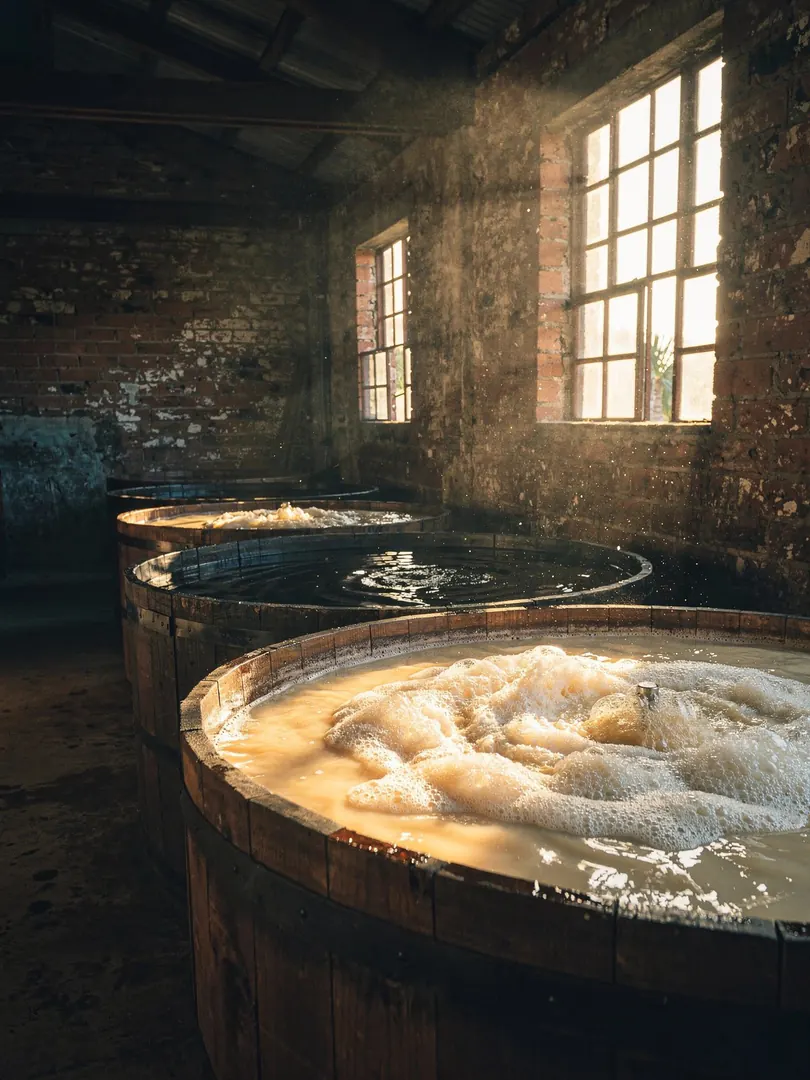
In the vat, the end of the main fermentation shows first on the surface. The bubbling eases off, the foam collapses, and hardly any bubbles rise anymore. Master distillers don't rely on the eye alone, though. They measure the liquid's density, since sugar is heavy and alcohol is light. Once the reading stops dropping, the yeast has used up its sugar.
With short fermentations, distillation follows immediately, ideally without delay, so bacteria don't get a chance to move in. With long fermentations, though, this is when the second, quieter stage begins. Now it's no longer about sugar but about smell and acidity. Experienced master distillers smell the vat to judge whether the desired fruity notes are building or whether the fermentation is tipping toward vinegar. Temperature is also monitored, since fermentation running too hot weakens the yeast and encourages off-flavors.