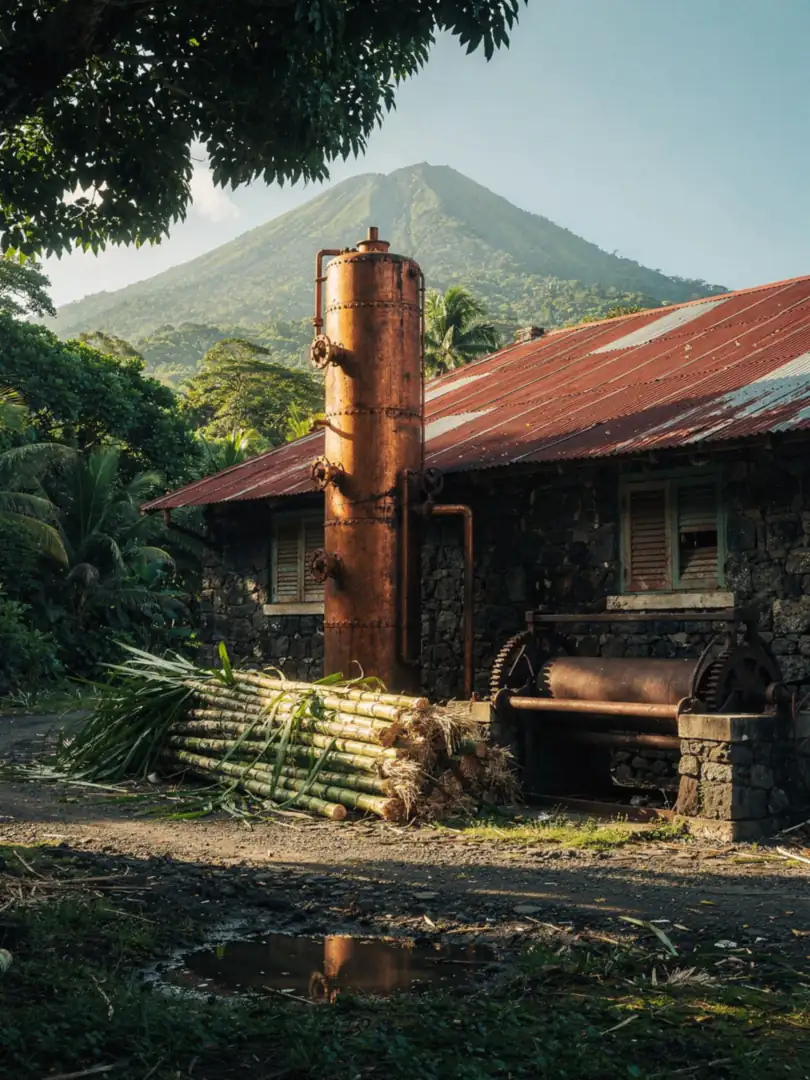
Martinique and the crisis
How did rhum agricole emerge? The sugar crisis of 1884–1896
Rhum agricole spread when sugar prices collapsed during the crisis of 1884 to 1896. Many plantations on Martinique gave up boiling sugar and began distilling fresh cane juice directly into rum. Individual juice rums are already documented from the early 19th century.
Why did sugar prices collapse in the late 19th century?
Sugarcane had been grown on Martinique since around 1640, and in 1639 a certain Trezel had been granted the monopoly on sugar production. For two centuries the island lived off sugar, and as everywhere in the Antilles, this rested on slave labor. Rum arose in the process from molasses, a byproduct of the sugar factories.
In the 19th century, cane sugar gained a powerful rival. In Europe, sugar beet cultivation grew, and beet sugar became ever cheaper in large factories. After the end of slavery in 1848, labor costs rose on the French islands at the same time. By the end of the century, when the world market was flooded with sugar, prices fell so low that many planters could no longer sell their sugar at a profit.
From sugar house to distillery: what the planters changed
The response of many small and mid-sized plantations was radically simple. Instead of boiling the juice for hours into sugar and distilling only the molasses, they fermented the fresh juice, called vesou in Creole, and distilled it right away. This saved the cost of an expensive sugar factory and produced a drink that sold well in France. What began as an exception during the sugar crisis of 1884 to 1896 thus became a style in its own right.
The juice spoils within a short time, so the distillery had to stand right next to the field and the mill. Distillation took place in a column still derived from French techniques for beet alcohol, which became known as the colonne créole, or Creole column. Alongside this, the large sugar factories kept operating and distilled molasses rum, the rhum de sucrerie. Both types of rum still exist on the French islands today.
Saint-Pierre 1902: the world's largest rum producer, and catastrophe
By the end of the 19th century, Martinique, with over 220,000 hectoliters of rum at 55 percent alcohol, was the world's largest rum producer. The center of trade was the port city of Saint-Pierre in the northwest of the island, with distilleries, warehouses and trading houses.
On 8 May 1902, the volcano Mont Pelée erupted. A pyroclastic cloud destroyed Saint-Pierre within minutes, killing around 28,000 people. The city's destruction took with it a large part of the rum industry in the north and many trading houses. The center of the industry subsequently shifted to other parts of the island.
During the First World War, demand from France rose sharply, including for supplying the army. Afterward, Paris moved to protect its own distillers: in 1922 an import quota for rum from the Antilles was introduced. In 1938 came the first analytical definition of rum, which prescribed a minimum content of aromatic compounds alongside alcohol, and which still forms the basis of the definition today.
From stopgap solution to AOC Rhum de la Martinique
Over time, what had been a response to a crisis became a mark of quality. With the decree of 5 November 1996, Martinique was granted the controlled designation of origin AOC Rhum de la Martinique, to this day the only AOC for rum. It mandates fresh juice, short fermentation and the Creole column. The details are covered in the topic Origin and Law.
Under EU law, only rum from the French overseas departments and from Madeira may carry the word agricole. Juice rums from Mauritius, Haiti or Thailand follow the same idea, but are not permitted to use this name here. Guadeloupe, alongside rhum agricole, still produces a good deal of molasses rum. The history thus explains why agricole remains, to this day, primarily a French word.