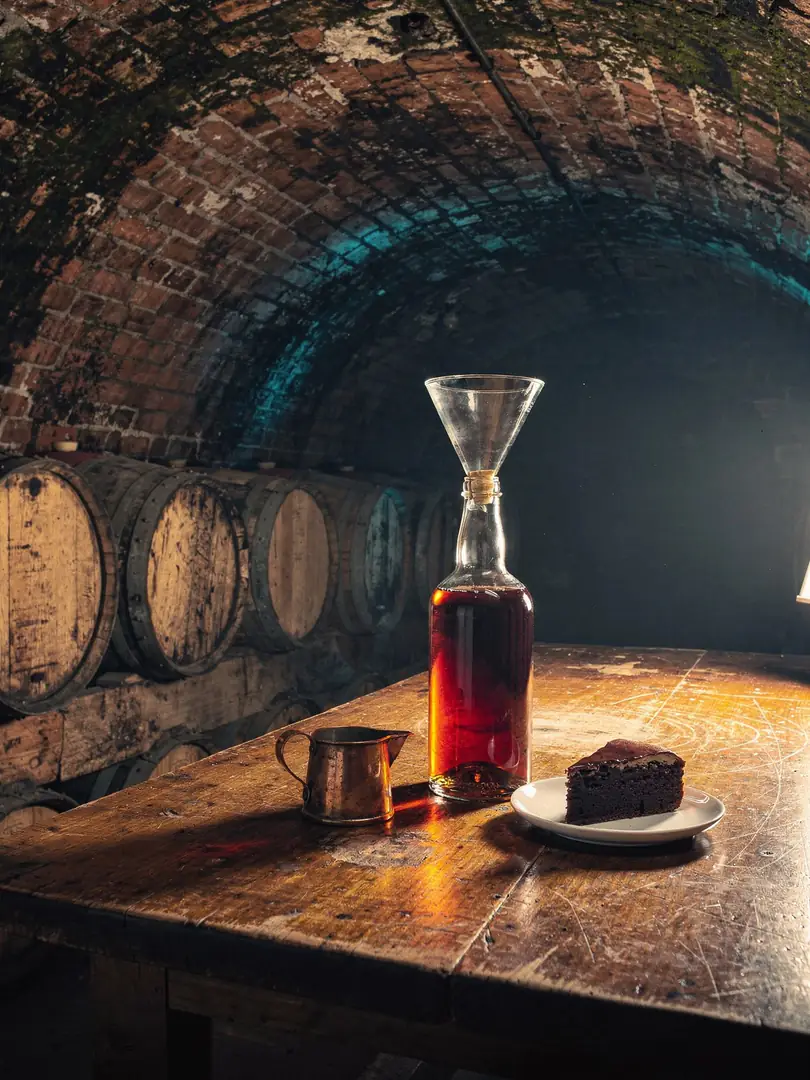
Rum without colonies
Rum in Central Europe: Flensburg, Kunstrum and Inländerrum
Central Europe forged its own paths to rum in the absence of, or at a distance from, colonies. Flensburg traded rum from the Danish West Indies from 1755 onward and blended it, while in Austria-Hungary Kunstrum emerged from neutral spirit and essence. From this came Rum-Verschnitt, Inländerrum and Tuzemák.
Why did Flensburg become a rum city?
In the 18th century, Flensburg belonged to the composite Danish state. Denmark held the islands of St. Croix, St. Thomas and St. John in the Caribbean, known as the Danish West Indies. From 1755 onward, Flensburg ships brought rum and sugar from there. The rum itself was never distilled in Flensburg. The city served as a trading and blending hub: strong colonial rum arrived in casks and was diluted, blended and bottled there.
At its height, the city had more than 200 rum houses. Their prosperity rested on plantations worked by enslaved people. Denmark abolished slavery in its colonies in 1848, after enslaved people rose up on St. Croix. In 1917, it sold the islands to the United States; today they are the US Virgin Islands. Flensburg has since addressed this chapter of its history in exhibitions.
What changed after 1864? Jamaican rum and Rum-Verschnitt
After the Second Schleswig War, Flensburg became part of Prussia in 1864. According to the commonly told account, this ended duty-free access to Danish colonial rum. The Flensburg houses switched to rum from Jamaica, which was highly aromatic and strong. A small proportion of it was enough to make large quantities of neutral alcohol taste like rum. This practice, as secondary sources describe it, gave rise to Rum-Verschnitt.
Fitting this picture are the Jamaican rums with very high ester content, the aromatic compounds that smell of banana, pineapple or solvent. The trade grade known as Continental Flavoured, with roughly 700 to 1,600 grams of esters per hectoliter of pure alcohol, was intended mainly for Europe, for blending, baking and confectionery. Today two rum houses still operate in Flensburg: A. H. Johannsen, founded in 1878 and based on Marienstraße since 1912, the oldest still active, and Braasch on Rote Straße.
Anyone wanting to see this history firsthand can visit the Rum Museum in the basement of the Maritime Museum, a former customs warehouse, and follow the Rum and Sugar Trail, with 20 stops through the old town.
Kunstrum: rum without sugarcane in Austria-Hungary
Austria-Hungary had no colonies in the Caribbean, so genuine rum was correspondingly expensive. Even so, rum had its place in the kitchen, in pastries, punch and tea. Producers helped themselves with Kunstrum, a drink that tasted like rum without being made from rum. They diluted spirit made from domestic raw materials such as beets, added rum essence for flavor and caramel coloring for color.
Inländerrum was first officially described in the Codex alimentarius Austriacus, the Austrian food code, in the 1917 volume, with a minimum alcohol content at the time of 40 percent. Preparatory work for this ran from 1891 to 1898. The best-known brand is Stroh from Klagenfurt, which cites 1832 as its founding year, a claim made by the producer itself. Similarly, within the same monarchy, Slovenian Domači rum and Bohemian Tuzemák emerged.
What became of Kunstrum after EU accession?
With Austria's accession to the EU, the European definition of rum applied, under which rum must be made exclusively from sugarcane. After a transition period ended on 31 December 1998, Inländerrum changed fundamentally. Since then, all of its alcohol content consists of rum, supplemented with Inländerrum essence, which is itself obtained from rum distillate produced in Austria. Alcohol from beets or potatoes is no longer permitted.
In legal terms, Inländerrum still does not count as rum, because it is flavored. It is a protected geographical indication in the category of other spirit drinks, with a minimum strength of 38 percent. Since 1 January 2003, the Czech Tuzemák may no longer be called rum, and it continues to be made from potato or beet alcohol with rum essence. The relevant regulations are explained in the topic Origin and Law.