Rum at Sea
Rum Ration, Grog, and Black Tot Day: Rum in the Royal Navy
For over 300 years, the Royal Navy issued its sailors a daily rum ration. After the conquest of Jamaica in 1655, rum gradually replaced beer and brandy, and from 1740 it was diluted and served as grog. The final ration was poured on July 31, 1970—Black Tot Day.
Why Did Royal Navy Sailors Receive Rum?
Clean drinking water was scarce aboard a sailing ship. Water stored in barrels turned foul after a few weeks, and beer barely kept in the tropics. Alcohol, however, didn't spoil and took up less space in the hold. For a long time, English sailors received beer, and on long voyages, wine or brandy as well.
With the conquest of Jamaica in 1655, the fleet had a direct source in the Caribbean. Rum was cheap and plentiful there, and it gradually replaced beer and brandy aboard ship. By the 18th century, this had become a fixed daily ration. Secondary sources cite the Admiralty regulations of 1731, which set it at half a pint per day—just under 0.3 liters—undiluted.
This amount was enough to keep an entire crew regularly drunk. Accidents, quarrels, and discipline problems followed. This explains why, from this point on, the history of the rum ration reads mainly as a history of its dilution and reduction.
What Is Grog? Admiral Vernon and the 1740 Order
The first step was taken by Admiral Edward Vernon. In 1740 he ordered that rum be mixed with water before being issued. This turned the strong ration into a diluted drink that sailors soon called grog. According to tradition, the name goes back to Vernon's nickname Old Grog, after his coat made of grogram, a coarse fabric.
Later, lemon or lime juice and sugar were added. The juice helped against scurvy, a deficiency disease caused by a lack of vitamin C that killed many sailors on long voyages. Grog aboard ship was therefore not a pleasure drink, but a diluted, acidified mandatory ration. The hot grog mixed today in northern Germany from rum, hot water and sugar is a later landlubber's version of this name.
Up Spirits: How the rum ration was issued and cut
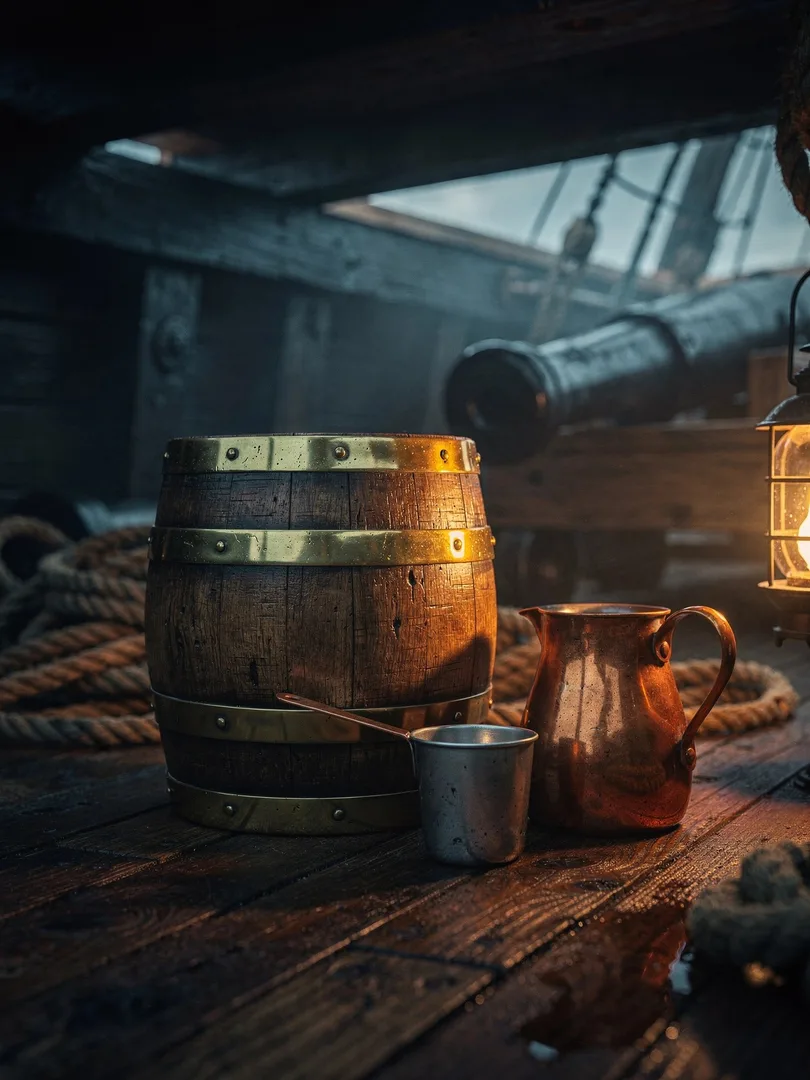
The issue followed a fixed ritual. At the call Up Spirits at six bells of the forenoon watch, around eleven o'clock, the rum cask was opened and dispensed under supervision. The stock was managed by the paymaster, the purser. Sailors turned this title into the word pusser, a term still attached to navy rum today.
The quantity fell in two large steps. In 1824 the ration was halved to a quarter pint, in 1850 it was halved again to an eighth of a pint, around 71 milliliters, and the evening issue was dropped. From 1881, officers no longer received grog. In the end, the ration consisted of an eighth of a pint of rum at 95.5 proof, which is 54.6 percent alcohol.
A well-known legend surrounds Admiral Nelson. After his death at the Battle of Trafalgar in 1805, his body was brought back to England in a cask of brandy. Legend has it that sailors secretly drank from it, which is why navy rum carries the nickname Nelson's Blood. There is no evidence that the cask was actually tapped.
Black Tot Day: Why did the rum ration end in 1970?
In the 20th century, the daily ration no longer suited a fleet equipped with radar, missiles and complex technology. Anyone working on such equipment had to be sober. The Admiralty therefore abolished the ration. On 31 July 1970 it was issued for the last time. Among sailors, this day has since been known as Black Tot Day.
The story had an aftermath in trade. In 1979 Charles Tobias was granted the rights to the name by the Admiralty, along with the details of the blend, a mix of five West Indian rums. He founded the company Pusser's on Tortola, which began selling the rum publicly from 1980. Navy rum is nonetheless not a protected category. Navy Strength, too, is merely an industry convention of around 57 percent, not a standard.