Heat in the Warehouse
Tropical Ageing: Does Rum Mature Faster in the Caribbean?
Yes, rum matures faster in tropical heat than in a cool cellar: warmth drives it deeper into the wood, colour and wood aromas arrive sooner, and more evaporates. But the formula "one tropical year equals three European years" is just a commonly cited rule of thumb, not a measurement.
What Does the Heat Do in the Warehouse?
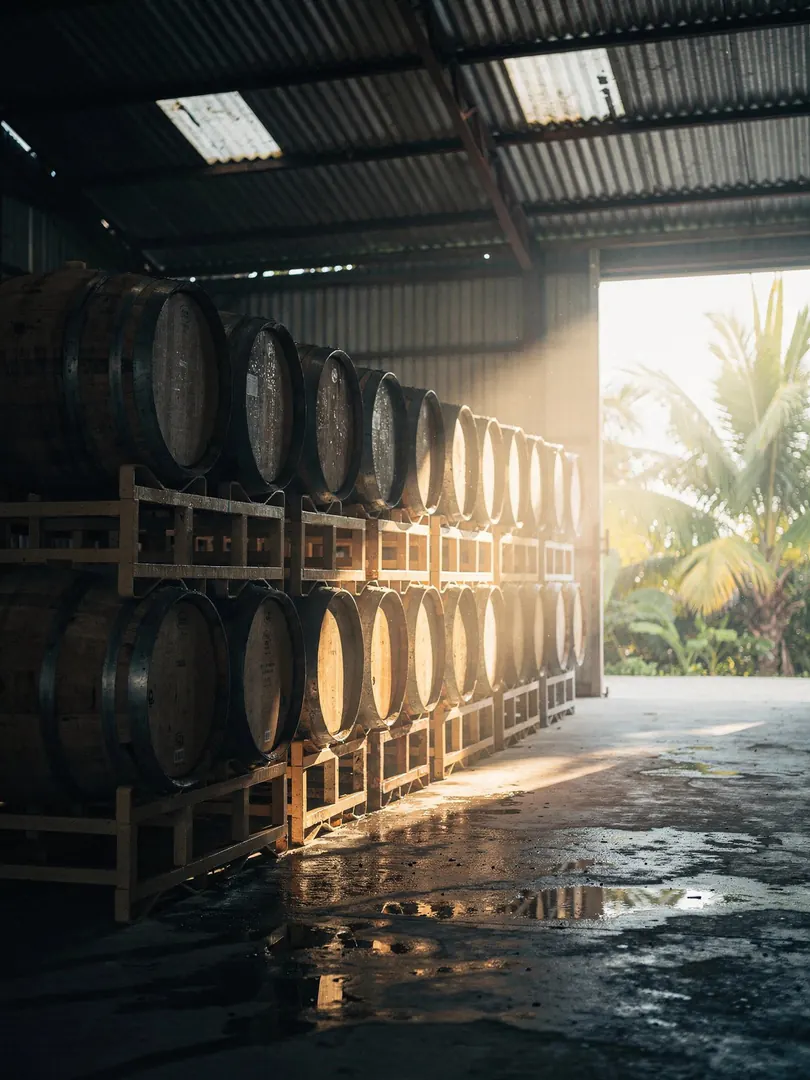
A warehouse in Guyana or Barbados is a warm place. The specification for Demerara Rum describes storage at sea level at around 24 to 32°C and roughly 70 percent humidity. There's no winter all year round, when maturation nearly stops as it does in a Scottish warehouse.
Warmth expands both rum and wood. The rum penetrates deeper into the staves and dissolves more compounds there. In cooler nights it retreats again, bringing some back with it. This daily breathing accelerates the exchange. On top of that, chemical reactions simply run faster in warmth.
The result shows up first in the colour. A rum that spent three years in the Caribbean is often noticeably darker and woodier than a spirit of the same age from a cool cellar. Vanilla, tannins and spice also emerge earlier.
Does the Rule "One Year Equals Three Years" Hold Up?
The rule comes from marketing and doesn't hold chemically one to one. Leaching of the wood and evaporation really do run much faster in the tropics. Other processes, such as slow oxidation and the build-up of fine esters, follow their own pace. They can't simply be multiplied by three.
A five-year-old tropical rum is therefore not the same as a fifteen-year-old rum from a European warehouse. It may have a similar amount of wood influence, but less of the fine, matured depth. Conversely, a rum long aged in Europe often lacks the power and density that a tropical rum shows after just a few years.
Experts therefore use the rule of thumb at most as a rough picture. It explains why a twelve-year-old rum from the Caribbean comes across differently from a twelve-year-old Scotch whisky. As a conversion for labels, it doesn't work.
Altitude, Construction, Sea: Differences Within the Tropics
Tropics doesn't mean the same climate everywhere. Zacapa from Guatemala, according to the producer, matures in a warehouse at 2,300 metres near Quetzaltenango, which the brand calls the House Above the Clouds. At that altitude it's considerably cooler than on the coast, and maturation runs more slowly.
The building matters too. A warehouse with a tin roof heats up strongly during the day, while thick stone walls buffer the heat. Casks under the roof mature faster than casks on the floor. Proximity to the sea brings humidity and salt air, while inland warehouses can be drier.
Master blenders therefore distribute their casks deliberately or move them during maturation. For blending, they select casks from different corners so that woody and fresh components complement each other.
What Fast Maturation Means for Old Rums
The flip side of speed is loss. In tropical warehouses, many times more evaporates than in Scotland. After twenty years, often only a small remainder is left from a cask, which can also taste strongly of wood.
That's why very old, purely tropically aged rums are rare. Many distilleries prefer to bottle their top rums at eight to fifteen years, because beyond that the wood easily gains the upper hand. A high age statement on a tropical rum is therefore no automatic sign of quality, but rather a hint of heavy wood influence.
For label readers, a simple rule follows: alongside the number, the place of maturation counts. If it says Caribbean, Guyana or Central America, ten years is a long time. For a rum matured in Europe, ten years feels younger.