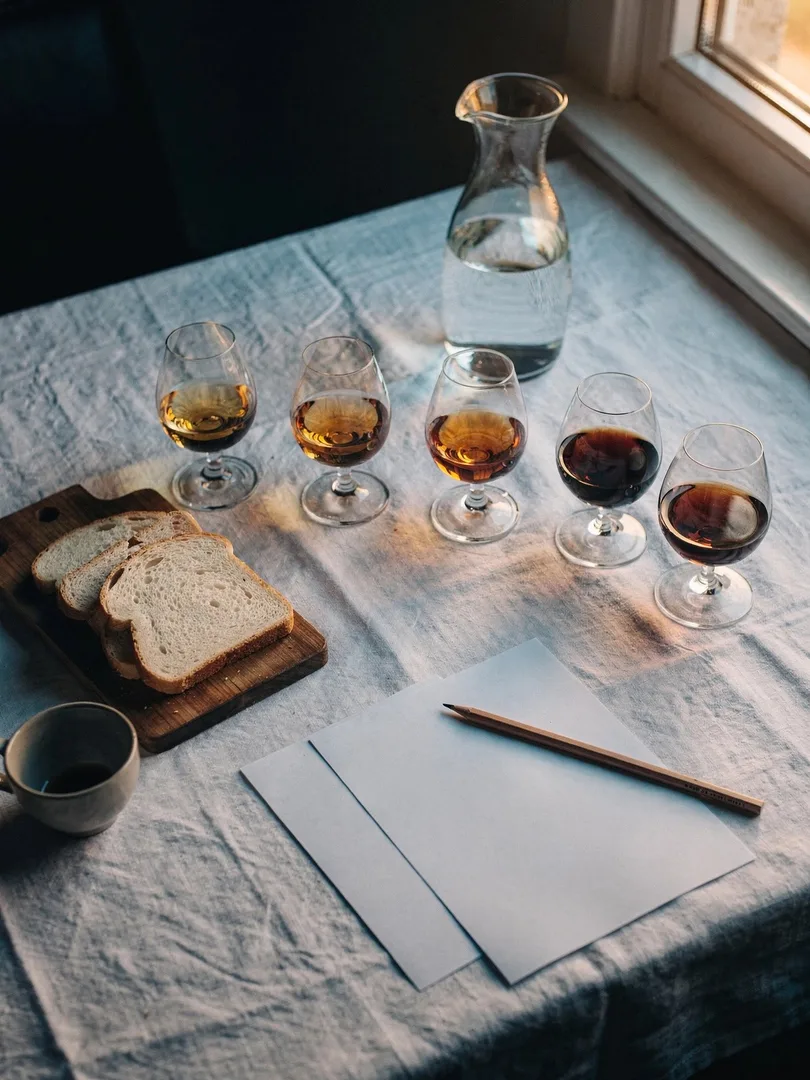
The tasting evening
Rum tasting at home: order, quantity, notes
For a rum tasting at home, four to six rums at about 1 to 2 centiliters per person are enough, arranged from light to heavy and from low to high alcohol strength. You'll also want still water, neutral bread, matching glasses, a simple note sheet, and a theme that ties the samples together.
Choosing a theme for the rum tasting
A good tasting has a thread running through it. Six random bottles side by side just create a jumble you won't learn much from. Better to pick a question the comparison can answer. How does rum from cane juice differ from rum made from molasses? What does the still contribute? What happens to a style the longer it sits in the cask?
For beginners, a country survey works well: a rum from Barbados, a Rhum Agricole from Martinique, a Jamaican rum, a Demerara rum from Guyana. Those with more experience might choose a narrower theme, such as three age statements from the same distillery, or rums of the same origin with and without added sugar. The narrower the theme, the finer the differences you'll learn to pick up.
In what order should you taste rum?
The order determines whether the later rums still stand a fair chance. A tried-and-true approach: light to heavy, young to old, low to high strength, dry to sweet. An overproof or a heavily sweetened rum belongs at the end, since alcohol numbs the mucous membrane and sugar leaves a film on the tongue.
With very aroma-intensive rums, like a high-ester Jamaican, it's worth scheduling those late too. Their scent can linger in the room and in your nose for minutes. Between samples, a sip of water and a piece of unsalted white bread help neutralize the palate. Coffee beans, sometimes offered as a nasal reset, tend to just add a new smell rather than clear the old one.
Anyone wanting to taste blind needs a second person. They pour into numbered glasses and keep track of which number corresponds to which bottle. Participants only see the bottles at the end. This keeps things honest: sometimes the cheaper rum suddenly outperforms the pricier one.
How much rum per person: quantity and responsibility
One centiliter is enough to judge a rum on the nose and palate; two centiliters allow for a second pass with water. More than that isn't necessary for a tasting. The total adds up, though: six samples of two centiliters each at 40 percent come to 4.8 centiliters of pure alcohol combined, roughly 38 grams. That's an amount worth taking seriously when planning.
That's why the rule is: no one has to finish every glass. A spittoon is standard practice among professionals and not considered impolite. Water is always on the table, and a proper meal should come beforehand. Anyone who has to drive doesn't taste. A tasting is meant for discovering differences, not for drinking as much as possible.
Notes for a rum tasting: a simple scoresheet
A scoresheet needs no more than five fields per rum: color, nose, palate, finish, overall impression. Add a column for the number and, once revealed, the name. Those who prefer can assign a score, but short descriptive words often say more afterward than a number does. "Banana, glue, dry, long" describes a rum better than "87 points."
A list of basic terms on the side is helpful: fruit, floral, spice, wood, sweet, green, earthy. It gives beginners words to draw on when nothing comes to mind spontaneously. A brief discussion after the tasting is worthwhile. Often, through conversation, you recognize notes you sensed yourself but couldn't quite name.
Preparing glasses, light, and the room
Use identical glasses for all samples, ideally nosing glasses, or white wine glasses otherwise. A bright room with a white tablecloth or white paper helps with comparing colors. Scented candles, perfume, and kitchen smells are disruptive. And the bottles should be in the room an hour before starting so that all the rums are at the same temperature.
It's practical to arrange the glasses beforehand on a sheet of paper with numbers, so nothing gets mixed up when refilling. Each guest gets their own set of glasses—they're not meant to be shared. And anyone planning multiple rounds shouldn't wash glasses in between, but rather set out enough glasses from the start. A damp, freshly washed glass dilutes the sample and can smell of dish soap.