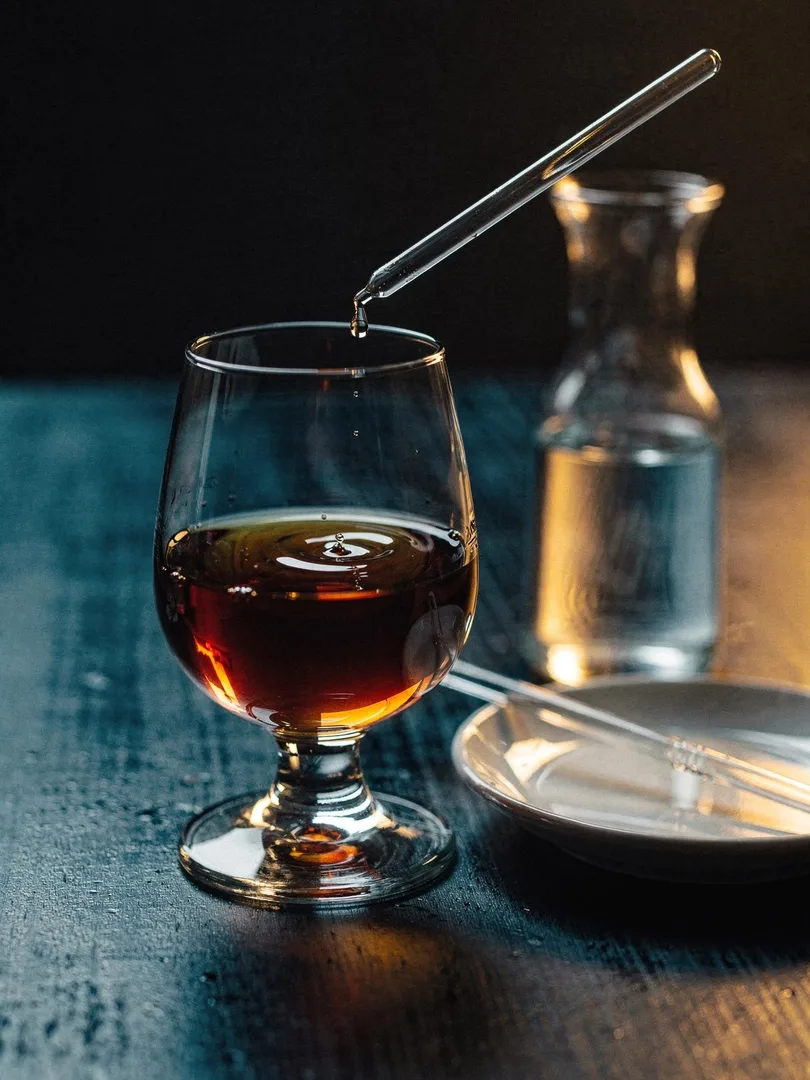
Dilution with restraint
Drinking Rum with Water or Ice?
A few drops of still water can open up a rum, especially bottlings above 50 percent alcohol. Ice, by contrast, cools and dilutes heavily, muting aroma and sweetness. For tasting, water added in small increments makes sense, while ice suits a relaxed glass in the evening.
Why Water Can Unlock Aromas in Rum
Many aromatic compounds in spirits don't particularly favor pure water or pure alcohol, they prefer to sit at the boundary between the two. Researchers at Linnaeus University in Kalmar, Sweden, simulated this on a computer for whisky in 2017. Their result, published in Scientific Reports: the smoky aromatic compound guaiacol preferentially gathers at up to 45 percent alcohol near the surface of the liquid, right where the nose can reach it.
At around 59 percent, however, it becomes more enveloped by the alcohol and drawn inward. The study concerned whisky and a single molecule. The authors suspect that other flavor compounds behave similarly. For rum, this is a plausible explanation for why an overproof suddenly shows more fruit after a few drops of water, but it's not proof for every bottle.
Then there's a simple effect: less alcohol stings less. The olfactory membrane isn't numbed and can pick up finer notes. For a rum at 40 percent, this gain is small; at 57 or 63 percent, it's often substantial.
How much water to add to rum? Drops, not a splash
The rule is: a little, and gradually. Take a pipette or a teaspoon and add two or three drops to the glass. Swirl, wait half a minute, then nose again. If the rum opens up, you can add a touch more. If it turns flat and watery, that was too much, and there's no taking it back.
The water should be still, room temperature, and flavor-neutral. Highly mineralized water brings its own notes, and tap water with a chlorine smell does too. Anyone wanting a clean comparison should taste each rum neat first, then with water, noting both impressions separately.
Caution is warranted for rums bottled above 60 percent. A Sunset Very Strong from St. Vincent comes in at 84.5 percent, and a Stroh 80 from Austria at 80 percent, though Stroh is legally classified as a domestic rum. Such strengths, taken neat in large sips, irritate the mouth and throat considerably. They're intended mainly for mixed drinks and baking.
Rum on the rocks: what cold and melting ice do
Ice does two things at once. It chills the rum to just a few degrees within minutes while continuously releasing water. Cold slows the evaporation of aromatic compounds, so the rum smells quieter. At the same time, the tongue perceives sweetness more weakly at low temperatures. A heavily sweetened rum can therefore seem more balanced on ice than it actually is.
Because the ice melts, the drink changes with every passing minute. The first sip is cold and strong, the last cool and thin. This makes it unsuitable for tasting, since you're not judging a fixed state. For a relaxed glass, though, it can be exactly right. A single large cube melts more slowly than several small ones.
Anyone wanting to get to know a rum on the rocks should therefore try a sip neat first, and only then chilled. That way you know what the ice has changed, and can keep the two impressions apart.
Neat, with water, or on the rocks: which rum, which way?
A light, aged rum at 40 percent usually shows best neat. Water adds little here, and ice tends to take something away. With aroma-rich cask-strength rums from Jamaica or Guyana, the water experiment is almost always worthwhile. Rhum Agricole blanc is traditionally drunk in the Antilles in a Ti' Punch with lime and cane sugar, rather than neat.
Those who prefer rum on the rocks need no justification. Taste isn't a competition. What matters is knowing, when comparing and buying, that rum on ice tastes different from rum neat. Anyone who buys a bottle based on how it tasted on ice may be in for a surprise when tasting it neat.
A word on quantity: water in the glass changes the drink's alcohol content, but not the amount of alcohol consumed. A glass of rum with water added contains just as much alcohol as before. Still, a glass of water on the side is a good idea while tasting, to neutralize the palate.