Plant and varieties
What is sugar cane? Plant, varieties, and breeding
Sugar cane is a perennial tropical grass of the genus Saccharum that stores sugar in its stalks. Nearly all modern varieties are crosses of noble and wild cane, bred since the late 19th century on Java and Barbados.
Sugar cane as a plant: a grass that stores sugar
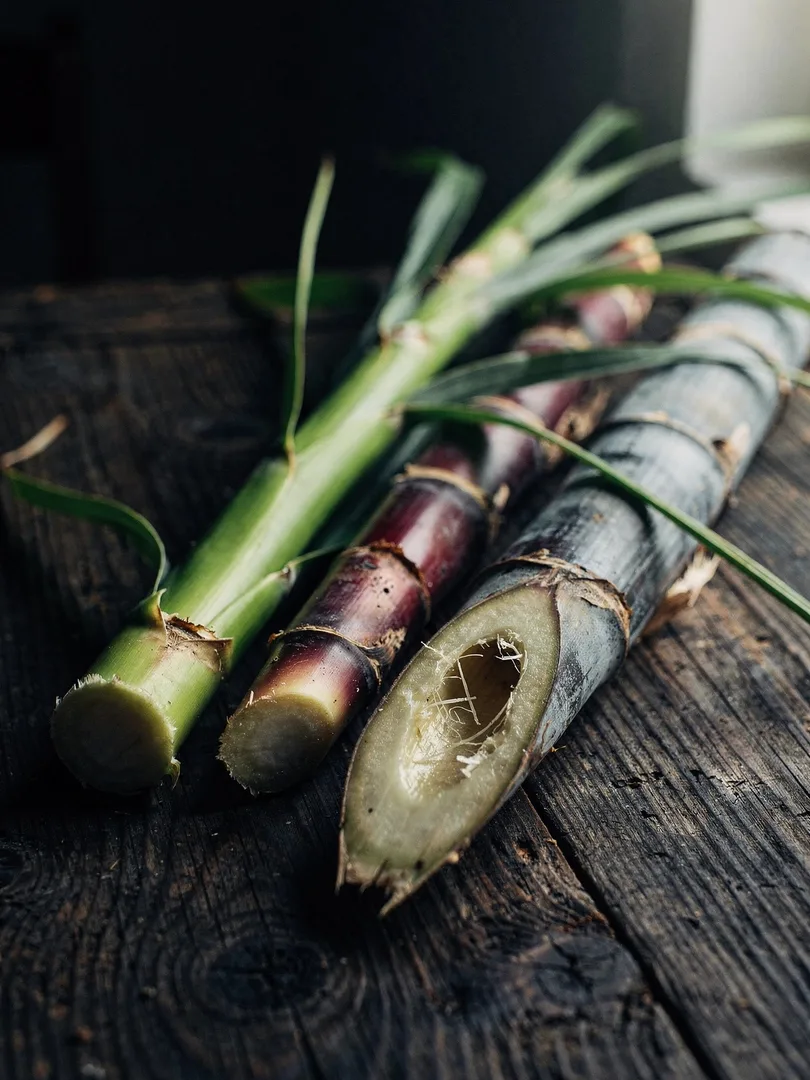
Anyone standing in front of a sugar cane field for the first time sees a wall of green stalks, often ten to sixteen feet tall. Botanically, the cane belongs to the sweet grasses, making it related to corn, millet, and bamboo. Its stalks are divided into nodes and segments like a bamboo cane, but filled inside with fibrous, juicy pulp. The plant stores sugar in this pulp, which it draws from sunlight through its leaves, mainly as sucrose, in other words, ordinary table sugar.
The cane is a so-called C4 plant. This refers to a particularly efficient form of photosynthesis that delivers large amounts of sugar in heat and strong sunlight. That's why sugar cane thrives in the tropics and subtropics, needs plenty of water during the growing season, and a drier phase in which it accumulates sugar. It cannot tolerate frost. It is propagated almost exclusively from cuttings: stalk segments with buds are planted in the soil, from which new shoots grow. After harvest, the rootstock sprouts again, so a field can be harvested for several years in a row.
Saccharum officinarum and Saccharum spontaneum: noble and wild cane
The genus Saccharum includes several species. Two matter most for sugar. Saccharum officinarum, the so-called noble cane, has thick, juicy stalks with plenty of sugar and little fiber. It is believed to have been domesticated in New Guinea and spread from there through South and Southeast Asia to the west. Saccharum spontaneum, by contrast, is a wild cane with thin stalks and little sugar, but tough, disease-resistant, and adaptable.
For a long time, planters grew almost exclusively noble cane. In the Americas, the first widespread form was called Canne Créole, or Creole cane. From 1785, the French Antilles adopted Canne d'Otaheite, named after Tahiti and introduced via Île Bourbon, today's Réunion. It was more productive and gradually displaced the old cane. Both varieties, however, were noble canes with the same weakness: little resistance to disease.
Breeding on Java and Barbados: Where the modern varieties come from
In the late 19th century, disease and cheap competition from European beet sugar hit cane growers hard. The solution came from two research stations. On Java, F. Soltwedel first grew seedlings from cane seed around 1887; on Barbados, J. B. Harrison and J. R. Bovell achieved the same around 1888. For a long time, it was believed that sugar cane produced no viable seed. With seed, however, breeders could cross and select varieties.
Breeders crossed noble cane with wild Saccharum spontaneum, then crossed the offspring back with noble cane. The new varieties thus combined the sugar content of one with the hardiness of the other. The abbreviations still reveal their origin today: POJ stands for the Dutch Proefstation Oost-Java, B for Barbados. On Madeira, for instance, POJ 2725 grows alongside the old variety caiana. Almost every sugar cane used to make rum today is such a hybrid.
Can you taste the sugar cane variety in rum?
Barely, in rum made from molasses. Molasses is a byproduct of the sugar factory, boiled, thickened, and often blended from many fields, so varietal differences blur. It's different with rum made from fresh sugar cane juice. Here, the juice from a single harvest goes almost directly into the fermentation vat, and distillers on Martinique or Guadeloupe report clear differences between red, blue, and yellow cane. Some houses bottle rhums from a single variety, such as blue cane, canne bleue. What they say about the flavor is, of course, producer information.
How seriously Martinique takes this subject shows in the AOC Rhum de la Martinique. It permits Saccharum officinarum, Saccharum spontaneum, and their hybrids, but requires that every variety be acclimatized on the island for at least four years. Genetically modified varieties are banned. This makes the plant itself part of the origin, much like the grape variety in wine.